All Quizzes
MindLift Quiz
What's Your Inner Voice Type?

Discover how your inner dialogue shapes your confidence

~2 min10 questions
Start with question 1 of 10
When you make a mistake, your first thought is:
About this quiz

What's Your Inner Voice Type?

Discover how your inner dialogue shapes your confidence

Your inner voice isn't random. It's shaped by early experiences, core beliefs, and cognitive patterns described in CBT research.

This quiz will reveal: your dominant inner voice pattern, the thinking trap behind it, and how to gently retrain it.

A smiling woman sits at an outdoor café table with her hands resting on a closed notebook
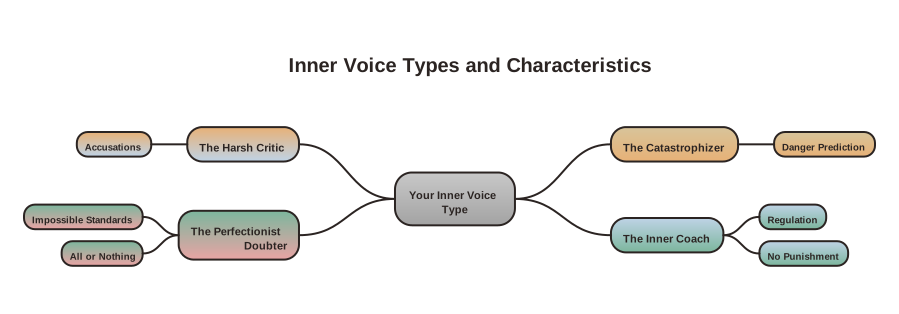
Mind map of the four inner voice types this quiz identifies: the Harsh Critic that speaks in accusations, the Catastrophizer that predicts danger first, the Perfectionist Doubter with impossible all-or-nothing standards, and the Inner Coach whose self-talk regulates instead of punishing
The four voice types — the quiz names the one narrating your day.
How does this quiz work?

How does this quiz work?

Answer 10 questions about how you usually react, not how you would like to. ~2 min is the usual time to finish, there are no right answers, and What's Your Inner Voice Type? scores your result on your device — free, no email, no signup.

  1. When you make a mistake, your first thought is:

    • "I always mess things up."
    • "This is going to ruin everything."
    • "They probably think I'm incompetent."
    • "It's not ideal, but I'll fix it."
  2. When someone doesn't reply to your message:

    • "They're annoyed with me."
    • "I said something stupid."
    • "They're probably busy."
    • "It must mean something bad."
  3. When you succeed at something:

    • "That was luck."
    • "Anyone could've done it."
    • "I should've done better."
    • "I'm proud of myself."
  4. Before a big meeting or date, your brain says:

    • "Don't embarrass yourself."
    • "This is going to go badly."
    • "You're not prepared enough."
    • "Just show up and do your best."
  5. When you compare yourself to others:

    • "They're ahead. I'm behind."
    • "I'll never get there."
    • "I should be further by now."
    • "We all have different timelines."
  6. When something uncertain happens:

    • You imagine worst-case scenarios.
    • You replay it repeatedly in your mind.
    • You assume it reflects something about you.
    • You wait for more information.
  7. Your inner voice tone is usually:

    • Critical
    • Anxious
    • Demanding
    • Balanced
  8. If you feel something strongly:

    • It must be true.
    • It confirms your fears.
    • It means you failed somehow.
    • Feelings aren't always facts.
  9. When others succeed:

    • It highlights your flaws.
    • It increases pressure.
    • It proves you're behind.
    • It inspires you.
  10. After a hard day:

    • You replay what you did wrong.
    • You imagine how it could get worse.
    • You criticize yourself.
    • You decompress and move on.
What results can you get?

What results can you get?

Your answers sort you into one of 4 results — The Harsh Critic, The Catastrophizer, The Perfectionist Doubter, The Inner Coach. Each result comes with a description of its thinking pattern, plus the answer mix that produced it.

ResultWho gets itWhat it looks like
The Harsh CriticLabeling + personalization + self-attack
The CatastrophizerFortune-telling + threat inflation
The Perfectionist DoubterAll-or-nothing thinking + "should" statements
The Inner CoachBalanced self-talk + adaptive regulation

The Harsh Critic

Labeling + personalization + self-attack

Your inner voice speaks in accusations.

"You're lazy." "You're not good enough."

Research on inner dialogue shows that self-critical styles activate threat systems in the brain — the same systems designed for external danger.

You don't lack ability. You lack gentle self-talk.

The Catastrophizer

Fortune-telling + threat inflation

Your brain is a future-predicting machine. But it predicts danger first.

You prepare for worst-case outcomes as protection.

Short-term? It feels proactive. Long-term? It fuels anxiety loops that keep your nervous system on high alert.

The thoughts feel urgent, but they're usually just loud — not accurate.

The Perfectionist Doubter

All-or-nothing thinking + "should" statements

You hold yourself to impossible standards.

If it's not perfect, it's failure. If it's good, it could've been better.

This voice can drive achievement — but it quietly drains confidence. Every win gets discounted. Every gap gets magnified.

The bar keeps moving because the goal was never excellence. It was control.

The Inner Coach

Balanced self-talk + adaptive regulation

You use self-talk to regulate, not punish.

Research shows that constructive inner speech supports executive function and emotional resilience.

You can acknowledge difficulty without spiraling. You can feel uncertain without catastrophizing.

Your work now is consistency — not self-criticism. Keep choosing this voice, especially on hard days.

Frequently Asked Questions

Frequently Asked Questions

What are the inner voice types?

The four inner voice types are: The Harsh Critic (self-attacking labeling), The Catastrophizer (future-predicting anxiety), The Perfectionist Doubter (impossible standards), and The Inner Coach (balanced self-regulation). Each reflects a different pattern of cognitive processing described in CBT research.

Why is my inner voice so negative?

A negative inner voice is usually shaped by early experiences, core beliefs, and learned cognitive patterns. CBT research shows that self-critical inner speech activates the brain's threat system — the same system designed for external danger. It's not a character flaw; it's a trainable habit.

Can I change my inner voice type?

Yes. Research on inner dialogue shows that self-talk patterns are learned habits, not fixed traits. Through consistent practice of cognitive reframing and self-compassion techniques, you can gradually shift from a critical inner voice to a more balanced, coaching-style dialogue.

Is this quiz based on science?

This quiz is inspired by cognitive behavioral therapy (CBT) principles, specifically research on cognitive distortions, inner dialogue patterns, and self-talk as a regulatory tool. It is an educational self-reflection tool, not a clinical diagnostic instrument.

Keep exploring

If you are in crisis or thinking about harming yourself, call or text 988 (US) or find a local line at findahelpline.com. MindLift is a self-help tool and not a replacement for professional care.