About this result
Mostly Good
One of 4 results in Do I Have Social Anxiety?.
MindLift is a CBT app that turns harsh self-talk into a kinder response in 60 seconds. Free to start. Try the reframe on the App Store · Google Play
Social anxiety doesn't seem to be a significant issue for you
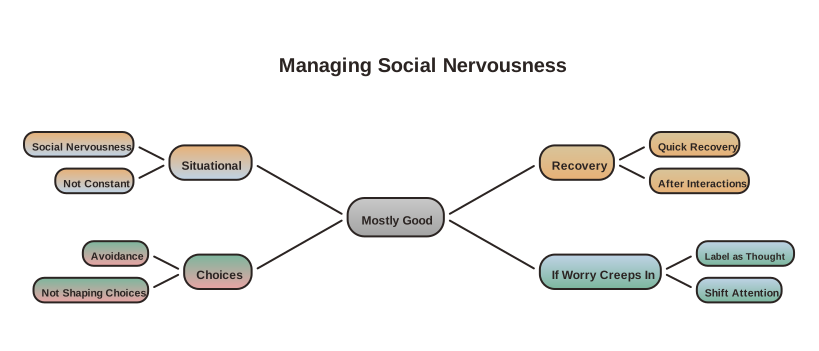
You handle most social situations pretty naturally. Occasional awkwardness is just being human — your nervous system isn't treating social events as threats.
Social nervousness is situational, not constant
You recover quickly after interactions
Avoidance isn't shaping your choices
You already have healthy psychological flexibility.
here's one thing to try tonight: The fact that you're reflecting on this is healthy. If a worry does creep in after a conversation, label it: "just a thought" — and shift your attention back to what's in front of you.
Other results in this quiz
Frequently Asked Questions
Frequently Asked Questions
What does Mostly Good mean?
Social nervousness is situational, not constant
What can I do if my result is Mostly Good?
The fact that you're reflecting on this is healthy. If a worry does creep in after a conversation, label it: "just a thought" — and shift your attention back to what's in front of you.
If you are in crisis or thinking about harming yourself, call or text 988 (US) or find a local line at findahelpline.com. MindLift is a self-help tool and not a replacement for professional care.
Sources
The questions and result descriptions in this quiz draw on the studies below. The quiz is a self-reflection tool, not a diagnosis, and none of these papers tested this quiz itself.
- Cuijpers P et al. (2016). How effective are cognitive behavior therapies for major depression and anxiety disorders? A meta-analytic update of the evidence. World Psychiatry. — DOI