About this result
The Future Catastrophizer
One of 4 results in Overthinking Test & Quiz.
Threat anticipation + worst-case projection + hypervigilance
Your brain runs threat simulations before anything has happened.
Future-focused overthinking feels like planning, but it's actually threat management. Your mind scans for danger before it arrives — and finds it everywhere.
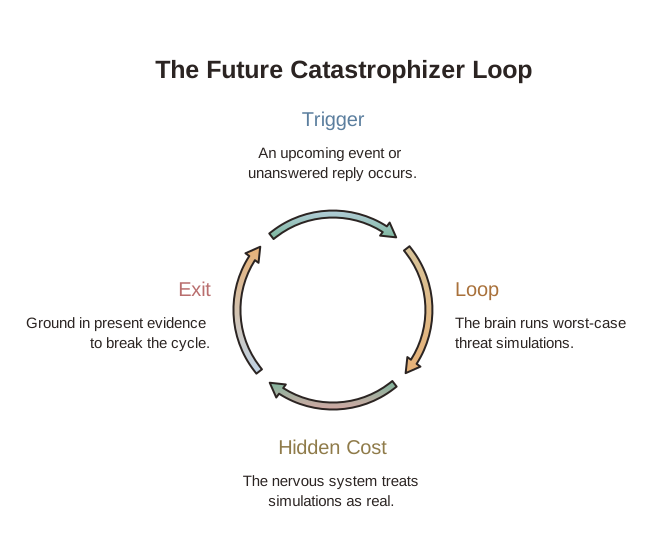
Research on threat anticipation suggests that picturing a threat can switch on a stress response much like facing one. Your body can react to an imagined threat much like a real one.
You're not preparing for the future. You're spending the present in it.
here's one thing to try tonight: When a catastrophic thought arrives, ask: 'What's actually true right now?' Ground your nervous system in present evidence before your mind runs to worst-case futures.
- an upcoming event, or a reply that has not come yet.
- "if this goes wrong, everything falls apart."
- run the worst-case simulation, again, to feel prepared.
- "the danger was real. keep scanning."
Reframe: "if this goes wrong, everything falls apart." → "if this goes wrong, it'll be hard, and I've handled hard before."
What's the likely outcome, not the worst one?
Write the worst case in one line, then the most likely case in one line. Read the second one twice.
Read more about catastrophizing
Other results in this quiz
Frequently Asked Questions
Frequently Asked Questions
What does The Future Catastrophizer mean?
Future-focused overthinking feels like planning, but it's actually threat management. Your mind scans for danger before it arrives — and finds it everywhere.
What can I do if my result is The Future Catastrophizer?
When a catastrophic thought arrives, ask: 'What's actually true right now?' Ground your nervous system in present evidence before your mind runs to worst-case futures.
If you are in crisis or thinking about harming yourself, call or text 988 (US) or find a local line at findahelpline.com. MindLift is a self-help tool and not a replacement for professional care.
Sources
The questions and result descriptions in this quiz draw on the studies below. The quiz is a self-reflection tool, not a diagnosis, and none of these papers tested this quiz itself.