Discover how peaceful your daily rhythm really is.
About 1 minute8 questions
Start with question 1 of 8
How do you usually start your morning?
About this quiz
What's Your Peaceful Routine Style?
Discover how peaceful your daily rhythm really is.
Your daily routines quietly shape how your mind feels.
Some habits calm your nervous system. Others keep your brain in constant alert mode.
Take this quick quiz to discover your current rhythm.
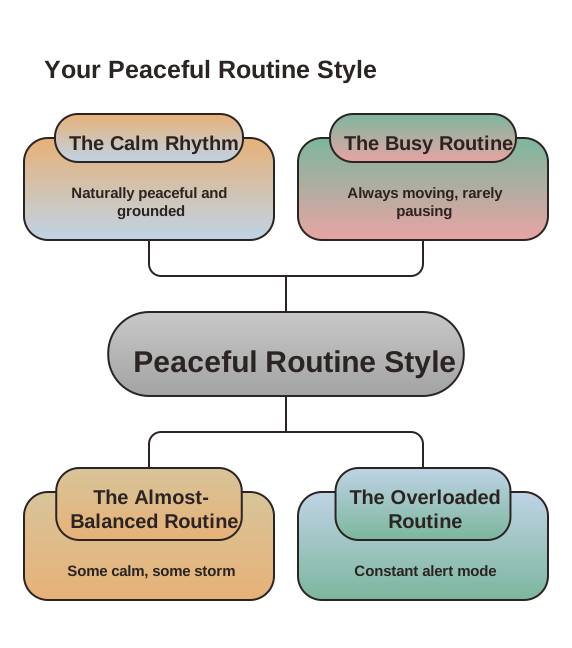
The four routine styles — how peaceful your daily rhythm really is.How does this quiz work?
How does this quiz work?
Answer 8 questions about how you usually react, not how you would like to. About 1 minute is the usual time to finish, there are no right answers, and What's Your Peaceful Routine Style? scores your result on your device — free, no email, no signup.
How do you usually start your morning?
Slowly, with a calm routine
Coffee + checking messages
Immediately rushing into tasks
Phone notifications first
During the day, how often do you pause or take breaks?
Several intentional pauses
A few short breaks
Only when I'm exhausted
Almost never
When your mind feels overwhelmed, you usually:
Take a breath or step away
Distract yourself
Push through the stress
Spiral into overthinking
Your evenings usually look like:
Calm wind-down routine
Some relaxation
Scrolling or multitasking
Still working or thinking
When you drink coffee or tea, you:
Enjoy it slowly
Drink while doing something
Drink while working
Don't notice finishing it
Before sleep, your mind usually:
Feels calm
Drifts between thoughts
Replays the day
Overthinks tomorrow
Your daily schedule feels:
Balanced and manageable
Busy but okay
Often overwhelming
Constantly rushed
If you had 10 free minutes right now, you would:
Rest or go outside
Watch something relaxing
Catch up on tasks
Check notifications
What results can you get?
What results can you get?
Your answers sort you into one of 4 results — The Calm Rhythm, The Almost-Balanced Routine, The Busy Routine, The Overloaded Routine. Each result comes with a description of its thinking pattern and one growth move you can practise this week, plus the answer mix that produced it.
Result
Who gets it
What it looks like
The Calm Rhythm
26–32 points
Naturally peaceful and grounded
The Almost-Balanced Routine
20–25 points
Some calm, some storm
The Busy Routine
14–19 points
Always moving, rarely pausing
The Overloaded Routine
8–13 points
Constant alert mode
The Calm Rhythm
Naturally peaceful and grounded
Your routines already support a peaceful mind.
You naturally build small moments of recovery into your day.
Your nervous system gets regular chances to reset.
This balance helps you handle stress more effectively.
Keep protecting these quiet habits. They may seem small, but they are the foundation of your mental resilience.
The Calm Rhythm
The pattern
You naturally build small moments of recovery into your day.
A kinder next step
Keep protecting these quiet habits.
This balance helps you handle stress more effectively.
The Almost-Balanced Routine
Some calm, some storm
Your schedule has some calm moments but also periods of stress.
You know what peace feels like — you just don't always get enough of it.
There are moments of calm in your day, but they compete with rushing.
Small adjustments could make your daily rhythm much more peaceful.
Try adding one intentional pause to your day — even 2 minutes of stillness between tasks can shift your entire mental tempo.
The Almost-Balanced Routine
The pattern
There are moments of calm in your day, but they compete with rushing.
A kinder next step
Try adding one intentional pause to your day — even 2 minutes of stillness between tasks can shift your entire mental tempo.
You know what peace feels like — you just don't always get enough of it.
The Busy Routine
Always moving, rarely pausing
Your day often moves quickly from one task to another.
Your mind rarely gets a chance to reset between activities.
This constant pace can create background stress that builds over time.
Introducing small calming rituals could make a big difference.
Start with one micro-pause: before your next task, take three slow breaths. This tiny habit can interrupt the rush-and-react cycle.
The Busy Routine
The pattern
Your mind rarely gets a chance to reset between activities.
A kinder next step
Start with one micro-pause: before your next task, take three slow breaths.
This constant pace can create background stress that builds over time.
The Overloaded Routine
Constant alert mode
Your daily rhythm keeps your mind in constant alert mode.
This doesn't mean you're doing something wrong — modern life is simply intense.
Your brain is stuck in "go mode" without enough recovery time.
Adding even two small peaceful habits can gradually calm your mental environment.
Pick one moment today to do nothing for 60 seconds. Not scrolling. Not planning. Just being. Your brain needs permission to rest.
The Overloaded Routine
The pattern
Your daily rhythm keeps your mind in constant alert mode.
A kinder next step
Pick one moment today to do nothing for 60 seconds.
Not scrolling. Not planning. Just being.
This doesn't mean you're doing something wrong — modern life is simply intense.Frequently Asked Questions
Frequently Asked Questions
Why do daily routines affect mental health?
Daily routines create predictable patterns that help regulate your nervous system. When your brain knows what to expect, it spends less energy on alert responses and more on recovery and creativity. Small calming rituals signal safety to your brain.
How can I build a calmer routine?
Start small: add one intentional pause to your day, drink your morning tea without your phone, or take three slow breaths between tasks. Consistency matters more than duration — even 2 minutes of calm can shift your daily rhythm.
What if my routine is overloaded?
An overloaded routine doesn't mean you're failing — modern life is genuinely intense. The key is adding tiny recovery moments, not overhauling everything. One peaceful habit added consistently is more powerful than a dramatic lifestyle change that doesn't stick.
What does this routine quiz measure?
This quiz assesses how your daily habits and routines support mental peace. It looks at your morning routine, break patterns, evening habits, and how you respond to stress.
Can I change my routine style?
Yes. Daily routines are habits that can be adjusted gradually. Even adding one small calming ritual — like a 2-minute pause or a mindful cup of tea — can shift your routine toward more peace over time.
Is this quiz scientifically based?
This quiz is inspired by behavioral psychology research on how daily habits influence the nervous system and emotional regulation. It is an educational self-reflection tool, not a clinical assessment.
Keep exploring
If you are in crisis or thinking about harming yourself, call or text 988 (US) or find a local line at findahelpline.com. MindLift is a self-help tool and not a replacement for professional care.