
Turn this into a daily habit — free to start in the MindLift app:
Mindfulness meditation techniques are short ways to notice what your mind is doing right now (a breath, a sound, a thought) and step back from it instead of following it. Psychologists call that step back decentering: seeing a thought as a passing mental event, not a fact. Most of the seven techniques below take one to five minutes.
What is mindfulness and how do I start?
Mindfulness is paying attention to the present moment without judgment. To start, try 5 minutes of mindful breathing a day: sit comfortably, follow your breath, and gently return attention each time it wanders. It isn't about stopping thoughts — it's about noticing them without getting swept up in them.
Kabat-Zinn (1994); Bishop et al. (2004)
What Is Mindfulness?
Mindfulness is the practice of purposefully paying attention to the present moment without judgment. It's noticing what's happening right now — in your thoughts, feelings, body, and surroundings — with curiosity and acceptance, rather than trying to fix or flee it.
It has roots in Buddhist meditation traditions but is now backed by decades of research. It isn't about emptying your mind or reaching a special state — it's about developing a different relationship with your experience.
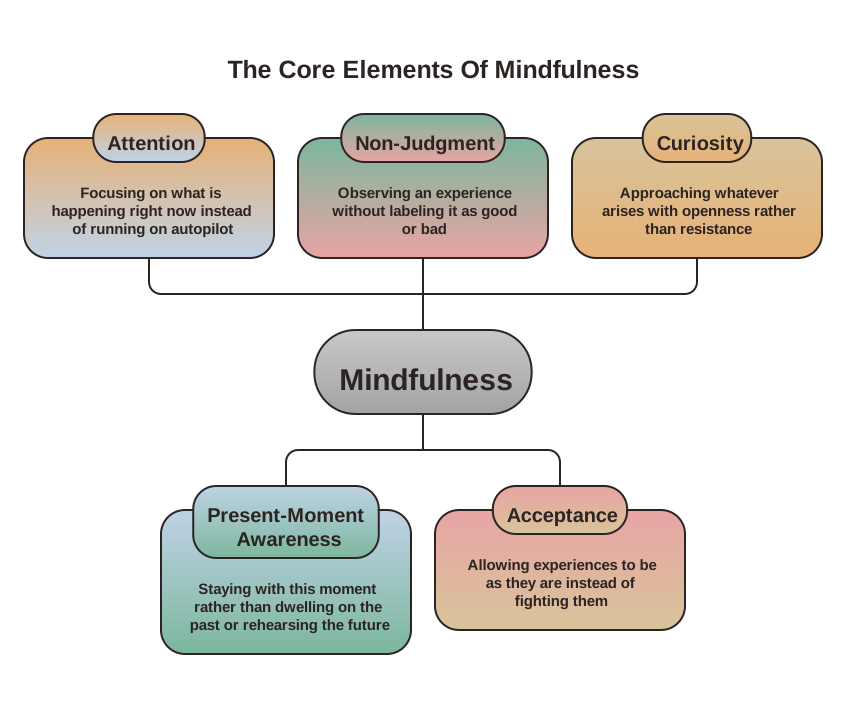
The five elements underneath the skill
- Attention — focusing on what's happening right now.
- Present-moment awareness — not dwelling on the past or rehearsing the future.
- Non-judgment — observing without labelling experience good or bad.
- Acceptance — letting experiences be as they are.
- Curiosity — meeting whatever arises with openness.
Mindfulness as Noticing and Decentering
Clinical researchers describe mindfulness as two moves: steering attention to what is happening now, and meeting it with curiosity instead of judgment. The second move is what matters for a busy mind. You stop treating each thought as an instruction and start seeing it as one event among many, which is called decentering.
That operational definition, written by a group of mindfulness and CBT researchers, frames mindfulness as self-regulated attention plus an open, accepting stance toward what you find[1]. Later work treats decentering as a shared ingredient across mindfulness, metacognitive and cognitive therapies: the ability to watch a thought such as "I always mess this up" without being fused with it[2]. This is why mindfulness sits so close to CBT. Noticing a thought is the first step; questioning it is the next.
A note on what we make: MindLift is not a meditation app. It has no guided sessions, timers or sleep sounds. It picks up where noticing leaves off: you type the thought you caught, it names the thinking pattern and offers a calmer, more accurate reframe in about 60 seconds. If you want a meditation library, a dedicated meditation app is the better tool, and CBT vs meditation apps explains when each one fits.
The Science Behind Mindfulness
Neuroimaging research shows that regular mindfulness practice changes brain structure — strengthening regions tied to attention, emotional regulation, and self-awareness while quieting the default-mode network associated with rumination. In a landmark study, Sara Lazar's team at Harvard found that experienced meditators had increased cortical thickness in attention and sensory-processing regions[3]; later work (Hölzel et al., 2011) found gray-matter changes after just eight weeks of an MBSR course[4], alongside a measurable reduction in amygdala reactivity — the brain's threat centre.
Translated out of the lab, people who practise consistently tend to report lower anxiety, steadier mood, better focus, and improved stress management — and the physical correlates studies track include lower resting heart rate and better sleep. The effect sizes vary by person and study; the through-line is that attention is trainable, and training it changes how the brain handles stress.
7 Mindfulness Meditation Techniques for Beginners
These seven techniques cover the basics of mindfulness meditation for beginners. There is no perfect way to do any of them. Each one trains the same move: notice where your attention went, then bring it back without scolding yourself for leaving.
- Mindful breathing — follow the breath in and out, 1 to 5 minutes.
- Noting thoughts — label each thought "planning", "worrying" or "judging" and let it go.
- Body scan — move attention from toes to head, noticing without fixing.
- Mindful walking — feel each step; good when sitting still is hard.
- 5-4-3-2-1 grounding — five senses, counted down, to get out of your head.
- The 3-minute breathing space — the MBCT check-in for stressful moments.
- Loving-kindness — warm phrases for yourself, then for others.
1. Mindful breathing
The foundation. Sit comfortably, soften your gaze or close your eyes, and follow the sensation of the breath in and out. When your mind wanders — and it will — return to the breath. Start with 5 minutes. If following the breath feels slippery, a counted pattern such as box breathing (in for 4, hold for 4, out for 4, hold for 4) gives attention a track to run on; our breathing techniques guide covers the other patterns.
2. Noting thoughts
Sit for a minute and, each time a thought shows up, give it a one-word label: "planning", "worrying", "remembering", "judging". Then return to the breath. The label puts a little space between you and the thought, which is decentering in miniature. It is also the bridge to CBT: once a thought has a name, you can ask whether it is accurate.
3. Body scan
Lie down and, starting from your toes, slowly move attention through each part of the body, noticing sensations without trying to change them. Takes 10–20 minutes and builds body awareness and release. Notice where you hold tension: jaw, shoulders, stomach. You don't need to fix anything.
4. Mindful walking
Walk slowly, focusing on your feet meeting the ground, your legs moving, and your surroundings. Ideal if sitting still feels hard — and it works anywhere, even from your desk to the kitchen.
5. The 5-4-3-2-1 grounding technique
A fast reset that uses your senses to anchor you in the present, especially under stress: notice 5 things you can see, 4 you can touch, 3 you can hear, 2 you can smell, and 1 you can taste. See the full 5-4-3-2-1 grounding walkthrough.
6. The 3-minute breathing space
This short practice comes from mindfulness-based cognitive therapy (MBCT). Spend about a minute on each step: first ask "what is going on in me right now?" and name the thoughts, feelings and body sensations; then narrow attention to the breath; then widen it again to the whole body. It is built for the middle of a stressful day, not a quiet room.
7. Loving-kindness
Sit quietly and repeat phrases like "May I be happy, may I be healthy, may I be at peace," then extend the same wishes to loved ones, neutral people, difficult people, and everyone. Good for mood and connection, and a gentle counterweight to a harsh inner critic.
Your First Minute, Narrated
A typical first attempt goes like this. You sit down, close your eyes, and within twenty seconds the inner monologue starts:
"Okay. Breathing. In… out. Did I reply to that email? Focus. In… out. I'm doing this wrong, my mind's already wandered. Everyone else finds this easy. This is pointless, I'm clearly not a mindfulness person. In… out. Was that even a full breath?"
Notice that almost none of that is the wandering itself. It's the commentary on the wandering — "I'm doing this wrong," "everyone else finds this easy," "I'm not a mindfulness person." That's the same judging voice you were hoping to get a break from, and it just followed you onto the cushion.
The mindful version of the same minute isn't quieter. It's just less argumentative:
"In… out. There's the email thought. Noted. Back to the breath. In… out. There's the 'I'm doing this wrong' thought. That's a thought too. Back to the breath."
The mind wandered exactly as often. The difference is that each return counted as the practice rather than as evidence of failure. Noticing you've drifted is the rep, not the mistake.
Try This in 60 Seconds (Eyes Open)
If closing your eyes makes the thoughts louder — common when you're anxious — do the eyes-open version instead. It works anywhere: a bus, a waiting room, your desk.
- Start with sight. Pick one object in front of you — a cup, a door handle, a leaf. Look at it as if you'll need to describe it to someone later. Colour, edges, where the light hits.
- Add sound. Keep looking at the object and notice the two or three sounds in the room without naming them "good" or "annoying." Just sounds.
- Finish with breath. Add your breath, without changing it. Object, sounds, breath — three things happening at once, none of them a problem to solve. When a thought pulls you off, come back to the object.
That's a complete practice. Nobody around you will know you did it.
Your first week of mindfulness practice
Days 1–2: mindful breathing foundation
Practise 5 minutes of mindful breathing twice daily, morning and evening. Just follow the breath in and out.
Pro Tip: Don't judge yourself when your mind wanders — noticing it wandered IS the practice.
Days 3–4: add body awareness
Keep the breathing practice and add a 5-minute body scan before bed, from toes to head.
Pro Tip: It's fine to fall asleep during an evening body scan — it means you're relaxed.
Days 5–6: mindfulness in motion
Add 10 minutes of mindful walking. Focus on each step, your feet on the ground, your body moving through space.
Pro Tip: Walk slower than usual so you can actually notice the experience.
Day 7: integrate into daily life
Pick one routine activity — brushing teeth, showering, eating breakfast — and do it fully mindfully.
Pro Tip: This is how mindfulness becomes a way of living, not one more thing on the schedule.
Integrating Mindfulness Into Daily Life
Formal meditation helps, but the real power comes from weaving mindfulness into what you're already doing — which is what makes it sustainable no matter how full your days are. For a cue-by-cue routine (commute, inbox, 2am), see how to practice mindfulness daily.
Morning
- Notice your body before getting out of bed.
- Brush your teeth with full attention to sensation and movement.
- Savour the aroma, warmth, and taste of your coffee or tea.
- Use your commute for a few rounds of mindful breathing.
Evening
- Slow down and actually taste dinner.
- Disconnect from devices deliberately — a digital sunset.
- Name three good things from the day.
- Do a short body scan to relax before sleep.
And throughout the day: take three mindful breaths before starting a new task, listen fully in conversations, and use waiting moments — a queue, a red light — as mini-resets.
Common Challenges and How to Work With Them
"My mind is too busy — I can't stop thinking"
Completely normal, and not the problem. The goal isn't to stop thoughts but to notice when you're caught in one and gently return. A busy mind just gives you more reps.
"I don't have time"
Start with 30 seconds to 2 minutes, attached to something you already do. Mindfulness isn't an addition to your schedule — it's being present for what's already in it.
"I keep falling asleep"
Try eyes slightly open, sit upright instead of lying down, or switch to walking meditation. If you're consistently drifting off, you may simply need more sleep.
"I want it to make the anxiety go away"
Mindfulness is noticing the anxiety, not evicting it. Feelings you stop fighting tend to pass faster, but if "pass faster" becomes the goal, you're back to fighting. Practising on ordinary days, not only bad ones, is what makes the skill available when you need it.
Building a Sustainable Practice
Consistency beats duration — five minutes daily does more than thirty minutes once a week. A simple on-ramp:
- Week 1: 2–3 minutes of mindful breathing daily.
- Week 2: add mindful eating to one meal a day.
- Week 3: add a 5-minute body scan before bed.
- Week 4: add mindful walking and scatter mini-resets through the day.
To make it stick: choose a consistent time and place, start smaller than feels necessary, link it to an existing habit, and be patient with yourself. Celebrate consistency over perfection — noticing you skipped a day and starting again is part of the practice, not a failure of it.
Where to Go Next
Mindfulness is a lifelong practice, not a destination. If overthinking is what pulls you out of the present, the companion piece is mindfulness exercises for an overthinking mind, and the MBSR guide for overthinkers covers the structured eight-week route. For loops that won't settle, the guide to stopping overthinking goes further. Curious where you start from? The How Mindful Is Your Mind? quiz takes about a minute.
MindLift is built for the moment a thought loop starts — name what's looping and get a grounded, believable reframe in about 60 seconds. Free to start, premium available. Try MindLift — free to start →
Frequently asked questions
What are the main mindfulness meditation techniques?
The core beginner techniques are mindful breathing, noting (labelling) thoughts, the body scan, mindful walking, 5-4-3-2-1 grounding, the MBCT 3-minute breathing space and loving-kindness. All of them train the same skill: noticing what is happening right now and stepping back from your thoughts instead of following them.
What exactly is mindfulness and how is it different from meditation?
Mindfulness is paying attention to the present moment without judgment. Meditation is a formal practice — usually sitting quietly for a set time — while mindfulness can be practised anytime, anywhere: eating, walking, even doing dishes. Meditation is one way to build mindfulness, but mindfulness extends into all of daily life.
How soon will I notice benefits from practising mindfulness?
Many people feel calmer and more focused after a single session. With regular practice, the benefits for stress and anxiety tend to build over time; structured programs such as MBSR run for eight weeks.
Is mindfulness just about relaxation?
While mindfulness often leads to relaxation, its primary goal is awareness, not relaxation. Sometimes it means observing a difficult emotion without trying to change it. That's what builds emotional resilience — the ability to respond rather than react.
I have a very busy schedule. Can I still practise mindfulness?
Yes. Mindfulness doesn't require extra time — it's bringing awareness to things you already do. Try mindful breathing on your commute, mindful eating at lunch, or a 2-minute body scan before bed. Even 30 seconds of mindful breathing counts.
What if mindfulness makes me more anxious?
That happens, especially early on: sitting still with your eyes closed can turn the volume up on thoughts you were busy enough to ignore. Keep your eyes open, shorten the practice to one minute, and lean on the outward-facing exercises — grounding, mindful walking — rather than the inward ones. If it stays distressing, that is worth mentioning to a therapist rather than pushing through alone.
Is MindLift a meditation app?
No. MindLift has no guided meditations, timers or sleep sounds. It is a CBT-based app for the moment after you notice a harsh thought: you type the thought, it names the thinking pattern and offers a kinder, more accurate reframe in about 60 seconds. It is free to start.
Like what you're reading?
Build your mindfulness habit
Daily reminders, guided exercises, and progress tracking in one app.


Free to start · premium optional