
Turn this into a daily habit — free to start in the MindLift app:
You're not irrational. You're not dramatic. You're not someone who catastrophizes or spirals — at least, that's not how you'd describe yourself. And yet.
There's a version of events your brain tells you that is quietly, consistently more negative than reality. A filter operating in the background that you rarely notice because it's been running so long it just feels like thinking.
That filter has a name. In cognitive behavioral therapy, the patterns are called cognitive distortions — automatic ways your brain interprets experience that are reliably skewed in a particular direction. Not random negative thinking. Systematic errors in perception that follow predictable patterns, repeat across situations, and feel completely true while they're happening.
The reason most people don't recognize their own cognitive distortions is simple: you can't see the lens you're looking through. The distortion doesn't announce itself. It just quietly shapes what you perceive, what you conclude, and how you feel — and then moves on before you've had a chance to question it.
This article is about the ones that hide in plain sight. Not the obvious catastrophizing anyone could spot, but the subtle patterns that feel like clear-eyed realism — right up until you examine them.
What makes a thought a distortion
A cognitive distortion isn't a thought that's negative. Negative thoughts are sometimes accurate. If you made a mistake, thinking “I made a mistake” is not a distortion — it's a fact.
A cognitive distortion is a thought that goes beyond what the evidence supports. It draws a larger conclusion than the facts justify. It fills in missing information with the worst-case interpretation. It generalizes from a single data point. It assigns meaning that isn't necessarily there.
The distortion isn't in the emotion — it's in the logic. And because the logic feels airtight from the inside, the emotion that follows feels completely warranted. This is why cognitive distortions are so hard to catch. You're not noticing a wild leap. You're following what feels like a very reasonable chain of reasoning — to a conclusion that is quietly, significantly off.
The distortions you probably have but haven't named
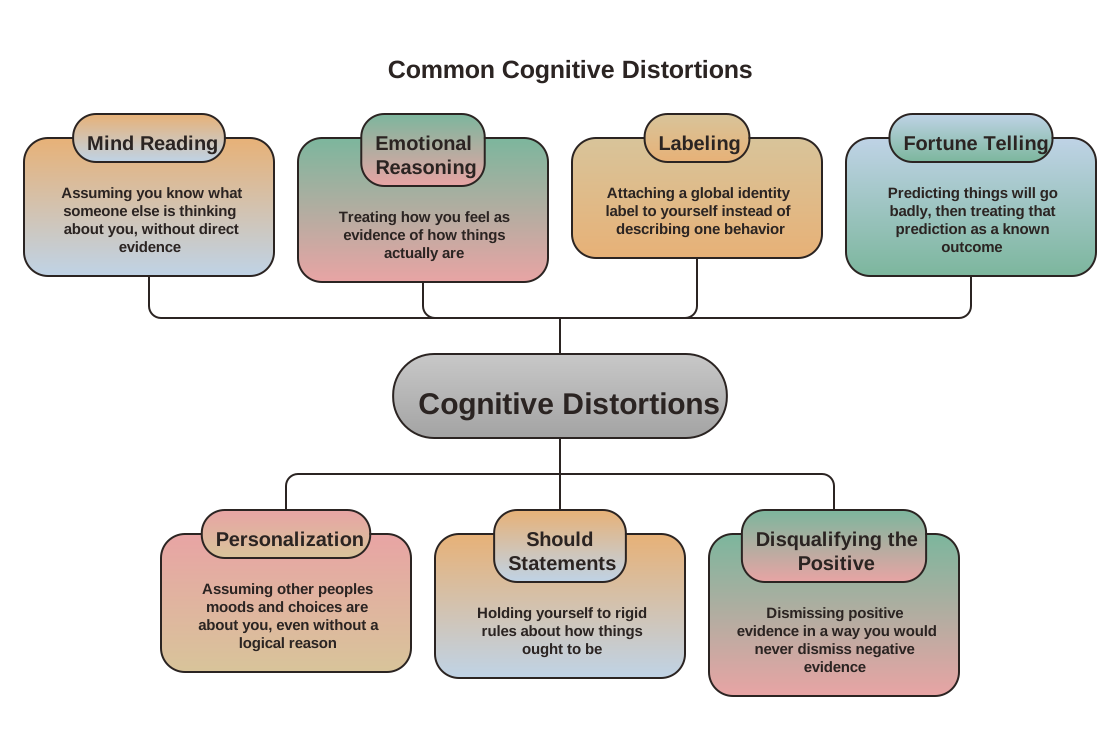
Mind reading
You assume you know what someone else is thinking — usually something negative about you — without any direct evidence. She didn't reply because she's annoyed with me. He gave me that look because he thought my comment was stupid.
Mind reading masquerades as social intelligence. You're reading the room, picking up on signals. Sometimes you are. The problem is that your brain doesn't distinguish between genuine social cues and the gaps it's filling in with anxiety. When you don't have information, it generates a plausible story — and that story almost always reflects your fears rather than reality.
The test: Is there actual evidence for what you believe they're thinking? Or is the evidence the absence of something — they didn't respond, they seemed quiet? Absence of information is not evidence of the negative conclusion your brain reaches by default.
Personalization
You assume other people's behavior, moods, and choices are about you — even when there's no logical reason they would be. Your manager seemed distracted, so it must be something you did. A friend cancelled, so you wonder what you did wrong.
Personalization isn't narcissism — it's the opposite. It's a form of hypervigilance that assumes your actions have outsized impact on the people around you, often rooted in environments where other people's moods were unpredictable. The reality is that people are mostly preoccupied with their own lives. You are not the center of other people's emotional weather. Ask: Is it actually more likely that this is about me, or about them?
Emotional reasoning
You treat how you feel as evidence of how things are. I feel anxious, so something must be wrong. I feel stupid, so I must have said something stupid.
Emotional reasoning makes anxiety self-confirming — the anxiety itself becomes the evidence. It's insidious because emotions feel authoritative; they feel like information. And they are — but they're information about your nervous system's current state, not reliable reports on external reality. The question: Would I reach the same conclusion if I didn't feel this way? If the conclusion only makes sense because of the emotion, you're inside emotional reasoning.
Should statements
You hold yourself to rigid rules about how things ought to be — and feel guilt or shame when reality doesn't comply. I should be further along by now. I shouldn't need this much time to recover.
Should statements feel like high standards rather than distortions, which is why they're common in self-aware, high-achieving people. But they don't reliably motivate — for many people they add shame without making the behavior any more likely. The alternative isn't lower standards; it's replacing the moral demand with honest acknowledgment. “I haven't been exercising” is more accurate and more actionable than “I should be exercising.”
Labeling
Instead of describing a specific behavior, you attach a global identity label to yourself. I'm so stupid. I'm such a failure. I'm broken.
Labeling turns a moment into a verdict. You didn't make a mistake — you are a mistake. Once you've assigned the label, your brain confirms it: noticing every piece of evidence that fits, filtering out everything that doesn't. Notice when you're using the verb to be about something that could more accurately be described with a specific behavior. “I struggle with this” is more accurate than “I am bad at this.”
Disqualifying the positive
You dismiss positive evidence in a way you'd never dismiss negative evidence. They complimented my work, but they were just being nice. It went well, but it was probably luck.
Notice the asymmetry: negative evidence counts automatically and without qualification, while positive evidence requires a disclaimer before it can be admitted. Your brain is applying completely different standards to the two types of information. If you would accept negative evidence without a caveat, apply the same standard to the positive. “They complimented my work” is data. It doesn't require a counterargument.
Fortune-telling
You predict things will go badly — and then treat that prediction as a known outcome rather than a guess. I know this conversation is going to go badly. There's no point applying because I won't get it.
Realism acknowledges uncertainty (“this might go badly, and if it does, here's how I'll respond”). Fortune-telling eliminates the uncertainty and replaces it with a negative outcome treated as established — which then affects behavior in ways that can actually produce it. The question that interrupts it: Is this a prediction or a fact? What are the other possible outcomes?
| Distortion | Sounds like | The question that catches it |
|---|---|---|
| Mind reading | “She didn't reply because she's annoyed with me.” | Is there actual evidence — or is the evidence an absence? |
| Personalization | “My manager seemed distracted — it must be something I did.” | Is it more likely this is about me, or about them? |
| Emotional reasoning | “I feel anxious, so something must be wrong.” | Would I reach the same conclusion if I didn't feel this way? |
| Should statements | “I should be further along by now.” | What's the honest description underneath the moral demand? |
| Labeling | “I'm so stupid. I'm such a failure.” | Am I using “I am” where a specific behavior would be more accurate? |
| Disqualifying the positive | “They complimented my work, but they were just being nice.” | Would I demand this much qualification of negative evidence? |
| Fortune-telling | “I know this conversation is going to go badly.” | Is this a prediction or a fact? What are the other possible outcomes? |
Quick self-check: which distortions run your thinking?
Notice how strongly each statement fits you, then see which family of distortions leans heaviest.
How to read your patterns
If your distortions center on what others think
Mind reading and personalization dominate. Your brain runs a near-constant background process monitoring how you're being perceived. It's exhausting — and largely fictional: you're not reading minds, you're generating stories about minds, and those stories reflect your anxiety more than other people's actual thoughts. The reframe isn't “they probably don't think that” — it's examining the evidence honestly: what do you actually know versus what are you filling in?
If your distortions center on how you feel about yourself
Labeling, should statements, and disqualifying the positive dominate. Your inner critic is highly active and highly selective — accepting negative evidence automatically while requiring qualifications before positive evidence can count. The work is noticing the asymmetry: when the label appears, ask what the same brain would say if a close friend described that moment. The gap between the two responses is the distortion.
If your distortions center on what's coming
Fortune-telling and emotional reasoning dominate. Your brain treats predictions like facts and feelings like evidence. The interruption: catch the moment a prediction is being treated as a known outcome. What would have to be true for this to be accurate? What has actually happened in similar situations before?
If you have a mixed pattern
Your distortions are distributed rather than clustered — different situations trigger different distortions. This is very common. The practical implication: get good at catching the thought quickly, before your brain has decided which distortion to run, rather than memorizing which pattern applies where.
Why knowing the name changes something
Naming a cognitive distortion doesn't stop it. The thought still appears; the feeling still arrives. What changes is that you have a moment of distance between the thought and your full belief in it. Instead of “she's definitely angry with me,” there's a brief pause where something recognizes: “this might be mind reading.”
That pause is everything. It's the space where a different response becomes possible. CBT is built on this principle: thoughts are not facts, and the gap between a thought appearing and accepting it as true is where the work happens. Naming your distortions is how you create that gap.
What to do when you catch one
Naming the distortion is the first step. The second is examining the thought rather than accepting or suppressing it. Ask:
- What is the actual evidence for this thought? (Not “does it feel true” — feelings don't count as evidence here.)
- What is the evidence against it? What would I have to ignore to accept it as true?
- What's the most realistic interpretation, accounting for all the evidence? Not the most optimistic or pessimistic — the most accurate.
- What would I say to a close friend who came to me with this exact thought?
In the middle of a spiral, these are genuinely hard to apply — because the distorted thought feels so obviously true that questioning it feels like denial. That's normal, and it gets easier with repetition. The goal isn't to answer perfectly. It's to introduce enough friction that the thought doesn't run unchecked.
The ones that feel most like realism
The most dangerous cognitive distortions are the ones that feel most like clear-eyed perception. Mind reading feels like emotional intelligence. Personalization feels like self-awareness. Emotional reasoning feels like intuition. Disqualifying the positive feels like modesty. Should statements feel like accountability. Fortune-telling feels like realism.
These distortions are convincing precisely because they're dressed as virtues. The tell is always the same: a conclusion that goes further than the evidence supports, drawn automatically and without scrutiny, in a direction that makes you feel worse about yourself, others, or the future. That gap — between what the evidence shows and where your brain lands — is where your distortions live.
One thing to try today
Pick one distortion from this list that felt recognizable. For the next 48 hours, just notice when it appears. Don't try to stop it. Don't argue with it immediately. Just name it when it shows up: “that's mind reading,” “that's labeling,” “that's fortune-telling.”
That's it — just the noticing. You'll be surprised how often it appears once you know what to look for. And that frequency is itself useful information: you're not occasionally having a distorted thought, you're running a program that shapes almost everything you perceive. Knowing that changes what you're working with. (If those thoughts tend to loop on the past, it's worth understanding why rumination makes everything worse; if they spin toward the future, see overthinking vs rumination.)
For the full map of thinking traps and how to reframe each one, start with the thinking traps field guide. For short definitions, use the cognitive distortions glossary; for what the studies show, see the research on cognitive distortions.
Frequently asked questions
What are cognitive distortions?
Cognitive distortions are automatic, systematic ways your brain interprets experience that are reliably skewed in a negative direction. They are not random negative thoughts — they follow predictable patterns, repeat across situations, and feel completely true while they are happening. The error is in the logic (drawing a conclusion that goes beyond the evidence), not the emotion.
What are the most common cognitive distortions?
Some of the most common and easiest to miss are mind reading (assuming you know what others think), personalization (assuming others’ moods are about you), emotional reasoning (treating feelings as facts), should statements, labeling (turning a mistake into an identity), disqualifying the positive, and fortune-telling (treating a negative prediction as a known outcome).
Why are cognitive distortions hard to recognize?
Because you can't see the lens you're looking through. The most convincing distortions feel like virtues: mind reading feels like emotional intelligence, personalization like self-awareness, emotional reasoning like intuition, fortune-telling like realism. They've borrowed the aesthetic of careful thinking while producing its opposite.
How do you fix cognitive distortions?
You don't stop the thought — you create a gap between the thought appearing and believing it. Name the distortion, then examine it: What's the actual evidence for and against it? What's the most realistic interpretation? What would I tell a friend with this exact thought? Repetition makes the gap easier to create over time.
Like what you're reading?
Continue your wellness journey
Reframe negative thoughts in 60 seconds — free to start in the MindLift app.


Free to start · premium optional