
Turn this into a daily habit — free to start in the MindLift app:
You've probably used the words interchangeably.
“I can't stop overthinking this.” “I keep ruminating on what happened.” They feel like the same thing — the same loop, the same exhaustion, the same inability to just let it go.
But they're not the same thing. And if you're trying to break the cycle, the difference matters more than you'd expect.
They feel identical. They're not.
Both overthinking and rumination involve repetitive, intrusive thoughts you can't seem to turn off. Both feel unproductive even while they're happening. Both tend to get worse at night, when you're tired, when you're alone with nothing else occupying your brain. But they're pointed in different directions.
Overthinking is future-focused. It's the spiral of what might happen, what could go wrong, what you should do, what you'll say, what they'll think. It's anticipatory. The threat hasn't happened yet — your brain is trying to prepare for every possible version of it.
Rumination is past-focused. It's the loop of what already happened, what you said, what they meant, why it went the way it did, what it says about you. The event is over — but your brain keeps returning to it as though more analysis will finally produce the resolution it never finds.
One is your brain trying to control the future. The other is your brain trying to resolve the past. Neither is working — but the reason they're not working is different, which means the way out is different too.
| Overthinking | Rumination | |
|---|---|---|
| Direction | Future-focused — what might happen | Past-focused — what already happened |
| When it shows up | Before something happens, or while something uncertain is unfolding | After something that felt threatening to your sense of self or your relationships |
| What it's trying to get | Certainty, in a situation that is genuinely uncertain | Resolution — the closure it believes more analysis will finally produce |
| What it attaches to | Generalized — it jumps between topics and picks up new worries | Specific and personal — one event, one relationship, one version of you |
| Why it never ends | The future doesn't resolve into a knowable answer, however many times you run it | The past doesn't change, and the insight it promises never arrives through more looping |
| What actually helps | Interrupt the certainty-seeking: catch planning tipping into simulation, and redirect to one concrete next step | Challenge the interpretation layered on the event — the meaning your brain assigned, not the facts |
What overthinking actually looks like
Overthinking tends to show up before something happens, or when something uncertain is unfolding. You have a difficult conversation coming up and you've rehearsed it forty different ways. You sent a text and you're now analyzing every possible interpretation of the silence. You made a decision and you're cycling through whether it was the right one. You're lying awake running scenarios.
The core of overthinking is the attempt to achieve certainty in a situation that is genuinely uncertain. Your brain is trying to think its way to safety: If I can just figure out exactly what will happen and exactly what I'll do, I'll be okay. The problem is that certainty isn't available. The future doesn't resolve into a knowable answer no matter how many times you run the simulation, so the loop continues.
Overthinking often has a generalized quality — it can jump between topics, attach to new worries, move from one concern to another. If it wasn't this, it would be something else.
What rumination actually looks like
Rumination tends to show up after something has happened — specifically after something that felt threatening to your sense of self, your relationships, or your place in the world. You said something and you've replayed the moment seventeen times. You had a conflict and you keep returning to what was said and what it means. Something ended — a relationship, a job, a friendship — and you're cycling through what went wrong and what it says about who you are.
The core of rumination is the attempt to resolve something that already happened by thinking about it more. Your brain believes the right analysis will finally produce the relief, the understanding, the closure it's been looking for. It won't. The insight rumination promises never arrives through rumination. The past doesn't change no matter how many times you return to it.
Rumination tends to be more specific and more personal than overthinking. It attaches to a particular event, a particular relationship, a particular version of yourself that you're having trouble accepting.
The overlap — and why it gets confusing
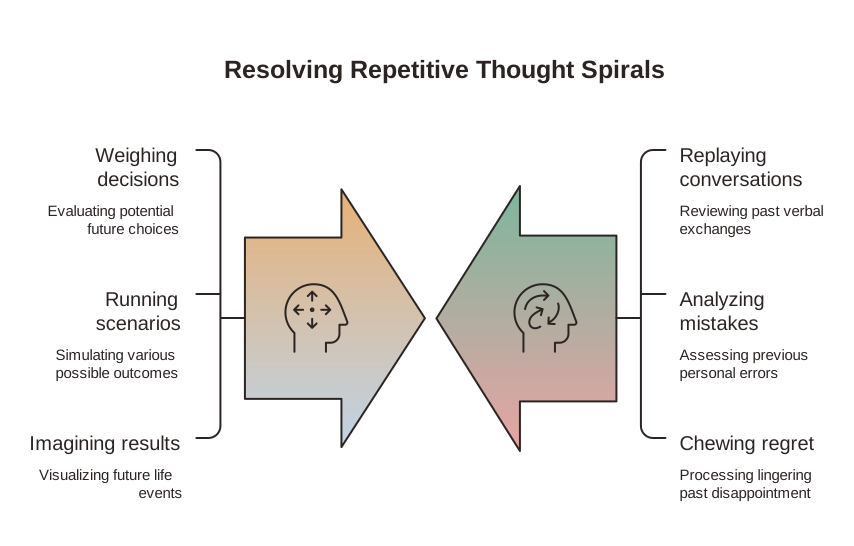
Most people who identify as overthinkers do both, often simultaneously. Something happens (past-focused rumination kicks in). That event also has future implications (future-focused overthinking begins). The two loops reinforce each other, and it becomes impossible to tell where one ends and the other starts.
This is also why people use the words interchangeably — because in practice, the experience is often a blend. You're replaying the argument while simultaneously running scenarios about what happens next. But even within the blend, one tends to dominate. And identifying which one is driving your particular pattern is the first step toward doing something about it.
Quick self-check: which one is driving your spiral?
Notice how strongly each statement fits you, then see which pattern leans heaviest.
How to read your answers
If you're primarily a ruminator
Statements 1, 3 and 5 are your territory. Your brain processes difficulty by returning to the past — analyzing what happened, looking for the moment things shifted, trying to understand it enough to finally feel okay. The frustrating part is that the understanding never quite lands. Rumination feels like processing, but it's closer to re-experiencing: each return to the memory activates the same emotional response without delivering resolution.
What helps ruminators isn't more analysis — it's a different kind of engagement with the thought. Specifically, challenging the interpretation your brain has built around the event, rather than continuing to examine the event itself.
If you're primarily an overthinker
Statements 2 and 4 are your territory. Your brain processes uncertainty by trying to think its way to safety — running every scenario, preparing for every outcome, staying one step ahead of whatever might go wrong. The frustrating part is that certainty never arrives. Because the uncertainty is always real, the loop always has material to work with.
What helps overthinkers isn't more preparation — it's learning to tolerate the uncertainty rather than solve it. That means catching the moment your brain shifts from genuine planning into unproductive spinning, and redirecting before the spiral gains momentum.
If you do both
Your brain is doing double the work. Something happens, and you analyze what went wrong (rumination) while simultaneously catastrophizing about what it means going forward (overthinking). This is the most exhausting pattern — and the most common one. The key isn't treating them as separate problems; it's catching the moment the spiral begins, before your brain has had time to build both loops at once.
Why the direction of the spiral changes the solution
This is the part most advice skips. Generic tips — “practice mindfulness,” “take a walk,” “distract yourself” — treat overthinking and rumination as the same problem with the same solution. They're not.
For rumination, the goal is to change your relationship to what already happened. You're not trying to figure out what occurred — you already know. What you're doing is re-experiencing it with a set of interpretations layered on top: that it means something specific about you, that it signals how others see you, that it's evidence of a pattern you can't escape. The intervention that works is examining and challenging those interpretations — not the facts of what happened, but the meaning your brain has assigned to it. “She didn't respond because she's angry with me.” “I said the wrong thing, which proves I always say the wrong thing.” That is where the distortion lives, and that's what needs to be questioned.
For overthinking, the goal is to interrupt the certainty-seeking. Your brain is trying to eliminate a risk that cannot be eliminated through thinking. The intervention that works is recognizing when genuine planning has tipped into unproductive simulation — and introducing something concrete to redirect toward. Sometimes that's identifying one actual next step and taking it. Sometimes it's naming the specific fear underneath the scenario-running (overthinkers often don't consciously know what they're actually afraid of). Sometimes it's accepting that uncertainty is real and the discomfort of not knowing is something to move through rather than think around.
The thought underneath the thought
Whether you're a ruminator, an overthinker, or both, there's usually a core belief operating in the background that makes these patterns sticky. For ruminators, it's often some version of: I did something wrong. Something is wrong with me. I need to understand what it was so I can fix it. For overthinkers, it's often: Something bad is coming. I need to be ready. If I'm prepared enough, I'll be okay.
These beliefs are not facts — they're conclusions your brain formed at some point and has been operating from since. They feel like reality because they're so familiar. But they're the lens, not the landscape. Identifying which belief is driving your pattern is some of the most useful work you can do — not because the belief disappears once you name it, but because you can start to ask whether it's actually true, and what it would mean if it weren't.
What they have in common
For all the differences between overthinking and rumination, they share one thing: the belief that more thinking will eventually resolve the discomfort. It won't. The thought doesn't contain the resolution. The resolution comes from engaging with the thought differently — questioning it, reframing it, or accepting the uncertainty it's trying to protect you from.
The loop is not your enemy. It's your brain doing its best with a strategy that doesn't quite work. Understanding why it's doing what it's doing — whether it's trying to resolve the past or control the future — is the first step toward finding something that actually does. If rumination is your dominant pattern, it's worth understanding why rumination makes everything worse — and the specific distortions that fuel it, which often show up as common cognitive distortions.
One last thing
If you recognized yourself in both categories, you're in good company. The majority of people who identify as chronic overthinkers are also chronic ruminators. The two patterns coexist because they're driven by the same underlying discomfort with uncertainty and threat — just pointed in different directions.
You don't need to fix both separately. You need to get better at catching the spiral early, examining the thought underneath it, and offering your brain something more grounded to hold onto. That's a skill. It gets easier with practice. And the best time to practice it is the moment the thought appears — not an hour later, when the loop has already built momentum.
If the rumination side is your dominant pattern, it has a shape worth knowing: replaying, rehearsing, self-prosecuting, or compulsive fixing. The free What Kind of Ruminator Are You? quiz sorts it in two minutes, and the rumination hub has the loop-specific exits — including rumination vs worry, the other comparison people ask about.
Frequently asked questions
What's the difference between overthinking and rumination?
Overthinking is future-focused — the spiral of what might happen, what could go wrong, what you should do. Rumination is past-focused — the loop of what already happened, what was said, and what it says about you. Both are repetitive and unproductive, but one tries to control the future and the other tries to resolve the past, so they need different interventions.
Can you have both overthinking and rumination?
Yes — most people who identify as chronic overthinkers also ruminate, often at the same time. Something happens (rumination kicks in) and it also has future implications (overthinking begins). The two loops reinforce each other, which is why the experience blends together and people use the words interchangeably.
Is rumination worse than overthinking?
Neither is simply 'worse,' but they're linked to different things: rumination is strongly associated with depression (it both causes and maintains low mood), while overthinking is more tied to anxiety and certainty-seeking. What matters is matching the intervention to the pattern.
How do you stop overthinking versus rumination?
For rumination, challenge the interpretation your brain has layered on the event — not the facts of what happened. For overthinking, interrupt the certainty-seeking: catch when planning tips into unproductive simulation, name the fear underneath, and accept the uncertainty rather than trying to think your way out of it.
Like what you're reading?
Stop the spiral in real time
MindLift gives you a gentle CBT-based reframe the moment your thoughts start looping.


Free to start · no account required
- Nolen-Hoeksema S et al. (2008). Rethinking Rumination. Perspectives on Psychological Science. — DOI (opens in a new tab)
- Nolen-Hoeksema S (2000). The role of rumination in depressive disorders and mixed anxiety/depressive symptoms. Journal of Abnormal Psychology, 109(3), 504–511. — DOI (opens in a new tab)
- Ehring T, Watkins ER (2008). Repetitive Negative Thinking as a Transdiagnostic Process. International Journal of Cognitive Therapy. — DOI (opens in a new tab)
- Watkins ER (2008). Constructive and unconstructive repetitive thought. Psychological Bulletin. — DOI (opens in a new tab)
Mental Wellness Writers
The MindLift Wellness Team writes evidence-based content on CBT, self-talk, and everyday mental health tools.
Was this article helpful?