
Turn this into a daily habit — free to start in the MindLift app:
You said something in a meeting two days ago. It probably landed fine. But your brain won't let it go.
You've replayed the moment seventeen times. You've imagined three different ways it could have come across badly. You've drafted apology texts you never sent. And every time you think you've moved on, something pulls you right back — the same scene, the same spiral, the same sick feeling in your stomach.
This isn't overthinking. It has a name: rumination. And it's doing far more damage than you realize.
What rumination actually is
Rumination is the mental habit of repeatedly cycling through a painful thought, memory, or worry without moving toward a resolution. You're not processing it. You're not solving it. You're just running the loop again.
The word comes from the Latin for “chewing the cud” — the way cows re-chew already-digested food. The image fits. You're chewing something you've already chewed, over and over, and getting nothing new from it.
Psychologists define rumination as a passive response to distress. You keep focusing on the bad feeling, its causes, and what it might mean — on repeat. The key word is passive. It feels like thinking, but it's not productive thinking. It's more like being thought at.
Rumination is different from reflection. Reflection has a purpose — you revisit something to understand it, take the lesson, and move on. Rumination circles back because something feels unresolved. But it never delivers the resolution it promises.
Why your brain does this
Here's the part that makes rumination so hard to stop: it feels like it's working.
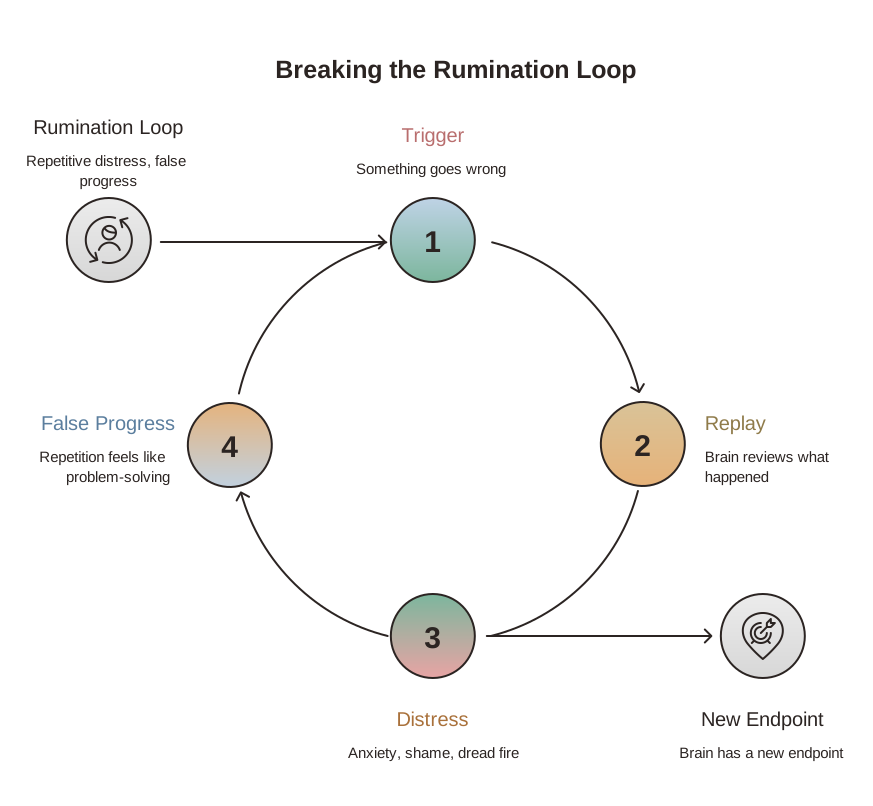
When something goes wrong — a conflict, a mistake, a rejection — your brain registers a threat. Its job is to keep you safe, so it tries to solve the problem. It reviews what happened, hunts for what you did wrong, and runs simulations of what could still go wrong.
This is a useful feature — in small doses. The problem is that your brain doesn't know when to stop. Once it flags something as unresolved, it keeps returning to it, mistaking repetition for progress.
But you're not solving anything. You're just firing the same emotions — the anxiety, the shame, the dread — on every pass, without getting any closer to resolution.
Brain research shows that rumination keeps your threat-detection system (the amygdala) on high alert. The more you ruminate, the more sensitive your nervous system gets to that particular worry. Thinking about it more doesn't calm it down. It makes it louder.
The three ways rumination makes everything worse
1. It distorts your memory of what happened
Memory is not a recording. Every time you recall something, you rebuild it — through whatever mood you're in right now. When you're anxious, your brain fills the gaps with worst-case readings. When you're ashamed, you turn up the evidence that supports the shame.
This means the version of events you replay on day five looks quite different from what actually happened on day one. The pause in her response felt like disapproval. The slight look on his face confirmed he was judging you. The fact that she hasn't texted back obviously means something is wrong.
None of those readings are facts. They're your brain's distortions, and each replay locks them in deeper. By day five, the story in your head is far darker than what actually happened.
2. It blocks actual problem-solving
Rumination feels productive — and that's precisely why it's so insidious. You believe you're working on the problem. You're not.
Research consistently shows it: people stuck in rumination are worse at finding solutions than people who aren't. When your mind is stuck on “what went wrong and why,” it's not available for “what can I do about it.” Rumination narrows your thinking instead of expanding it.
The irony is brutal: the thing your brain is trying to do (resolve the threat) is exactly what rumination prevents.
3. It becomes a self-sustaining mood state
The more you ruminate, the worse you feel. The worse you feel, the more naturally your mind returns to ruminative thinking. It becomes a loop that feeds itself.
Research links high levels of rumination to increased risk of depression and anxiety disorders. This isn't just correlation — rumination is now understood as a mechanism that both causes and maintains depression. You don't ruminate because you're depressed. Ruminating makes you more depressed, which makes you ruminate more.
If your worst spirals tend to hit late at night, or when you're already tired or stressed, this is why. Your ability to regulate emotion is running on empty — so the loop starts more easily and grips harder.
What rumination looks like in real life
It's not always obvious that you're ruminating. Here are the signs:
- You replay a conversation that's already over, and each replay makes you feel worse, not better.
- You ask yourself “why” questions that don't have answers — why did I say that, why does this keep happening, why am I like this.
- You find yourself thinking about the same scenario in the background while you're trying to do something else.
- You seek reassurance from friends but feel only briefly relieved before the worry comes back.
- You tell yourself you're “just processing,” but hours later nothing has shifted.
These are the hallmarks: repetition, emotional escalation, and no forward movement.
The difference between rumination and problem-solving
One quick test: ask yourself whether this thought is taking you somewhere.
Problem-solving moves. It identifies a concrete action, a decision, a next step. Even when it's uncomfortable, reflection has a direction — you're moving toward understanding or toward a response.
Rumination circles. The same question keeps appearing. The same scenarios keep replaying. You keep arriving at the same emotional state without any new information or new choices.
If your thinking is going somewhere, it's reflection. If it's going in circles, it's rumination. And circles are not a path to resolution — they're just the long way to staying stuck.
How to actually stop it
Most advice for stopping rumination is well-meant and nearly useless. “Just don't think about it.” “Distract yourself.” “Think positive.” These approaches fail because they treat rumination as a choice you can override with willpower. It's not. It's a habit your brain has learned to repeat.
Here's what actually works.
Name it out loud (or in writing)
The first step is breaking the passive quality of rumination. When you're ruminating, you're in the thought — you've lost the outside view that lets you question it.
Naming it out loud, even briefly, breaks that grip. “I'm ruminating about the conversation with my manager” is different from being in the conversation with your manager. Naming creates just enough distance to change your relationship to the thought. This is why journaling can help. Not the kind where you write the spiral out in full — the kind where you briefly name what's happening and stop there.
Challenge the thought, don't suppress it
Suppression doesn't work — research consistently shows that trying not to think about something makes you think about it more (the famous “don't think about a white bear” effect).
What works is engaging with the thought differently. Instead of accepting the ruminative thought as true or trying to push it away, question it. Ask:
- Is this actually a fact, or is it an interpretation?
- What would I need to believe for this thought to be true?
- What's the most realistic version of what happened, not the worst-case version?
- What would I tell a friend who was thinking this?
You're not forcing yourself to feel better. You're checking whether the thought holds up — and most ruminative thoughts don't. They're built on assumptions, worst-case readings, and cognitive distortions that feel like facts but aren't.
Reframe the specific thought, not the situation
Generic positive thinking doesn't interrupt rumination because it doesn't engage with the actual content of your thought. “Everything will be fine” is not a response to “I think my colleague is angry at me for what I said in that meeting.”
A reframe works when it's specific. It uses your words, your situation, your particular distortion — and it offers a believable alternative your brain can actually hold onto. This is not about forcing yourself to feel positive. It's about building a thought that's more accurate than the one making you spiral.
Complete the loop
Rumination often persists because something genuinely feels unresolved. Sometimes there's an action available that would actually resolve it — an apology, a conversation, a decision. If that action exists and you haven't taken it, rumination is your brain's way of pushing you toward it.
Ask honestly: Is there something I could do here? If yes, name it and plan when you'll do it. Giving your brain a concrete next step — even a small one — often quiets the loop because it has somewhere to put its concern.
If the answer is genuinely no — if what you're ruminating about is not in your control, or already past the point of action — then the work is different. It's about accepting the uncertainty or the discomfort rather than solving it. That's harder. But it starts with recognizing that more thinking won't produce an answer thinking hasn't already found.
The role of real-time interruption
The challenge with rumination is that it tends to strike when you're least equipped to handle it — late at night, in the middle of something else, in the car on the way home from work.
This is why strategies that require you to sit down, calm yourself, and work through a structured process often fail. By the time you could do all of that, you're already deep in the spiral.
What works better is something you can do in the moment, right where the thought appears. Something that meets the thought with the exact words your brain is using, and offers an alternative believable enough to hold. That's what cognitive reframing is designed to do. Not a general mindset shift — a specific response to a specific thought. And the faster it happens, the more likely it breaks the loop before it gains momentum.
The pattern underneath rumination
If you ruminate often, it's worth looking at what sits beneath the pattern. Rumination is rarely random. It clusters around particular themes — your worth, your relationships, your performance, whether people like you, whether you're doing enough. Those themes point to your core beliefs about yourself, which is why different people ruminate in different ways.
The person who ruminates about what they said at work often carries a belief that they're not enough. The person who ruminates about a partner pulling away is often carrying a fear of abandonment far older than this relationship. The person who replays every social interaction is often working from a belief that they're easy to dislike.
Understanding your pattern doesn't stop rumination immediately. But it changes what you're working with. Instead of fighting individual thoughts one by one, you start to see the belief underneath — and that's what's actually worth examining.
What shape is your loop?
The pattern also has a shape. Some ruminators replay the past, some rehearse the future, some turn every event into a self-trial, and some disguise the loop as problem-solving. Our free What Kind of Ruminator Are You? quiz identifies yours in two minutes — no email — and the rumination hub collects every guide in this series, including the full six-step sequence for ending the loop.
You don't need to stop thinking. You need to think differently.
Rumination is not the same thing as caring. It's not the same thing as being conscientious, or smart, or invested in your life. It just feels that way because it's so consuming.
By the fifteenth pass, a looping thought has nothing new to tell you. It's just keeping your nervous system on alert, distorting your memory, narrowing your options, and burning time and energy you could spend elsewhere.
The goal isn't a quiet mind. It's a mind that can face difficulty without getting trapped in it. One that can notice a painful thought, examine it honestly, and move through it — instead of being pulled back into the loop again and again.
That capacity is trainable. It's not a personality trait you either have or don't. It's a skill, and it gets stronger every time you interrupt a spiral early enough to offer it something more grounded to hold onto.
Frequently asked questions
What is rumination?
Rumination is the mental habit of repeatedly cycling through a painful thought, memory, or worry without moving toward resolution. Unlike reflection, which is purposeful and moves you forward, rumination circles back passively — it feels like thinking but produces no new insight or solution.
What's the difference between rumination and reflection?
Reflection has direction: you revisit something to understand it and move forward. Rumination circles — the same question and scenarios keep replaying, arriving at the same emotional state with no new information. A quick test: if your thinking is going somewhere, it is reflection; if it is going in circles, it is rumination.
Why can't I stop ruminating?
Because rumination feels like it's working. When something goes wrong, your brain flags a threat and keeps returning to it, mistaking repetition for progress. It's a reinforced habit, not a conscious choice — which is why willpower and 'just stop thinking about it' don't work.
Does rumination cause anxiety and depression?
Research links high rumination to increased risk of depression and anxiety, and it's now understood as a mechanism that both causes and maintains depression — not just a symptom. Rumination keeps the brain's threat-detection system sensitized, making the worry louder over time.
How do you stop rumination?
Name it to create distance, challenge the thought instead of suppressing it (suppression backfires), reframe the specific thought with a credible alternative, and complete the loop by taking a concrete action if one exists. A specific, in-the-moment reframe works better than a structured exercise you can only do later.
Like what you're reading?
Stop the spiral in real time
MindLift gives you a gentle CBT-based reframe the moment your thoughts start looping.


Free to start · no account required
Mental Wellness Writers
The MindLift Wellness Team writes evidence-based content on CBT, self-talk, and everyday mental health tools.
Was this article helpful?