
Turn this into a daily habit — free to start in the MindLift app:
You sent the text two hours ago. They haven't replied. And now you're lying in bed at 1am running a full forensic analysis of your last three conversations, looking for the moment everything shifted.
Or maybe it's not that. Maybe it's someone you used to love, and your brain keeps replaying the ending on a loop — the words said, the words not said, the version of events where you did something different.
Either way, you know the feeling: loving someone and being completely hijacked by thoughts about them. Thoughts that feel urgent and important but mostly just leave you exhausted.
You're not dramatic. You're not "too much." Your brain is doing exactly what it was designed to do — just in the wrong direction. This article explains why overthinking about someone you love happens, what's actually going on neurologically, and what you can do about it right now.
Why You Can't Stop Thinking About Someone You Love
Before we get to fixes, it helps to understand the mechanism. Overthinking about a person you love isn't a character flaw. It's a stress response.
When you care deeply about someone, your brain treats the relationship as a primary attachment — something essential to your safety and wellbeing. This is evolutionary. Early humans who monitored their close relationships carefully survived longer. Your nervous system doesn't know it's 2026. It still treats "something feels off with this person I love" as a potential threat, and it responds accordingly.
The result? Your threat-detection system (the amygdala) flags the situation, your prefrontal cortex tries to "solve" it through analysis, and you end up in a loop — thinking, worrying, replaying, predicting — without ever reaching resolution.
Psychologists call this rumination: repetitive, passive focus on distressing thoughts and feelings. Unlike genuine problem-solving, rumination doesn't lead anywhere. It creates the illusion of thinking while actually just recycling the same anxious content.
A large body of research links rumination to increased anxiety, depression, and relationship dissatisfaction. Not because you're doing something wrong — but because the loop itself is the problem, not a lack of information.
What Overthinking About Someone Actually Looks Like
Overthinking in relationships tends to cluster into recognizable patterns. You might recognise yourself in some of these:
The forensic replay. Dissecting a conversation word by word, trying to identify the exact moment something changed.
The future catastrophe spiral. Fast-forwarding to worst-case scenarios — the breakup, the fight, the abandonment — as if predicting them will protect you.
The comparison trap. Measuring yourself against other people they know, previous partners, or the version of yourself you think they want.
The silence interpreter. Turning a late reply, a short text, or a quiet mood into evidence that something is wrong — with you, with them, with everything.
The post-mortem. If the relationship is already over, replaying what happened, building different endings, trying to find the version where you didn't get hurt.
All of these feel productive. None of them are. They're your brain trying to solve something that can't be solved through more thinking.
The Hidden Assumption Driving Most Relationship Rumination
Here's something CBT-based approaches surface that most "just relax" advice misses: overthinking isn't really about the other person. It's about what you believe their behavior means about you.
"They haven't texted back" isn't actually the thought that's keeping you up. The thought underneath it is: I'm too much. I pushed them away. They don't actually want this. I'm going to lose them because I'm not enough.
That hidden layer — the core belief doing the real damage — is where the anxiety lives. When you only address the surface thought ("I'm sure they're just busy"), you're applying a bandage to a wound you haven't found yet.
This is why generic reassurance doesn't work. Being told "you're overthinking" or "they definitely like you" doesn't reach the actual source of the spiral.
7 CBT-Backed Techniques to Stop Overthinking About Someone You Love
1. Name the cognitive distortion
Overthinking runs on cognitive distortions — mental shortcuts that feel like logic but aren't. When you're spiralling about someone you love, you're usually using one of these:
- Mind reading: Assuming you know what they're thinking ("They're annoyed with me")
- Fortune telling: Treating your fears as facts ("This is going to end badly")
- Catastrophising: Escalating a small signal into a massive conclusion
- Personalisation: Making their behaviour about you when it probably isn't
- Emotional reasoning: "I feel anxious, therefore something must be wrong"
Naming the distortion doesn't make the thought disappear, but it creates distance. Instead of I think they're pulling away, you get I notice I'm doing fortune-telling again. That shift — from inside the thought to observing it — is the beginning of interrupting the loop.
2. Challenge the hidden assumption, not the surface thought
Go one layer deeper. Instead of asking "Is this thought true?" ask: "What would it mean if this thought were true?"
Keep going until you hit the real belief.
They haven't texted → They're annoyed with me → I did something wrong → I'm too intense → I'm going to be alone
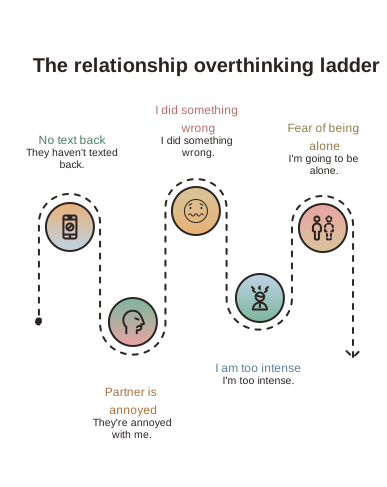
Once you can see the actual belief, you can work with it. Is there real evidence for it? What would you say to a friend who believed this about themselves? What's a more accurate — not more positive, just more accurate — way to hold this?
3. Give the spiral a scheduled window
This sounds counterintuitive, but it works. Instead of trying to suppress the thoughts entirely — which tends to amplify them, a phenomenon called the "white bear problem" — give them a specific, time-limited slot.
Tell yourself: "I'm not ignoring this. I'm thinking about it at 8pm for 20 minutes, and that's when I'll give it full attention."
When the thought arrives outside that window, you don't fight it — you redirect it. Not now. 8pm. Research shows this reduces the overall cognitive load of rumination because your brain stops treating the thoughts as something that needs to be processed immediately.
4. Interrupt the loop with pattern disruption
Rumination requires a specific mental state — passive, inward-focused, undirected. Anything that pulls you out of that state interrupts the loop, even briefly.
Effective disruptors include:
- Physical movement (even a five-minute walk changes neurochemistry)
- Talking out loud to yourself — it activates different neural pathways than internal thought
- Cold water on your face or hands
- Naming five things you can physically see, hear, or touch right now
These aren't cures. They're circuit breakers. They buy you enough space to choose your next thought rather than being carried by the spiral.
5. Separate solvable from unsolvable
A useful question to ask mid-spiral: Is there an action I can actually take right now?
If yes — take it. Send the message. Have the conversation. Make the decision. Action ends rumination faster than analysis.
If no — and often the answer is no, because you're spinning about something that's inherently uncertain — that's important information. You're not ruminating because you need more information. You're ruminating because you're trying to feel certain about something that can't be made certain through thinking.
Uncertainty tolerance is a skill. Most relationship anxiety lives in the gap between what you know and what you want to know. The work isn't getting more certainty — it's learning to stay present when certainty isn't available.
6. Reframe what the thoughts mean
One of the most effective CBT techniques isn't to challenge the content of anxious thoughts — it's to change your relationship to them.
Instead of: I keep thinking about them because something is wrong.
Try: I keep thinking about them because I care about this. Caring is not a problem.
The thought itself becomes evidence of something true — your capacity for connection — rather than evidence of danger. This doesn't mean bypassing real issues. It means not treating the presence of worry as proof of disaster.
7. Address the unmet need underneath
Overthinking about someone you love almost always contains an unmet need. It might be:
- Reassurance (you need to feel secure in the connection)
- Clarity (something is genuinely ambiguous and unresolved)
- Closure (there's something unsaid or unprocessed)
- Self-worth (the relationship is touching something deeper about how you see yourself)
When you can identify the need, you can ask: Is there a direct way to meet this that doesn't involve more thinking? Sometimes the answer is a conversation. Sometimes it's doing something that rebuilds your own confidence separate from the relationship. Sometimes it's grief — letting yourself feel the loss rather than endlessly analysing it.
When Overthinking Becomes a Pattern (Not Just a Moment)
If you notice that overthinking follows you from relationship to relationship — that you've always been someone who spirals, regardless of the person — that's worth taking seriously.
Attachment theory suggests that people with anxious attachment styles are particularly prone to relationship rumination. If you grew up in an environment where connection felt unpredictable or conditional, your nervous system learned to monitor relationships very carefully as a survival strategy. That hypervigilance doesn't switch off when you're safe. It keeps running, looking for threats that may not be there.
Recognising this isn't about labelling yourself or pathologising your experience. It's about understanding that the pattern predates this person. The work isn't fixing this relationship — it's slowly building a felt sense of security that isn't entirely dependent on external signals.
What Doesn't Work (And Why)
For balance, it's worth naming the approaches that feel helpful but tend to make overthinking worse:
Seeking constant reassurance. Texting repeatedly, checking their social media, asking "are we okay?" every few days. This provides momentary relief but reinforces the anxiety loop and erodes trust over time.
Venting without direction. Talking about your worries to friends can be genuinely helpful — or it can become another form of rumination, just out loud. If you're going in circles in conversation the way you go in circles in your head, the medium has changed but the pattern hasn't.
Suppression. Trying to just not think about them. As mentioned above, this tends to backfire. Thought suppression increases thought frequency — the mental equivalent of trying not to think about elephants.
Using distraction as avoidance. Staying busy is useful when it gives your nervous system time to regulate. It becomes a problem when you're using it to avoid feeling something that needs to be felt.
When the Thoughts Come at 2am
Overthinking has terrible timing. It tends to peak when you're alone, tired, and most vulnerable — which is when your prefrontal cortex (the rational part) is least online and your emotional brain has the most influence.
A few things that help specifically in those moments:
Write the spiral down. Not to process it, just to externalise it. Getting it out of your head and onto paper or a screen reduces its intensity. You've "dealt with it" in a small but real way.
Reframe the physical feeling. Anxiety and excitement have almost identical physiological signatures. When your chest is tight and your mind is racing at 2am, try: My body is responding to something it cares about. Not "I'm broken," not "I'm in danger." Just: care.
Use a structured reframe. This is where tools like MindLift are designed to help. Instead of trying to reason yourself out of the spiral, you put the actual thought in — your exact words — and get back a reframe that challenges the hidden assumption in your specific language. Not affirmations. Not generic advice. Something that actually meets you where you are.
A Note on Professional Support
This article covers evidence-based self-help strategies rooted in CBT. For most people, most of the time, these tools make a meaningful difference.
But if you're finding that overthinking is significantly interfering with your relationships, your sleep, your work, or your sense of self — a therapist trained in CBT or ACT (Acceptance and Commitment Therapy) can help you go deeper. Particularly if the pattern feels long-standing, or if it's accompanied by depression or more pervasive anxiety.
Self-help tools work best as part of a broader mental health ecosystem, not as a replacement for professional support when that support is genuinely needed.
The Short Version
Overthinking about someone you love isn't weakness. It's a misdirected survival mechanism trying to protect you from uncertainty and loss. The thoughts feel urgent because the attachment is real — but more thinking doesn't produce more security. It just extends the loop.
What helps:
- Naming the cognitive distortion
- Finding the hidden assumption underneath the surface thought
- Scheduling worry rather than suppressing it
- Disrupting the mental state that sustains rumination
- Separating what you can act on from what you can't
- Addressing the actual unmet need
And when the spiral hits and you don't have the bandwidth to walk through all of that — having a tool that can meet you in sixty seconds, in your own words, without judgment, matters more than most people realise.
That's what MindLift was built for. Not to replace the deeper work, but to help you interrupt the loop in real time — so you can get through the night, make it to the morning, and approach the relationship (and yourself) with a little more clarity.
Frequently asked questions
Why can't I stop overthinking about someone I love?
Your brain treats close relationships as attachment bonds — essential to safety and wellbeing. When something feels uncertain about that bond, your threat-detection system activates. Rumination is the result: the brain trying to 'solve' the uncertainty through repeated analysis. But more thinking doesn't produce more certainty — it just extends the loop.
Is overthinking about someone a sign of anxious attachment?
It can be. Anxious attachment — often developed in childhood when connection felt unpredictable — creates hypervigilance about relationships. People with anxious attachment are particularly prone to relationship rumination because their nervous system learned to monitor connection carefully as a survival strategy. Recognising this can help you see the pattern as learned rather than fixed.
How do I stop ruminating about someone after a breakup?
Post-breakup rumination often loops because there's a genuine unmet need — closure, grief, or unprocessed emotion. Naming the need (not the thought) is the entry point: are you seeking clarity, processing loss, or rebuilding self-worth? From there, you can take a direct action toward that need rather than cycling through the same mental replay. Writing the spiral down, rather than just thinking it, also reduces its intensity.
What's the difference between thinking about someone and ruminating?
Thinking about someone moves forward — it generates insight, leads to decisions, or processes emotion. Rumination cycles in place: replaying the same content without new resolution. A rough test: after five minutes of thinking, do you feel clearer or more anxious? Rumination usually leaves you feeling worse and no closer to an answer.
Does seeking reassurance help with relationship anxiety?
In the short term, yes. In the long term, it tends to reinforce the anxiety loop. Each time reassurance relieves the anxiety, the brain learns that reassurance is what's needed — so it seeks it again sooner. Building your capacity to tolerate uncertainty, rather than eliminating it through reassurance, is the more sustainable path.
Like what you're reading?
Build kinder inner dialogue
The way you talk to yourself shapes every relationship. MindLift helps you soften that voice.


Free to start · premium optional