
Turn this into a daily habit — free to start in the MindLift app:
You know the loop. A thought arrives, you try to think it through, it doubles back on itself, and now twenty minutes have passed and you feel worse than when you started. Overthinking doesn't feel like overthinking from the inside — it feels like problem-solving. That's what makes it so hard to stop.
This guide covers seven techniques that interrupt the loop immediately. Not "try this for 30 days and maybe you'll see results" — these work in the moment, for the thought that's running right now.
Why "Just Stop Thinking About It" Doesn't Work
Telling yourself to stop overthinking activates the exact cognitive process you're trying to suppress. Research on thought suppression (Wegner, 1994) shows that trying not to think of something makes it more likely to intrude. This is sometimes called the "white bear effect."
The techniques below don't try to stop the thought — they interrupt the feedback loop that keeps it running. The difference matters: you're not fighting the thought, you're disengaging from the pattern that feeds it.
7 Techniques to Stop Overthinking Right Now
Thought Labeling
Time required: 30 seconds
Name what type of thought it is. Out loud or in writing: "This is catastrophizing." Or: "This is mind-reading." Or: "This is a 'should' thought."
Common labels: catastrophizing, mind-reading, all-or-nothing thinking, fortune-telling, emotional reasoning, personalization, "should" statements.
5-4-3-2-1 Grounding
Time required: 60 seconds
Name, in order:
- 5 things you can see right now
- 4 things you can physically feel (your chair, the temperature, your feet on the floor)
- 3 things you can hear
- 2 things you can smell (or would smell if you brought something close)
- 1 thing you can taste
The Reframe (Cognitive Restructuring)
Time required: 2–3 minutes
Write or type the exact thought that's looping. Then ask:
- Is this thought factually true, or is it an interpretation?
- What's the most realistic outcome (not the worst, not the best)?
- If a friend told me they were thinking this, what would I say to them?
- What would I think of this situation in 6 months?
Write a single sentence that's more balanced and believable than the original thought. That's the reframe.
Behavioral Activation (Do Something Small)
Time required: 5 minutes
Pick any small, concrete task and complete it. Wash one dish. Reply to one email. Walk to the kitchen and back. Make your bed. The task doesn't need to be related to what you're overthinking.
Containment Scheduling
Time required: 2 minutes to set up
Say to the thought: "I'll think about you at [specific time]." Choose a specific 15-minute window later in the day — 4pm, after dinner, before bed.
When the thought returns before that time, remind it: "I have a time for you. Not now."
Socratic Questioning
Time required: 3–5 minutes
Ask the thought a series of questions rather than accepting it as fact:
- What evidence actually supports this?
- What evidence contradicts it?
- Am I assuming the worst outcome is the most likely one?
- If the worst did happen, could I handle it? How?
- What would a realistic, non-catastrophizing version of this thought look like?
The 60-Second Mini-Reframe
Time required: 60 seconds
Open MindLift and type the thought that's stuck on repeat. The Mini-Reframe walks you through a CBT-based process for that exact thought and generates a more grounded alternative in under 60 seconds.
Take the Mini-Reframe now → (free to start)
Which Technique Should You Use?
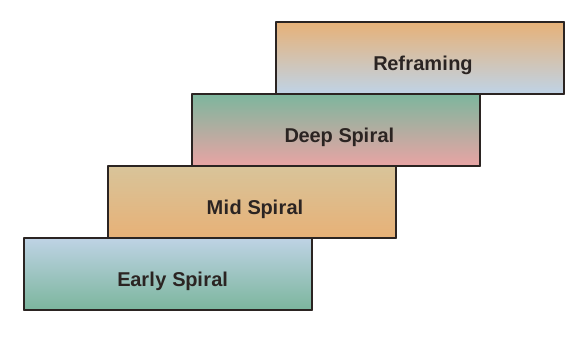
The answer depends on where you are in the spiral:
- Early in the spiral, still calm: Thought labeling or Socratic questioning work well because you still have access to your reasoning.
- Mid-spiral, anxious but functional: The reframe (technique 3) or containment scheduling (technique 5).
- Deep in the spiral, flooded: Physical grounding first (5-4-3-2-1), then behavioral activation, then reframe once you're calmer.
- Short on time: The 60-second Mini-Reframe.
What Won't Work
A few common approaches that feel productive but tend to make overthinking worse:
- Reassurance-seeking — asking others to confirm you'll be okay provides temporary relief but teaches the brain that the thought was genuinely dangerous, reinforcing the loop.
- Research spirals — Googling symptoms, outcomes, or worst-case scenarios feeds the loop rather than interrupting it.
- Suppression — "Don't think about it" — see the white bear effect above.
- Waiting for certainty — Overthinking is often a search for certainty about an uncertain situation. Certainty is usually not available. The loop runs because the brain keeps looking for it.
Related Reading
- Cognitive Reframing Techniques: 8 CBT Methods
- Overthinking vs Anxiety: What's the Difference
- How to Stop Spiraling Thoughts
- Thinking Traps and Cognitive Distortions
Frequently asked questions
What stops overthinking immediately?
The fastest techniques are physical interruption (change your posture, breath, or environment), thought labeling (name the distortion type), and the 5-4-3-2-1 grounding method. These work in under 60 seconds because they disengage the rumination loop without requiring you to resolve the thought.
Why can't I stop overthinking even when I try?
Trying to stop overthinking by thinking about it more usually makes it worse. Overthinking is a loop — it feeds on attention. The key is to interrupt the loop rather than engage with its content. Techniques like thought labeling, physical grounding, and cognitive reframing break the loop without requiring you to "solve" the original thought.
Is overthinking the same as anxiety?
They overlap but are distinct. Anxiety is a physiological state — the nervous system's threat response. Overthinking is a cognitive pattern — the mental loop the brain runs in that state. You can experience overthinking without clinical anxiety, and you can have anxiety without constant overthinking. CBT targets both.
What is the best app to stop overthinking?
Apps that use CBT-based cognitive reframing (rather than generic affirmations or meditation) tend to work best for overthinking. MindLift's Mini-Reframe walks you through a 60-second CBT process for the specific thought you're stuck on — free to start, no subscription required.
Like what you're reading?
Stop the spiral in real time
MindLift gives you a gentle CBT-based reframe the moment your thoughts start looping.


Free to start · premium optional