
Turn this into a daily habit — free to start in the MindLift app:
You check your phone again.
Replay their message. Analyze one sentence like it holds the meaning of everything.
Your mind turns into a detective. But instead of solving anything… it just keeps reopening the case.
Let's slow this down together.
Why Your Mind Keeps Going Back to Them
This isn't because you're “too attached” or “bad at letting go.”
It's because your brain is trying to do one thing:
Create certainty.
When you care about someone, uncertainty feels like a threat. Your nervous system registers “I don't know where I stand with this person” the same way it registers physical danger — as something that needs to be resolved.
- “Do they feel the same?”
- “Did I do something wrong?”
- “What if I lose them?”
So your brain tries to solve it by thinking more.
But here's the twist:
- Overthinking doesn't resolve uncertainty
- It feeds it
In CBT, this is called a rumination loop — repetitive thinking that keeps emotions active instead of allowing them to resolve naturally.
What's Actually Happening (CBT Lens)
Your thoughts start to distort reality a little. In CBT, these are called cognitive distortions — patterns that feel true, but aren't always accurate.
Common distortions in relationship overthinking:
- Mind reading → “They're pulling away”
- Catastrophizing → “This is going to end badly”
- Emotional reasoning → “I feel anxious, so something must be wrong”
And your inner voice keeps repeating them… louder each time. Not because they're true, but because repetition creates the feeling of truth.
Why It Gets Stronger (Neuroplasticity)
Your brain learns from repetition.
Every time you:
- Replay a conversation
- Check your phone compulsively
- Imagine worst-case scenarios
…you strengthen that neural pathway. Neuroscientists call this “cells that fire together, wire together.”
So the loop becomes easier to enter and harder to leave. Not because you're weak — because your brain is efficient. It's doing exactly what brains do.
The Trap: “If I Think Enough, I'll Feel Better”
It feels like: “I just need to figure this out.”
But what's really happening:
- You're chasing certainty that thinking can't provide
- You're trying to control someone else's feelings
- You're keeping your nervous system in an activated state
Overthinking feels like progress. But it's actually just repetition in a loop.
The Shift: You Don't Need to Stop Caring
You don't need to:
- Detach
- Ignore your feelings
- Pretend you don't care
You only need to:
Stop engaging with every thought.
That's the difference between:
Getting stuck inside it
- Replaying the same message
- Analyzing every word for hidden meaning
- Spiraling into worst-case scenarios
- Checking your phone every few minutes
Feeling something without spiraling
- Noticing the thought without following it
- Letting uncertainty be there without solving it
- Caring deeply and still redirecting your attention
- Choosing not to engage with every loop
5 Ways to Gently Break the Loop
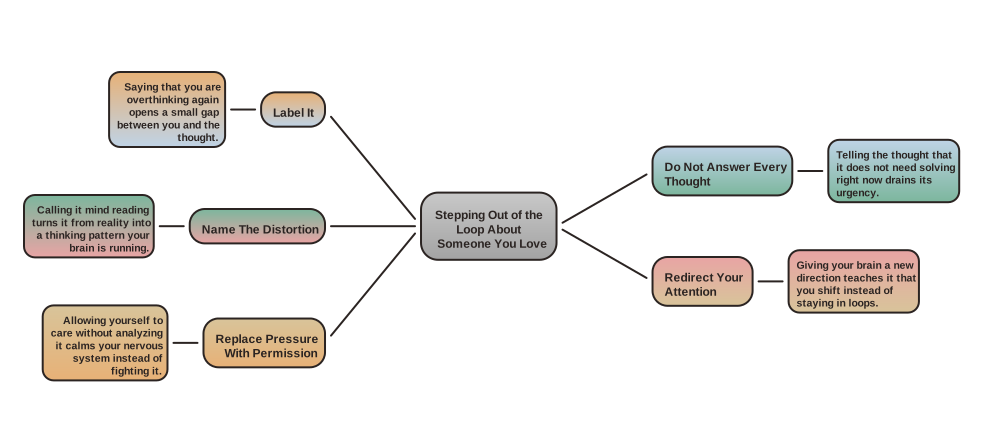
1. Label It (This Weakens It Instantly)
Instead of: “What does this mean??”
Try: “I'm overthinking again.”
This isn't dismissing the feeling — it's creating a tiny gap between you and the thought. Research shows that simply labeling an emotion or pattern reduces its intensity by calming the amygdala's threat response.
2. Don't Answer Every Thought
Not every thought needs a reply.
Try: “Maybe. I don't need to solve this right now.”
This reduces urgency instead of feeding it. The thought wanted to pull you into a debate. You didn't show up for it.
3. Name the Distortion
Catch your brain in the act:
- “This is mind reading — I'm guessing what they feel with no evidence.”
- “This is catastrophizing — I'm jumping to the worst outcome.”
- “This is emotional reasoning — I feel anxious, but that doesn't mean something is wrong.”
When you name it, you step out of it. The thought shifts from “reality” to “a thinking pattern my brain is running.”
4. Redirect Your Attention (Rewiring Happens Here)
Don't just “try to stop thinking.” Give your brain a new direction:
- Stand up, move your body
- Switch to a task that requires focus
- Put your attention on something real for 5 minutes
Each time you redirect instead of engaging, you teach your brain: “We don't stay in loops. We shift.” That's neuroplasticity working for you.
5. Replace Pressure With Permission
Instead of: “I need to stop thinking about them.”
Try: “It's okay that I care. I don't have to analyze it.”
This calms your nervous system instead of fighting it. The fight against a thought often amplifies it — what you resist persists. Permission removes the resistance.
MindLift Micro-Affirmations for This Exact Moment
Short. Grounded. Actually believable.
- “Not every thought needs solving.”
- “I can care without overthinking.”
- “Uncertainty is uncomfortable, not dangerous.”
- “I can pause the story.”
- “I don't have to figure this out right now.”
The Part Most People Miss
This isn't about one perfect reframe.
It's about repetition.
Every time you:
- Notice the loop
- Don't engage
- Redirect your attention
You are literally weakening the old neural pathway and strengthening a new one. That's neuroplasticity in real life — not as a concept, but as something you're doing right now.
A Softer Truth to Hold Onto
You're not overthinking because they're “too important.”
You're overthinking because your brain is trying to:
- Protect you from rejection
- Avoid loss
- Create safety in uncertainty
It's protection… just misdirected. Your brain isn't broken. It's doing its job. It just learned the wrong tool for this particular job.
Final Reframe
You're not “bad at letting go.”
You're practicing a pattern your brain learned well — probably for good reasons at some point.
And now, you're learning how to gently step out of it.
Not by caring less. Not by being harder on yourself. But by choosing, one moment at a time, not to follow every thought your brain generates about them.
That's not detachment. That's skill.
Frequently asked questions
Why do I keep overthinking about someone I care about?
When you care deeply about someone, uncertainty about the relationship feels like a genuine threat to your nervous system. Your brain responds by trying to resolve the uncertainty through thinking — analyzing their words, imagining worst-case scenarios, replaying conversations. This is a survival mechanism, not a character flaw. The problem is that overthinking doesn't create certainty; it amplifies it.
How do I stop replaying conversations in my head?
The most effective approach is not to 'stop' the thoughts but to change your relationship to them. CBT techniques like labeling ('I'm replaying again'), identifying cognitive distortions (mind reading, catastrophizing), and redirecting attention — rather than engaging — weaken the loop over time through neuroplasticity. Each time you notice and don't engage, you strengthen the pattern of stepping out.
Is overthinking about someone a sign of anxiety?
It can be. Rumination — repetitive, passive negative thinking — is closely linked to both anxiety and depression. In relationship contexts, it often reflects anxious attachment patterns, where the nervous system is calibrated to watch for signs of rejection or loss. CBT and self-compassion practices are both well-evidenced ways to reduce this pattern.
What's the difference between overthinking and caring?
Caring is an emotional state — feeling connected to someone, wanting good things for them. Overthinking is a behavior — repeatedly engaging with anxious thoughts about the relationship. You can care deeply and still choose not to engage with every thought the caring generates. The goal isn't to care less; it's to stop engaging with thoughts that don't serve you.
Does rumination make anxiety worse?
Yes. Research by Nolen-Hoeksema shows that rumination — repetitive negative thinking — actively worsens both anxiety and depression. It keeps the emotional system activated rather than allowing it to resolve naturally. This is why 'just thinking it through' often makes things feel worse, not better.
Like what you're reading?
Continue your wellness journey
Reframe negative thoughts in 60 seconds — free to start in the MindLift app.


Free to start · no account required
Mental Wellness Writers
The MindLift Wellness Team writes evidence-based content on CBT, self-talk, and everyday mental health tools.
Was this article helpful?