Turn this into a daily habit — free to start in the MindLift app:
Quick Answer
Why can't I stop the same thought from repeating?
A thought loop runs when your brain identifies something as 'unresolved' and keeps returning to it. Since most loops target things you can't control or don't have a definitive answer for, the brain never gets the 'all clear' — so it loops again.
Ever notice how once you start overthinking something, it's almost impossible to stop?
You tell yourself, "I'll think about this one more time and then move on."
But 20 minutes later, you're still spiraling.
That's not a character flaw.
That's your brain stuck in a loop.
And once you understand how the loop works, you can finally interrupt it.
What Is a Thought Loop?
A thought loop is when your mind keeps replaying the same thought, scenario, or worry — searching for a resolution it can't find. The loop runs because your brain believes it's solving a problem. But most thought loops target things that can't be resolved through more thinking: past conversations, uncertain futures, situations you can't control.
The thought loop meaning in psychological terms: it's a form of rumination where your cognitive system gets stuck in a processing cycle without a natural off-ramp. Understanding why it starts — and why it persists — is the first step to interrupting it.
MindLift is a CBT app built to interrupt a thought loop in the moment: type the thought that keeps replaying, and within about 60 seconds you get a kinder, realistic reframe in your own words — an off-ramp the loop can't generate on its own.
What Is Your Brain Actually Doing When You Can't Stop Thinking?
When you can't stop thinking, your brain is running a threat-detection cycle: your amygdala flags something uncertain, your prefrontal cortex replays scenarios to "solve" it, and — because most overthinking targets things you can't control — no resolution arrives, so the cycle restarts. The loop keeps running because your brain thinks it's helping.
1. The Overthinking Loop Is a Neural Pathway — Not a Choice
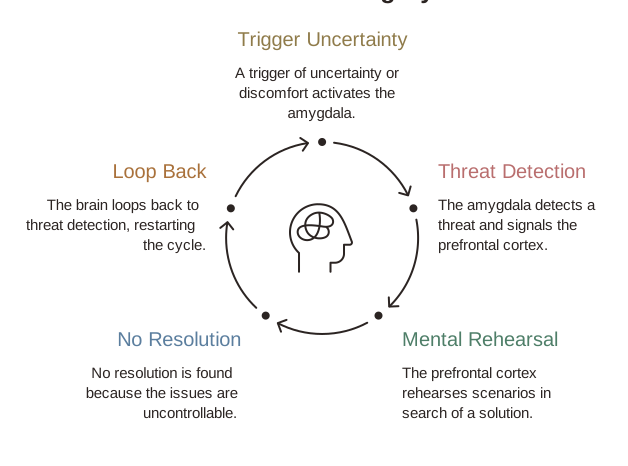
Here's what happens in your brain when you overthink:
🧠 Step 1: Trigger — Something uncertain or uncomfortable happens.
🧠 Step 2: Threat Detection — Your amygdala (fear center) flags it as a potential problem.
🧠 Step 3: Mental Rehearsal — Your prefrontal cortex tries to "solve" it by replaying scenarios.
🧠 Step 4: No Resolution — Since most overthinking targets things you can't control, there's no solution.
🧠 Step 5: Repeat — Your brain loops back to Step 2, trying again.
The loop keeps running because your brain thinks it's helping.
But it's not solving anything — it's just burning energy on repeat.
In short: Overthinking loops because your brain misidentifies unresolvable uncertainty as a solvable problem — and keeps trying.
2. Why It Feels Impossible to Stop
The more you overthink, the stronger the neural pathway becomes.
Think of it like this:
Every time you spiral, you're carving a deeper groove in your brain.
Eventually, overthinking becomes your default response to uncertainty.
This is called neuroplasticity — your brain adapts to what you practice.
The good news? You can rewire it.
The bad news? It requires interrupting the loop deliberately, repeatedly, and uncomfortably.
3. The 3 Types of Overthinking Loops
Type 1: The Replay Loop
You replay past conversations or events, looking for what you did wrong.
Why it happens: Your brain is trying to learn from mistakes — but it's stuck re-analyzing instead of moving forward.
Type 2: The What-If Loop
You imagine future scenarios and all the ways things could go wrong.
Why it happens: Your brain thinks if it prepares for every bad outcome, you'll be safe. Spoiler: you won't.
Type 3: The Decision Loop
You can't choose between options, so you keep weighing pros and cons endlessly.
Why it happens: Your brain is scared of making the wrong choice, so it stalls instead.
All three types share the same pattern: your brain is avoiding emotional discomfort by staying in analysis mode. If your Replay Loop is stuck on a specific conversation, here's why that particular loop keeps running.
In short: All overthinking loops — replaying the past, fearing the future, stalling on decisions — are the same mechanism: your brain avoiding discomfort through analysis.
What Actually Helps Break the Loop?
Interrupting the overthinking loop helps more than thinking harder about it. Six CBT techniques do the interrupting: name the loop when it starts, set a 5-minute timer, ask whether the problem is solvable right now, physically interrupt the pattern, redirect to something concrete, and practice letting the thought pass without engaging.
4. How to Interrupt the Loop (CBT Techniques That Actually Work)
Okay, so you're in the loop. How do you get out?
✨ 1. Name it when it starts
The moment you notice you're spiraling, say (out loud or in your head):
"I'm in the overthinking loop."
This activates your prefrontal cortex and interrupts the automatic pattern.
✨ 2. Set a 5-minute timer
Give yourself permission to think about it for 5 minutes, then stop.
Your brain will resist. Ignore it.
✨ 3. Ask: "Is this problem solvable right now?"
If yes → solve it and move on.
If no → you're ruminating, not problem-solving.
✨ 4. Physically interrupt the pattern
Stand up. Change rooms. Splash cold water on your face.
Physical movement breaks mental loops more effectively than willpower.
✨ 5. Redirect to something concrete
Do a task that requires focus: organize something, do a puzzle, cook.
Your brain can't overthink and focus on a task simultaneously.
✨ 6. Practice "dropping the thought"
This is the hardest one: when the thought comes back (and it will), acknowledge it and let it pass.
Don't engage. Don't debate. Just notice and move on.
In short: You break the loop by interrupting it — naming it, timing it, physically moving, and redirecting focus — not by thinking harder about it.
5. What Doesn't Work (And Why You Keep Trying It)
Four common escape strategies backfire on the overthinking loop, and most people try them anyway: trying to logic your way out, suppressing the thoughts, waiting until you feel ready, and expecting the loop to stop on its own.
❌ Trying to logic your way out — Overthinking is emotional, not logical. More thinking won't help.
❌ Suppressing the thoughts — This makes them stronger (see: the white bear experiment).
❌ Waiting until you "feel ready" to stop — You'll never feel ready. You interrupt anyway.
❌ Expecting the loop to stop on its own — It won't. You have to break it deliberately.
6. Can You Actually Rewire Your Brain to Stop Doing This?
Yes — the overthinking loop can be rewired, but not in one attempt.
Breaking the loop once feels impossible.
Breaking it 100 times? That's when it starts to change.
Your brain learns what you practice.
If you practice interrupting the loop, eventually your brain will default to that instead of spiraling.
It takes weeks, not days.
But it does work.
If your loop is escalating rather than repeating the same thought — getting worse with each pass — that's a spiral, which needs a different approach.
Final Thought
Breaking an overthinking loop comes down to catching the cycle while it is still running and interrupting it on purpose — naming the loop, giving it a time limit, or physically changing what you are doing — rather than waiting for the thinking to reach an answer it was never going to find.
The overthinking loop isn't a personality trait.
It's a pattern your brain learned.
And what's learned can be unlearned.
The trick is catching yourself in the loop and interrupting it before it runs its full cycle.
Do that enough times, and your brain will finally get the message:
This loop doesn't help. Time to try something else.
Frequently asked questions
Why can't I stop overthinking?
Your brain has built a neural pathway that makes overthinking its default response to uncertainty. The loop keeps running because your brain thinks it's solving problems, but since most overthinking targets things you can't control, there's no resolution and the cycle repeats.
What are the 3 types of overthinking loops?
The Replay Loop (dwelling on past events looking for what went wrong), the What-If Loop (imagining future worst-case scenarios), and the Decision Loop (endlessly weighing pros and cons). All share the same pattern: avoiding emotional discomfort by staying in analysis mode.
How do I break the overthinking loop?
Use these CBT techniques: name the loop when it starts, set a 5-minute timer for thinking, ask if the problem is solvable right now, physically interrupt the pattern (stand up, change rooms), redirect to a concrete task, and practice 'dropping the thought' without engaging.
Does overthinking get better over time?
Yes, with consistent practice. Neuroplasticity means your brain can rewire overthinking patterns, but it requires interrupting the loop deliberately and repeatedly over weeks, not days. Each interruption weakens the neural groove.
Like what you're reading?
Take control of your mental wellness
Reframe the thought that started it — personalized CBT reframes in the MindLift app.


Free to start · premium optional