
Turn this into a daily habit — free to start in the MindLift app:
You're lying in bed at 7:43am, scrolling. Within seconds, she appears.
She's already been to the gym. She's made a green smoothie. She's journaled three pages, taken her supplements, done her skincare, and is now sitting cross-legged in perfect morning light, looking radiant and accomplished — and it's not even 8am.
You put your phone down. The coffee you were enjoying feels a little less good now.
That's not a coincidence. That's your brain doing exactly what it was wired to do.
The “That Girl” trend is everywhere on TikTok. It promises that if you wake up early enough, eat clean enough, and optimize hard enough, you'll become the best version of yourself. On the surface, it looks like motivation. Underneath, psychology tells a more complicated story.
What Is the “That Girl” Trend, Really?
The “That Girl” aesthetic began gaining traction on TikTok in early 2021 as a wellness-meets-productivity subculture. The format is familiar: a montage of a hyper-organized morning routine featuring workouts, whole foods, journaling, skincare rituals, and a general air of effortless discipline.
The message is simple: this could be you — if you just tried harder.
It has since spread to YouTube, Instagram, and Pinterest. The content appeals to a deep human desire — the desire to become better. But the mechanism it uses to do that? That's where the psychology gets uncomfortable.
Social Comparison Theory: Your Brain's Oldest Bad Habit
In 1954, psychologist Leon Festinger proposed Social Comparison Theory — the idea that humans have a fundamental drive to evaluate their own opinions, abilities, and worth by comparing themselves to others.
It made sense for survival. In a small tribe, knowing where you stood relative to others helped you navigate resources, alliances, and status. But Festinger never anticipated TikTok.
There are two types of social comparison:
- Downward comparison — comparing yourself to someone you perceive as doing worse. This can temporarily boost self-esteem.
- Upward comparison — comparing yourself to someone you perceive as doing better. This can inspire… or devastate.
“That Girl” content is almost entirely designed for upward comparison. And the research shows that repeated upward social comparison — especially through curated digital content — is linked to lower self-esteem and to what psychologists call self-discrepancy: the painful gap between who you are and who you feel you should be.
Here's the cruel irony: the content designed to inspire you to be better is triggering the exact mental state that makes growth harder.
The Comparison Loop: What Happens in Your Brain
When you watch a “That Girl” video, here's what can happen:
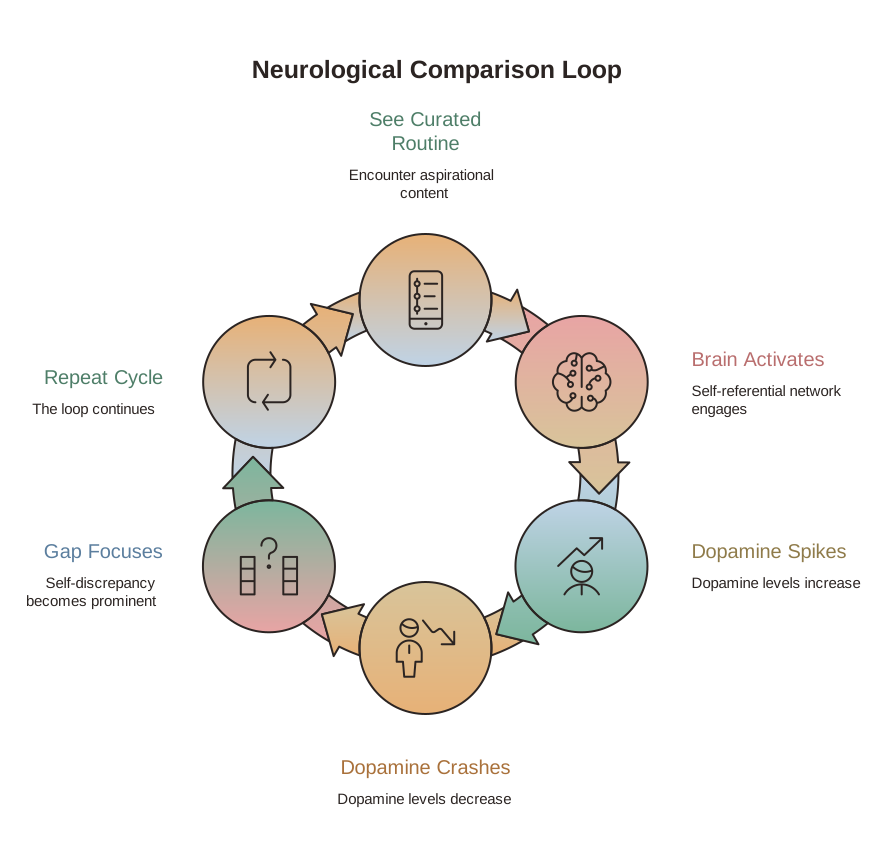
- Your attention turns to yourself.
The moment you see someone else's curated life, your mind starts measuring it against your own — your identity, your past, your future. Much of this comparison happens quickly and without deciding to do it.
- A lift — then a dip.
She has what I want. I could have that. This feels like motivation. But it's closer to wanting than doing, and the lift can fade into feeling vaguely worse than before you opened the app.
- It can register as a threat.
Coming off worse in a comparison on something you care about can feel like a small status threat. You may not notice it consciously — just a little tension. The scroll continues.
- The gap becomes the focus.
Instead of feeling motivated by what's possible, your attention locks onto the distance between where you are and where “That Girl” is. Psychologists call this self-discrepancy theory (Higgins, 1987) — and the bigger that gap feels, the more it correlates with depression and anxiety, not motivation.
This loop can repeat dozens of times in a single scrolling session. Multiply that across weeks and months, and you begin to understand why so many people report feeling simultaneously inspired and exhausted by wellness content.
The Perfectionism Trap Hidden Inside the Trend
“That Girl” content doesn't just trigger comparison. It packages perfectionism as self-care.
Every element of the aesthetic is polished. The meals are colorful and symmetrical. The workouts are intense but graceful. The journaling scenes are softly lit. Even the “candid” moments feel composed. The implicit message is that discipline should look beautiful — and if yours doesn't, you're not doing it right.
Psychologists distinguish between two types of perfectionism:
- Adaptive perfectionism: High standards with flexibility. You aim high and recover well from setbacks.
- Maladaptive perfectionism: High standards with rigidity. You aim high, and any deviation feels like failure.
“That Girl” culture quietly promotes the maladaptive version. Miss one morning workout? You fell off. Had a lazy Sunday? You're not “her.” The all-or-nothing framing makes it nearly impossible to build the very habits the trend promotes — because real habit formation requires forgiveness of imperfection, and “That Girl” leaves no room for it.
Perfectionism is not the pursuit of excellence. It's a shield against the fear of judgment. — Brené Brown
Who “That Girl” Actually Is — and Isn't
The dominant “That Girl” archetype on TikTok skews young, thin, white, and financially comfortable. The lifestyle it depicts — organic groceries, gym memberships, morning leisure time, aesthetic apartment — requires significant economic and social privilege.
This matters psychologically because the content is presented as universally achievable. The implicit message is: anyone can become That Girl if they want it enough. This erases structural realities and places the burden of inequality on individual willpower — a cognitive distortion with a name: the fundamental attribution error.
When viewers who can't access “That Girl” living don't become “That Girl,” they don't blame the system. They blame themselves.
What the Research Shows
Experiments on idealized social media content point the same way. Brief exposure to curated, idealized posts has been found to produce lower positive affect and reduced body satisfaction, and ten minutes of browsing Facebook left young women in a more negative mood than browsing a neutral website.
In one experiment, women who viewed idealized influencer posts felt worse about their bodies than women who viewed nature images. Not inspired. Not motivated. Worse.
The irony is almost poetic: a trend built around optimizing your wellbeing can end up lowering it for many of its viewers.
So Is All of It Bad? The Nuance Matters
Not all “That Girl” content is created equal. Some of it genuinely promotes habits with robust scientific backing:
- Regular exercise is one of the most well-supported interventions for depression and anxiety in the psychological literature.
- Sleep prioritization has profound effects on cognitive function, emotional regulation, and physical health.
- Journaling has been shown to reduce rumination and improve emotional processing.
- Hydration, nutrition, and movement are not trends — they are biology.
The habits aren't the problem. The packaging is.
When healthy behaviors are wrapped in an aesthetic of effortless perfection and presented as all-or-nothing identity markers, they stop being tools and become performance. And performance-based wellness is the enemy of sustainable change.
How to Use the Trend Without Letting It Use You
If “That Girl” content genuinely motivates you, you don't have to quit it entirely. But a few psychological tools can help you engage with it differently:
1. Audit your after-feeling
Notice how you feel 30 minutes after watching wellness content — not during. After, you get the real signal. If you consistently feel deflated, discouraged, or anxious, that content is costing you more than it's giving you.
2. Practice “inspiration vs. comparison” labeling
When you see a routine you admire, pause and ask: Am I feeling inspired (I could try that), or am I comparing (I'm not enough)? The former energizes. The latter drains. Training yourself to notice the difference gives you back your agency.
3. Follow “process” creators, not “perfection” creators
Seek out content that shows the mess — the missed workouts, the bad skin days, the 8am starts instead of 5am. Watching someone navigate imperfection gives you a more realistic model than watching someone perform flawlessness.
4. Build your routine off-camera
If you start your morning routine and immediately think this would make good content, you've shifted from doing to performing. The most durable habits are built in private, not produced for an audience — even an imaginary one.
5. Redefine “that girl” for your actual life
What does your best self actually look like — not filtered through TikTok's aesthetic? She probably sleeps enough. She's kind to herself when she misses a day. She moves her body in ways she enjoys. She eats food that makes her feel good, not just food that photographs well. She exists fully offline.
She doesn't need an audience to be real.
The Bottom Line
The “That Girl” trend isn't evil. But it's not neutral either.
It packages genuine self-improvement in an aesthetic that triggers comparison, promotes maladaptive perfectionism, erases privilege, and — if the research on idealized social media content is any guide — can leave many viewers feeling worse.
Understanding the psychology doesn't mean rejecting the desire to grow. It means getting smarter about where you source your motivation, how you consume aspirational content, and what “becoming better” actually means to you — separate from what it looks like on someone else's feed.
Your brain was wired to compare. That's not a character flaw. But you can learn to catch the comparison loop before it catches you — and choose what you do next.
That's not “That Girl.” That's something more valuable: self-awareness.
Frequently asked questions
What is the 'That Girl' trend on TikTok?
The 'That Girl' trend features content showing an idealized morning routine — 5am wake-ups, cold plunges, green juices, gym sessions, journaling — presented as the formula for becoming your best self. While the individual habits have merit, the trend packages them into a performance of productivity that drives social comparison.
Why does the That Girl aesthetic cause anxiety?
Because social comparison is automatic and largely unconscious. When you see someone's curated morning routine, your brain compares your reality to their highlight reel. Research on upward social comparison shows this often lowers self-evaluation — not because you're actually worse off, but because comparison distorts the frame of reference.
How does social media comparison affect mental health?
Exposure to idealized social media content is associated with lower mood, body dissatisfaction, and reduced self-esteem — particularly for frequent users. The mechanism is upward social comparison: measuring yourself against people who appear to be exceeding you on dimensions you care about.
Is the That Girl lifestyle realistic or harmful?
The individual habits (sleep, movement, nutrition) are beneficial. The harmful element is the all-or-nothing framing — the implication that if you're not doing all of it perfectly, you're failing. This triggers perfectionism and self-criticism, which are counterproductive to actual mental wellness and sustainable habit building.
Like what you're reading?
Continue your wellness journey
Reframe negative thoughts in 60 seconds — free to start in the MindLift app.


Free to start · premium optional