
Turn this into a daily habit — free to start in the MindLift app:
Ever noticed this?
One awkward conversation stays with you for days. One mistake at work feels bigger than ten successes. One critical comment echoes in your mind long after dozens of compliments have faded.
If that sounds familiar, you're not broken, pessimistic, or "too sensitive." Your brain is simply doing what it evolved to do.
Your Brain Has a Built-In Negativity Bias
Thousands of years ago, your ancestors survived because they noticed danger. Ignoring a beautiful sunset wasn't a problem. Ignoring a predator could be fatal.
So your brain evolved to pay more attention to threats than to pleasant experiences.
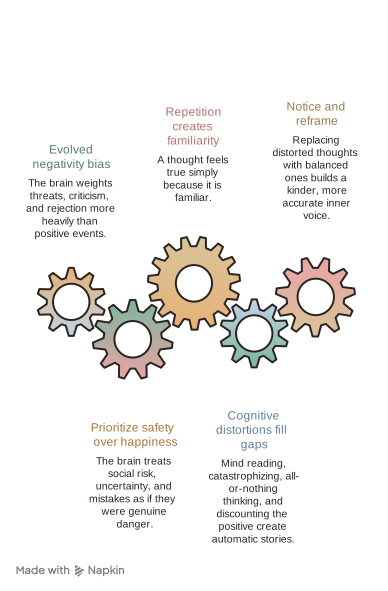
Psychologists call this the negativity bias. Even today, your brain naturally gives more weight to criticism, uncertainty, embarrassment, and rejection than to positive events.
That bias helped humans survive. It doesn't always help us thrive.
Why Negative Thoughts Feel So Convincing
Negative thoughts don't usually sound dramatic. Instead, they sound reasonable.
- "I'm probably not good enough."
- "They haven't replied… maybe they're upset."
- "I'll probably mess this up."
- "Everyone else seems to have it figured out."
The problem is that your brain often mistakes familiarity for truth. The more often you think something, the easier it becomes for your brain to believe it.
Over time, these thoughts become mental shortcuts that run automatically.
Your Brain Isn't Looking for Happiness — It's Looking for Safety
This surprises many people. Your brain's first priority isn't confidence or happiness. It's protection.
That means it constantly scans for:
- possible rejection
- possible failure
- possible embarrassment
- possible danger
Unfortunately, modern life rarely involves life-threatening danger. Instead, your brain treats social situations, uncertainty, criticism, and mistakes as if they're major threats.
Cognitive Distortions: When Your Brain Fills in the Blanks
Our brains don't just notice negative information. They also create stories from incomplete evidence. Some of the most common thinking traps include:
Mind Reading
"They think I'm annoying." — without actually knowing.
Catastrophizing
"If I make one mistake, everything will fall apart."
All-or-Nothing Thinking
"If I'm not perfect, I'm a failure."
Discounting the Positive
"They were just being nice." — you dismiss compliments while accepting criticism as fact.
These patterns feel believable because they happen automatically. But automatic doesn't mean accurate.
The Good News: Your Brain Can Learn New Patterns
Just as negative thinking becomes automatic through repetition, healthier thinking can too. Every time you notice a distorted thought and replace it with a more balanced one, you're strengthening a different mental pathway.
This doesn't mean pretending everything is positive. It means learning to question thoughts that aren't supported by evidence.
Instead of "I always fail."
Ask: "Is that actually true?"
Instead of "Everyone is judging me."
Ask: "What evidence do I have?"
Small shifts repeated consistently can gradually change how your brain responds.
Three Simple Ways to Challenge Negative Thoughts
1. Pause Before Believing Every Thought
Not every thought deserves your trust. Sometimes it's just your brain trying to protect you.
2. Look for Evidence
Ask yourself: What facts support this thought? What facts contradict it?
3. Talk to Yourself Like Someone You Care About
Most people would never speak to a friend the way they speak to themselves. Notice your inner dialogue. Would you say those words to someone you love?
Building a Kinder Inner Voice
Changing lifelong thinking patterns doesn't happen overnight. But it does happen through repetition. Daily reminders. Gentle reframes. Small moments of self-compassion.
The same brain that learned harsh self-talk can also learn a healthier one.
Ready to Retrain Your Inner Voice?
If you're tired of overthinking, self-doubt, and negative thought loops, MindLift helps you practice healthier thinking every day with personalized affirmations, CBT-inspired reframes, guided audio sessions, and daily mindset exercises.
Your brain learned these patterns through repetition. It can learn new ones the same way.
Frequently asked questions
Why does my brain focus on the negative?
It evolved to. The negativity bias is a survival mechanism: ancestors who paid closer attention to threats than to pleasant experiences were more likely to survive. So the brain still gives more weight to criticism, rejection, embarrassment, and uncertainty than to positive events — even when there is no real danger.
Why do negative thoughts feel so true?
Because the brain mistakes familiarity for truth. The more often you think something, the easier it becomes to believe and the more automatic it gets. Repetition makes a thought feel like a fact, even when it is not supported by evidence.
Is negativity bias a sign that something is wrong with me?
No. A strong pull toward negative thinking is normal and human — it does not mean you are broken, pessimistic, or too sensitive. It means your brain is doing the protective job it evolved to do. The goal is not to remove the bias but to stop automatically believing every thought it produces.
Can you actually retrain a negative-thinking brain?
Yes. Negative thinking becomes automatic through repetition, and healthier thinking can too. Each time you notice a distorted thought and replace it with a more accurate one, you strengthen a different mental pathway. Consistent, small reframes gradually change how the brain responds.
Like what you're reading?
Continue your wellness journey
Reframe negative thoughts in 60 seconds — free to start in the MindLift app.


Free to start · no account required
Mental Wellness Writers
The MindLift Wellness Team writes evidence-based content on CBT, self-talk, and everyday mental health tools.
Was this article helpful?