
Turn this into a daily habit — free to start in the MindLift app:
"Cognitive distortion" sounds like therapy-speak invented for Instagram carousels. It isn't. It's one of the oldest, most replicated observations in clinical psychology — and the research trail from a 1963 psychiatry journal to a 2021 analysis of millions of tweets is worth knowing, because it changes what you do with your own 2am thoughts.
Are cognitive distortions real, according to research?
Yes. Aaron Beck documented systematic thinking errors in depressed patients in 1963, and six decades of research has confirmed the pattern: distorted thinking is measurable, elevated in depression and anxiety, detectable even in social media language at population scale (Nature Human Behaviour, 2021), and — critically — modifiable through cognitive restructuring, a core active ingredient of CBT.
Beck (1963); Bathina et al. (2021)
1963: a psychoanalyst notices the thoughts arrive first
Aaron Beck was a Yale-trained psychoanalyst doing orthodox dream analysis with depressed patients when he noticed something his training didn't predict: his patients' waking thoughts contained consistent, patterned errors. Not random negativity — structure. They read rejection into neutral faces. They generalized one failure into a life verdict. They discounted every success as a fluke while treating every setback as data. And these thoughts arrived automatically, before any deliberate reasoning, and dragged mood down after them.
His 1963 paper in the Archives of General Psychiatry catalogued these "idiosyncratic cognitive distortions" — arbitrary inference, selective abstraction, overgeneralization, magnification. Renamed and expanded over the years (catastrophizing, mental filtering, all-or-nothing thinking, mind reading), that list became the backbone of cognitive therapy and eventually CBT. If you've ever seen a thinking-traps list, you've seen Beck's 1963 observations with better branding.
What six decades of testing did to the idea
Plenty of 1960s psychology died in the replication era. This construct didn't. Three findings define the modern evidence:
Distortions are measurable and track symptoms. Validated scales can reliably score distorted thinking, and scores rise with depression and anxiety severity — exactly what Beck's model predicted. By his own 40-year retrospective in 2005, the cognitive model had accumulated support across hundreds of studies, and therapies built on it had become the most-tested in psychiatry — we've covered that evidence base separately.
The process is transdiagnostic. Repetitive negative thinking built on distorted appraisals isn't unique to depression — Ehring and Watkins showed the same machinery running across anxiety, insomnia, and other conditions. Same engine, different content: the anxious version catastrophizes forward, the depressed version overgeneralizes backward.
It shows up at population scale. The most striking modern test: in 2021, researchers in Nature Human Behaviour analyzed millions of tweets and found that people with a reported depression diagnosis used distortion-typical language patterns — the linguistic signatures of "everyone always," "I never," "this proves" — significantly more than matched controls. A clinical observation from 12 patients in 1963, visible sixty years later in the language of the entire internet.
The part the carousel posts skip: you're supposed to have them
Distortions are not malfunctions. They're exaggerations of shortcuts every brain uses — speed-over-accuracy trade-offs, tilted by a built-in negativity bias that treats threats as more informative than good news. Catastrophizing is threat forecasting with the gain turned too high. Mind reading is social prediction doing its job badly. What separates an ordinary Tuesday from a clinical problem isn't whether these patterns fire — it's how often, how intensely, and how much authority you grant them.
That reframe matters practically, because it changes the goal. You will not achieve distortion-free thinking; nobody has it. The trainable skill is catching the distortion while it's running — and the research on that is the encouraging part.
From naming to reframing: what actually changes
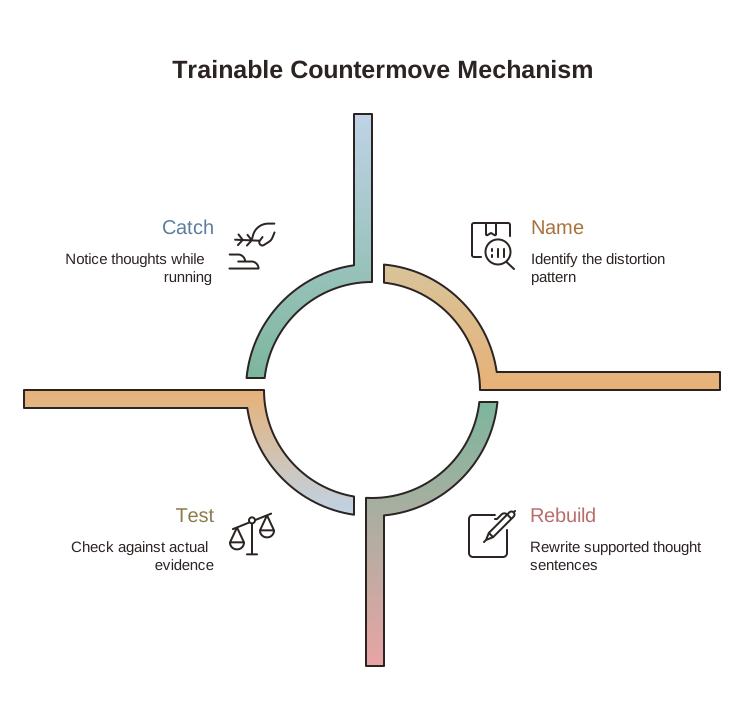
Across CBT's trial record, cognitive restructuring — catch the automatic thought, name the error, test it, rebuild it — is a core active ingredient. And the operation has a visible neural signature: reframing engages prefrontal control regions and quiets the amygdala, with the skill strengthening over weeks of practice. The distortion still fires first — it always will — but the catch-and-reframe gets faster until it runs almost in parallel.
The practical bottleneck was never knowledge. Most people can recite "catastrophizing" by now. It's that the distortion fires at 11:47pm mid-spiral, and the worksheet is in a drawer. The rep has to be available in the moment the thought is.
Bottom line
Cognitive distortions have survived sixty years of scientific scrutiny: documented in 1963, measurable since the 1980s, transdiagnostic by the 2000s, detectable in mass language data by 2021. They're universal, systematic, and — this is the actionable part — responsive to a specific, trainable countermove. You don't argue with the feeling. You catch the thought, name the pattern, and rebuild the sentence. Sixty years of research says that's the rep that works.
MindLift spots the distortion in the exact thought you type and returns a Realist, Growth, and Compassionate reframe in about 60 seconds. Free to start, premium available. Try MindLift — free to start →
Frequently asked questions
What are cognitive distortions?
Cognitive distortions are systematic errors in how thoughts represent reality — patterns like catastrophizing (assuming the worst outcome), all-or-nothing thinking (one flaw means total failure), mind reading (being sure you know what others think), and mental filtering (only registering the negative). The concept comes from Aaron Beck's 1963 clinical research, which found these patterns appearing consistently in depressed patients' automatic thoughts.
Are cognitive distortions scientifically valid?
Yes — this is one of the better-supported constructs in clinical psychology. Beck's original observation has been replicated and extended for six decades: distorted thinking can be reliably measured, is elevated in depression and anxiety, and shows up transdiagnostically across conditions. In 2021, researchers even detected it at population scale, finding significantly higher rates of distortion-typical language in the social media posts of people with depression across millions of tweets.
Does everyone have cognitive distortions?
Yes. Distortions are exaggerated versions of normal cognitive shortcuts — the brain's speed-over-accuracy trade-offs, sharpened by its built-in negativity bias. Everyone catastrophizes sometimes; everyone mind-reads. What research links to depression and anxiety is not having distortions but their frequency, intensity, and how much you believe them. The clinical line isn't "distorted vs. clear thinker" — it's how often the distortion runs unchallenged.
Can you actually fix cognitive distortions?
The evidence says you can change your relationship to them, which is what matters. Cognitive restructuring — catching the thought, naming the distortion, testing it against evidence, and generating a more accurate version — is a core active ingredient in CBT's six decades of trial results. Neuroimaging of the same operation shows prefrontal control regions engaging while the amygdala's response drops. The distortions still fire; you get faster at catching them, and they lose authority.
What is the most common cognitive distortion?
Research and clinical reports consistently put catastrophizing, all-or-nothing thinking, and overgeneralization among the most frequent — with catastrophizing especially central to anxiety and mind reading to social anxiety. In practice most spiraling thoughts stack several at once: "I froze in the meeting (filtering), everyone noticed (mind reading), I always do this (overgeneralization), this job is over (catastrophizing)." That stacking is why one caught thought can defuse a whole spiral.
Like what you're reading?
Continue your wellness journey
Reframe negative thoughts in 60 seconds — free to start in the MindLift app.


Free to start · premium optional