
Turn this into a daily habit — free to start in the MindLift app:
For a few months last year, you couldn't sit through a staff meeting, walk past a group of teenagers, or scroll for ninety seconds without someone saying "6-7." It didn't mean anything. Nobody could tell you what it meant — including, by most accounts, the people saying it. That was sort of the whole point. And it's also exactly why it stuck.
By January it was over. Word of the year, then a banished word, then gone. If you've got a kid, a niece, a nephew, or just a group chat, you lived through it. And somewhere in there you probably had the thought: how is a phrase this dumb still running through my head? I didn't even choose to remember it.
A thought keeps repeating not because it's true, important, or even makes sense, but because it's simple, repetitive, and unresolved — the same mechanism behind earworms. In CBT terms this pattern is rumination, and trying to suppress it reliably backfires. What interrupts a loop isn't willpower; it's giving the thought somewhere to go, which is why naming the pattern underneath it works better than fighting it.
That question is worth sitting with for a second, because the answer isn't really about the meme. It's about how loops work — and it's the same mechanism behind a much less funny kind of repeat: the thought that replays at 2am, or right before you hit send, or every time a certain name comes up in conversation. Different content. Same wiring.
Repetition doesn't need a reason
Earworms — the technical term is involuntary musical imagery — don't require a song to be good, meaningful, or even something you like. They just need to be simple, repetitive, and slightly unresolved. A melody that loops back on itself without quite landing tends to stick harder than one that resolves cleanly, because your brain treats "unfinished" as something to hold onto. That's a documented memory effect, not a personal failing: things you haven't mentally closed the loop on get replayed more than things you have.
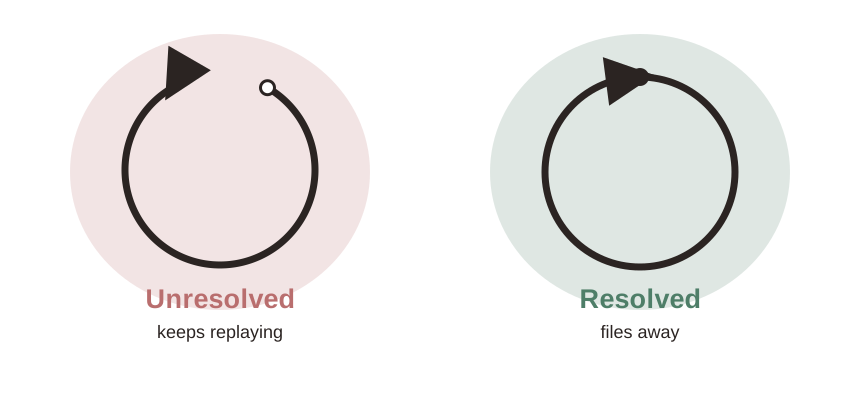
"6-7" had that quality almost perfectly. Two syllables, no ending, no meaning to file away and be done with. Your brain couldn't resolve it, so it kept surfacing it instead.
Harsh thoughts work the same way — they're just not funny.
Your thought loops run on the same track, different cargo
In CBT terms, this pattern has a name: rumination. Not the same as thinking something through — rumination is when you replay the same distressing thought without it going anywhere, over and over, without new information or resolution. It's often paired with a distortion called mental filtering, where one detail (the one critical comment, the one thing you said wrong, the one look someone gave you) gets isolated and looped while everything else that happened gets quietly dropped from the reel.
"I always mess this up." "They probably think I'm annoying." "I shouldn't have said that." These loop for the exact same structural reason "6-7" did — short, unresolved, easy to trigger, hard to file away — except each replay costs you something instead of being a dumb bit with your coworkers.
If you want to find out which loop you personally default to, the free mental loop quiz sorts it into one of a few common circuits in about two minutes. And if it's the specific sentences that get you — "I always…", "They probably…" — the science of self-talk and the brain goes deeper into why those exact phrasings feel so convincing.
Why telling yourself to stop doesn't work
There's a classic bit of psychology research where people are told not to think about a white bear for five minutes. Almost everyone thinks about the white bear — more than if they'd never been told anything at all. Actively suppressing a thought tends to backfire and bring it back stronger. This is called ironic process theory, and it's worth knowing about mainly because of what it rules out: you are not looping on a thought because you're weak-willed or bad at managing your mind. Suppression was never going to work. It doesn't work on anyone.
What actually interrupts a loop
If suppression doesn't close a loop, what does? Roughly: giving the thought somewhere to go, instead of fighting it or waiting for it to get bored and leave. An unresolved loop keeps replaying because it's unresolved — so resolving it, even briefly, tends to quiet it down.
That's the whole idea behind MindLift's Mini-Reframe. You type the exact thought that's looping — word for word, no journaling prompt, no explaining yourself — and in about 60 seconds you get back a response that's actually believable, not a generic "you've got this." Each reframe is tagged with the pattern underneath it (a Realist read, a Growth angle, a Compassionate one), so you're not just getting a nicer sentence — you're seeing the shape of the loop you're stuck in, which is most of what it takes to stop feeding it.
It's not therapy, and it's not meant to replace it — think of it as something to do in the moment a loop starts, rather than something you save up for a weekly session. Most of the week doesn't have a therapist in it. The loop doesn't check your calendar before it starts.
If a thought loop is running most of the day, most days, or coming with intrusive images or urges that feel out of your control, that's worth bringing to a licensed professional rather than working through alone — MindLift is built for the everyday version of this, not a substitute for that kind of support.
Next time you catch yourself replaying something at 11pm and can't figure out why it won't let go — it's not a character flaw. It's an unresolved loop looking for an ending. Give it one.
Frequently asked questions
Is it normal to have the same thought over and over?
Yes — occasional looping is a normal feature of how memory handles unresolved things, not a sign something's wrong. It becomes worth addressing when the loop is frequent, distressing, or getting in the way of your day.
What's the difference between overthinking and rumination?
Overthinking usually still moves — you're turning a decision over, weighing options. Rumination is more static: the same thought replays without new angles or resolution, which is what makes it feel stuck rather than productive.
Why can't I just stop thinking about it?
Actively trying to suppress a thought tends to bring it back more, not less — this is well-documented in psychology research (the "white bear" effect). Trying harder to not think about something isn't a willpower issue; it's how suppression works on everyone.
How do I interrupt a thought loop fast?
Give the thought somewhere to land instead of pushing it away — naming the pattern behind it and responding to it directly tends to close the loop faster than distraction or suppression. That's the mechanic behind MindLift's Mini-Reframe: type the thought, get a grounded response in about 60 seconds.
Like what you're reading?
Stop the spiral in real time
MindLift gives you a gentle CBT-based reframe the moment your thoughts start looping.


Free to start · premium optional