
Turn this into a daily habit — free to start in the MindLift app:
Quick Answer
How does the brain respond to self-talk?
Inner monologue draws on language production areas and self-referential networks, much like speech does. When self-talk is negative and repetitive, it can keep the body's stress response switched on, even when nothing in your environment has changed.
You're running late. Before you've even checked your phone, a voice in your head has already delivered a verdict: "Classic. You always do this."
That voice — your inner monologue — fires roughly 6,200 thoughts per day. Most of them you never consciously choose. Yet neuroscience is now revealing just how powerfully that stream of self-talk shapes your brain, your mood, and your nervous system — in real time.
What Actually Happens in Your Brain When You Talk to Yourself
Self-talk isn't just "thinking." Brain imaging studies show it activates overlapping networks — the default mode network (associated with self-referential thought), Broca's area (language production), and the prefrontal cortex (evaluation and judgment). In other words, inner speech draws on some of the same language systems as talking out loud.
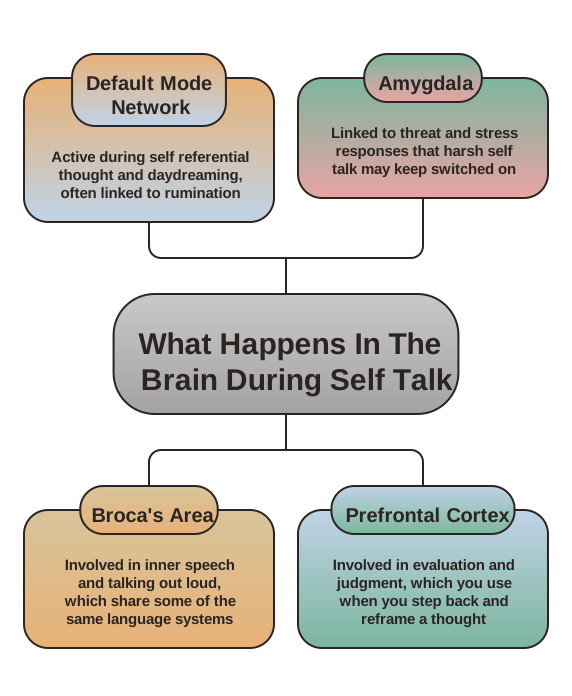
When self-talk is negative and repetitive, research on worry and rumination suggests it can prolong the body's stress response — keeping heart rate and stress hormones elevated even if nothing in your environment has changed. The thought itself becomes the stressor.
The Two Types of Self-Talk — and Why One Wires You for Anxiety
Researchers broadly categorize self-talk as instructional (directing attention and behavior) or motivational (affecting effort and emotion). Neither is inherently negative. But a third pattern — ruminative self-talk — is where things go wrong.
Ruminative self-talk is negatively valenced, repetitive, and past- or future-focused — "why did I say that," "what if everything goes wrong." Unlike constructive reflection, it doesn't move toward resolution. It just amplifies distress. And over time, it makes pessimistic thinking more habitual. This is closely related to what happens when overthinking hijacks your decisions.
The Neuroscience of Reframing: How CBT Changes Brain Structure
Cognitive Behavioral Therapy (CBT) — the gold-standard psychological treatment — works by teaching you to identify and reframe distorted thoughts. What's remarkable is that this doesn't just change how you feel. It visibly changes your brain.
Neuroimaging studies of CBT for anxiety disorders have reported changes in activity in regions involved in fear and emotion regulation, such as the amygdala and prefrontal cortex. You're not suppressing thoughts — you're practicing an alternative route.
"I completely froze in that meeting. Everyone thinks I'm incompetent."
"I struggled with one answer. That doesn't define my competence — and most people were focused on their own performance."
The reframe doesn't deny the experience. It challenges the catastrophic conclusion — and with repetition, that becomes your brain's new habit. For a deeper look at the specific patterns that make thoughts distorted, see thinking traps and cognitive distortions.
The 60-Second Window: Why Speed of Interruption Matters
Here's the critical insight most mental health content misses: the earlier you interrupt a negative thought spiral, the easier it tends to be to redirect. Once a spiral gains momentum — after several minutes of rumination — emotion runs higher and reframing becomes harder to reach.
This is the design philosophy behind MindLift: 60-second, in-the-moment thought interruption. Not a scheduled journaling session. Not a 20-minute meditation. A brief, targeted disruption that catches the thought while it's still catchable — and uses your own words to reframe it, making it far more credible to your brain than a generic affirmation.
How to Start Rewiring Your Inner Dialogue Today
The science points to four high-leverage practices:
Name it. Research by Matthew Lieberman at UCLA shows that simply labeling a negative emotion ("I'm feeling anxious") reduces amygdala activation. Putting words to a feeling is itself a form of regulation.
Use your name. Studies by Ethan Kross found that self-distancing — talking to yourself in the third person ("What would you tell a friend in this situation?") — significantly reduces rumination and increases wise reasoning.
Interrupt fast. Don't wait until you're deep in a spiral. Catch the thought at the first sign of overthinking and challenge it before the emotional hijack takes hold. This is the principle behind not every thought deserving a response.
Repeat the reframe. A single reframe doesn't change a habit. But consistent, daily practice — the same way you'd build any habit — gradually does. The research on neuroplasticity and rewiring your mind explains exactly why repetition is the mechanism.
Final Thought
Your inner dialogue isn't just background noise. It's a neurological event — one that either deepens grooves toward anxiety or builds pathways toward regulation. The science is clear that you can change it. The question is whether you catch the thought early enough to do so.
That's the window. And 60 seconds is enough.
Frequently asked questions
What is self-talk and how does it affect the brain?
Self-talk is your internal monologue — the stream of roughly 6,200 thoughts per day that run through your mind. Brain imaging shows it activates overlapping networks including the default mode network, Broca's area (language production), and the prefrontal cortex. When self-talk is negative and repetitive, it can keep the body's stress response activated even when nothing in your environment has actually changed.
What is ruminative self-talk?
Ruminative self-talk is a pattern of negatively valenced, repetitive inner dialogue that is past- or future-focused without moving toward resolution. Researcher Susan Nolen-Hoeksema at Yale described it as mentally pressing a bruise to check if it still hurts — on a loop. Unlike constructive reflection, rumination amplifies distress and over time makes pessimistic thinking a more habitual response.
Does CBT reframing actually change your brain?
Neuroimaging studies of CBT for anxiety disorders have reported changes in activity in brain regions involved in fear and emotion regulation, such as the amygdala and prefrontal cortex. You're not suppressing thoughts; you're practicing an alternative response. The reframe doesn't deny the experience — it challenges the catastrophic conclusion, and with repetition, that becomes the brain's new habit.
What is the 60-second window for thought interruption?
The 60-second window refers to the early stage of a negative thought before it gains spiral momentum. Catching a thought at the spark — rather than after several minutes of rumination — tends to make reframing easier, because the more intense an emotion gets, the harder it is to reach a different interpretation.
How do you rewire negative inner dialogue?
Four practices with strong research support: (1) Label the emotion specifically — Matthew Lieberman's UCLA research shows that naming a feeling reduces amygdala activation. (2) Use self-distancing — Ethan Kross found that talking to yourself in the third person reduces rumination and increases wise reasoning. (3) Interrupt early — catch the thought before the emotional hijack takes hold. (4) Repeat the reframe — a single reframe doesn't change a habit, but consistent daily practice gradually does.
Like what you're reading?
Continue your wellness journey
Reframe negative thoughts in 60 seconds — free to start in the MindLift app.


Free to start · premium optional