
Turn this into a daily habit — free to start in the MindLift app:
Are you looking for the right words of affirmation for men — something genuine, not cheesy?
Many men don't openly ask for reassurance. But that doesn't mean they don't need it.
In fact, research in cognitive psychology shows that positive verbal reinforcement can counter distorted thinking patterns and strengthen emotional resilience. Supportive language also reduces emotional threat responses and improves regulation.
The right words can: Boost his confidence • Strengthen emotional safety • Deepen intimacy • Reduce defensiveness • Improve long-term relationship satisfaction
Below, you'll find 100 words of affirmation examples for men — organized by situation.
Why Words of Affirmation Matter for Men
Words of affirmation matter for men because much of the praise men hear is tied to output — the promotion, the fixed tap, the paid bill — while the inner critic keeps score on everything else. A specific, respect-based sentence interrupts that script and tells him who he is, not only what he did.
1. Men Often Receive Performance-Based Praise
Many boys grow up hearing praise tied to winning, achieving, providing, and fixing problems. Rarely do they hear affirmation about emotional strength, character, effort, or vulnerability.
Words of affirmation help separate who he is from what he accomplishes.
2. Affirmation Counters the Critical Inner Voice
Cognitive distortions like all-or-nothing thinking, catastrophizing, and "should" statements often fuel self-pressure.
A man may think:
- "I should be further by now."
- "I can't mess this up."
- "I'm not doing enough."
“I should be further by now.”
Show the answer
Should statement. Cognitive distortions like all-or-nothing thinking, catastrophizing, and "should" statements often fuel self-pressure.
Hearing: "I'm proud of how hard you're trying." — directly challenges that internal script.
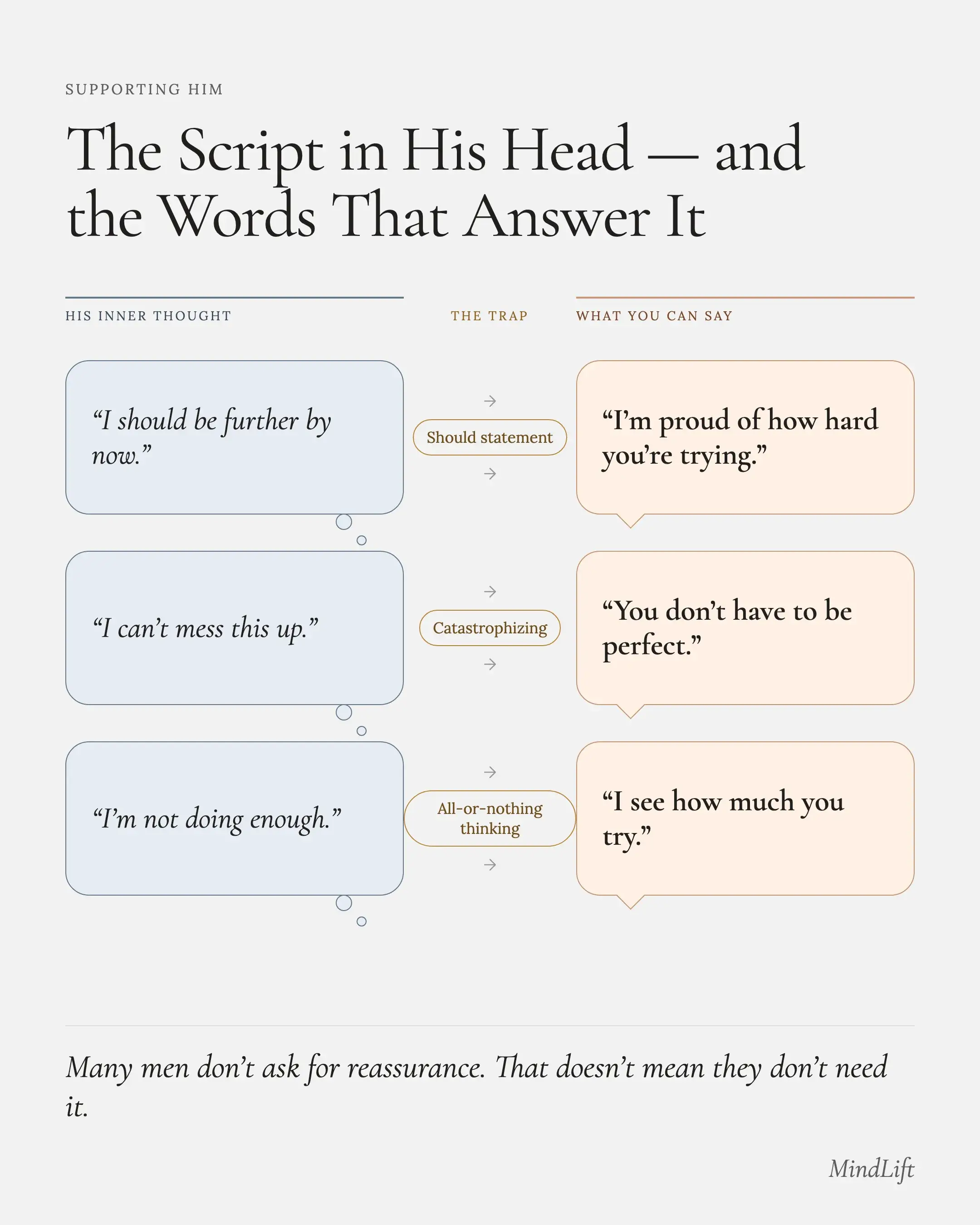
Naming the trap is the part that makes the words work. In cognitive behavioural therapy, the skill is called reframing: you notice the thought, name the pattern inside it, and answer it with something more accurate. "I should be further by now" turns into "I'm not where I planned, and I'm still moving." Your sentence can model that kind of answer, but it works best alongside his own. If he wants to practise it himself, MindLift lets him write the thought down, names the pattern behind it and suggests a reframe he can save for the next time it shows up.
3. Respect-Based Affirmations Land Deepest
For many men, affirmation feels strongest when it communicates: Respect • Trust • Belief • Appreciation
Performance Praise
- Tied to winning, achieving, providing, and fixing problems
- Rarely says anything about emotional strength, character, effort, or vulnerability
- Ties who he is to what he did
Respect-Based Affirmation
- Communicates respect, trust, belief, and appreciation
- Separates who he is from what he accomplishes
- Directly challenges the internal script that keeps score
100 Words of Affirmation Examples for Men
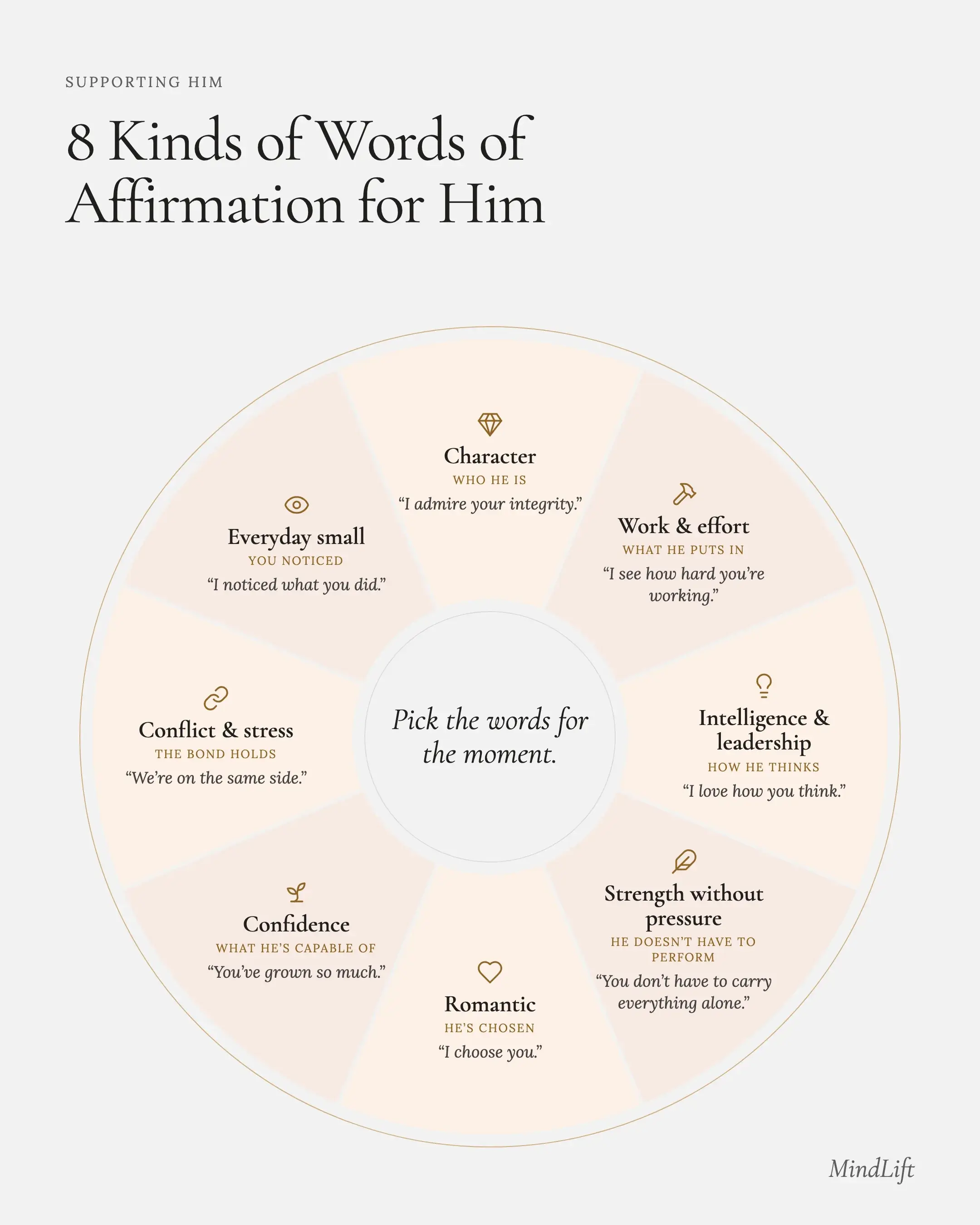
The 100 words of affirmation examples below are organized by what they affirm — character, work and effort, intelligence, strength without pressure, romance, confidence, conflict, and daily life — so you can pick the line that fits your man and the moment instead of reaching for a generic compliment.
| Category | What it affirms | How many | One from the list |
|---|---|---|---|
| Character-based | Who he is | 15 | "I admire your integrity." |
| Work & effort | What he puts in | 15 | "I see how hard you're working." |
| Intelligence & leadership | How he thinks and decides | 15 | "I love how you think." |
| Strength without pressure | That he doesn't have to perform | 10 | "You don't have to carry everything alone." |
| Romantic | That he's chosen | 15 | "I choose you." |
| Confidence-boosting | What he's capable of | 10 | "You've grown so much." |
| During conflict or stress | That the bond holds | 10 | "We're on the same side." |
| Everyday small | That you noticed | 10 | "I noticed what you did." |
❤️ Character-Based Affirmations
- I admire your integrity.
- You're dependable.
- You're steady.
- You have a strong heart.
- You're thoughtful.
- You're patient.
- You show up consistently.
- You're reliable.
- You're grounded.
- You're trustworthy.
- I respect you.
- You handle things with maturity.
- You're growing.
- You're resilient.
- You're becoming your best self.
💼 Work & Effort Affirmations
- I see how hard you're working.
- I'm proud of your dedication.
- You don't give up easily.
- Your effort matters.
- You're building something meaningful.
- You take responsibility seriously.
- I admire your discipline.
- You stay focused.
- You provide stability.
- You care deeply about doing things well.
- You've made real progress.
- You're capable.
- I trust your decisions.
- You handle pressure well.
- You're ambitious in a healthy way.
🧠 Intelligence & Leadership Affirmations
- I love how you think.
- You solve problems calmly.
- You're strategic.
- You make thoughtful decisions.
- You stay level-headed.
- You see the bigger picture.
- I value your perspective.
- You lead naturally.
- You handle challenges wisely.
- You're sharp.
- I respect how you analyze situations.
- You think things through.
- You bring clarity.
- You adapt quickly.
- You stay composed under stress.
🛡 Strength Without Pressure
- You don't have to carry everything alone.
- I'm on your team.
- You're safe with me.
- You don't need to prove anything.
- I appreciate your vulnerability.
- You're allowed to rest.
- You don't have to be perfect.
- I see how much you try.
- You're doing better than you think.
- You matter to me.
💕 Romantic Words of Affirmation for Him
- I choose you.
- I feel lucky to love you.
- You make me feel secure.
- I'm grateful for you.
- You make hard days easier.
- I admire you deeply.
- You make my life better.
- I love the way you love me.
- You're attractive to me.
- I love you.
- You're my person.
- I'm proud to be with you.
- I feel safe with you.
- You inspire me.
- I respect the man you are.
🔥 Confidence-Boosting Affirmations
- You've grown so much.
- You handled that well.
- You can do this.
- I believe in you.
- You've overcome a lot.
- You're stronger than this challenge.
- You've got this.
- You learn from setbacks.
- You bounce back quickly.
- I trust your instincts.
🧩 During Conflict or Stress
- We'll figure this out together.
- I still respect you.
- I value our relationship.
- I care about your feelings.
- You matter even when we disagree.
- I appreciate you listening.
- I don't doubt your intentions.
- I see your effort.
- We're on the same side.
- I choose you, even in hard moments.
🌱 Everyday Small Affirmations
- Thank you for today.
- I noticed what you did.
- That meant a lot to me.
- I appreciate you showing up.
- I'm proud of your effort.
- You handled that calmly.
- I admire your consistency.
- I see your growth.
- I trust you.
- You're enough as you are.
How to Make Words of Affirmation Feel Authentic
Words of affirmation feel authentic when they are specific, tied to effort or character rather than results, and repeated often enough to become believable. A vague compliment slides off; a precise observation about something he actually did lands, because it proves you were paying attention.
For affirmation to land:
- ✔ Be specific
- ✔ Focus on character, not just success
- ✔ Tie praise to effort
- ✔ Speak it consistently
Instead of: "You're amazing."
Try: "I really admired how patient you were during that conversation."
Specific = believable.
Final Thoughts: Affirmation Builds Emotional Safety
Words of affirmation for men are not about feeding an ego; they build emotional safety. Each honest, specific sentence tells him he is respected, secure, trusted and seen — and over time that steady signal rewires the inner script from "I have to earn this" to "I am already enough".
In practice, that comes down to four things:
- Respect
- Emotional security
- Trust
- Recognition
Men often carry silent pressure to perform, provide, and protect.
Sometimes the most powerful thing you can say is:
"I see you. And I respect you."
Frequently asked questions
What are words of affirmation for men?
Words of affirmation for men are genuine, specific verbal statements that communicate respect, trust, belief, and appreciation. Unlike generic praise, effective affirmations for men focus on character, effort, and emotional strength rather than just accomplishments or performance.
Why do men need words of affirmation?
Many men grow up receiving only performance-based praise tied to winning, achieving, and providing. Words of affirmation help separate who he is from what he accomplishes, counter the critical inner voice, reduce defensiveness, and strengthen emotional safety in relationships.
What type of affirmation resonates most with men?
Research shows that respect-based affirmations land deepest with many men. Affirmations that communicate respect, trust, belief, and appreciation tend to be more impactful than purely emotional or compliment-based statements.
How do I make words of affirmation feel authentic?
Be specific rather than generic, focus on character rather than just success, tie praise to effort, and speak consistently. Instead of 'You're amazing,' try 'I really admired how patient you were during that conversation.' Specific equals believable.
Can words of affirmation help with a man's mental health?
Yes. Research in cognitive psychology shows that positive verbal reinforcement can counter distorted thinking patterns like catastrophizing and all-or-nothing thinking, while strengthening emotional resilience and reducing the critical inner voice.
Like what you're reading?
Build kinder inner dialogue
The way you talk to yourself shapes every relationship. MindLift helps you soften that voice.


Free to start · premium optional