What are the male archetypes?
The male archetypes — also called masculine archetypes — are recurring personality patterns: ways of moving through the world that show up across cultures, stories, and generations.
The framework traces back to Carl Jung, and to Moore and Gillette's classic King–Warrior–Magician–Lover model of the mature masculine. You aren't assigned one at birth — one simply becomes your default.
Your default is the pattern that runs first under pressure — the steward who holds everything together, the builder who can't stop improving, the rebel who answers only to himself. It decides how you handle conflict, and it writes the sentence your inner voice repeats at 2am.
Each archetype in this guide covers three things: the gift (what this pattern does brilliantly), the shadow (how the same strength turns on you under stress — the King's steadiness becomes unreachability, the Hero's drive becomes worth-through-achievement), and the inner voice — the exact thought the archetype generates, because that thought is the practical thing you can catch and reframe.
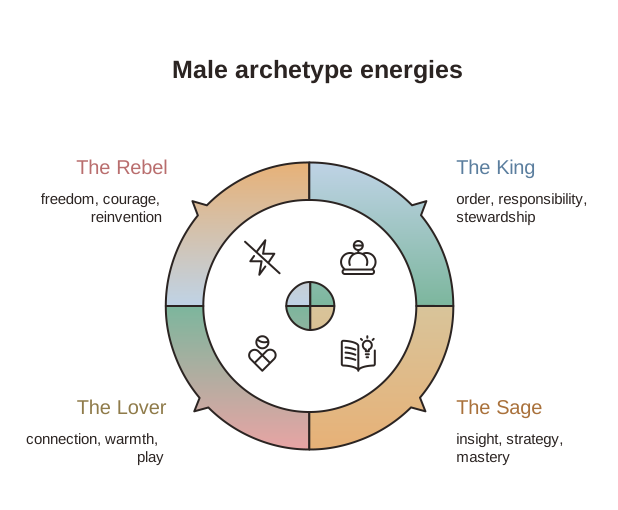
The twelve archetypes group into four families below. Read the one that stings a little — that's usually yours — or take the free quiz and get your dominant archetype in about five minutes.
The King family
The King family gathers the King, the Warrior, and the Protector — stewardship, drive through resistance, and vigilance that holds the line — and each of them pairs that gift with a predictable shadow pattern.
Order, discipline, and protection — the archetypes that hold things together.
The Sage family
The Sage family gathers the Sage, the Magician, and the Creator — depth that sees beneath the surface, mastery that makes the impossible practical, and craft that builds what he imagines — and each of them carries a predictable shadow alongside that gift.
Wisdom, mastery, and craft — the archetypes that understand and build.
The Lover family
The Lover family gathers the Lover, the Caregiver, and the Jester — devotion that feels life at full volume, generosity that shows up every time, and timing that brings lightness into heavy rooms — and each of them pays for that gift with a predictable shadow.
Depth, care, and levity — the archetypes that make people feel seen.
The Rebel family
The Rebel family gathers the Rebel, the Explorer, and the Hero — autonomy that answers to himself, curiosity that keeps to the edge of the map, and courage that rises to the moment — and each of them carries a predictable shadow alongside the gift.
Freedom, momentum, and proof — the archetypes that refuse the script.
All 12 archetypes at a glance
The same twelve, side by side — each with its family and the sentence it repeats when it's running the show.
| Archetype | Family | What it looks like | The inner voice |
|---|---|---|---|
| The King | King | Order, responsibility, stewardship | “It's on me.” |
| The Warrior | King | Discipline, drive, advancing through resistance | “Push through.” |
| The Protector | King | Vigilance, loyalty, holding the line | “Not on my watch.” |
| The Sage | Sage | Wisdom, depth, seeing beneath the surface | “Think it through.” |
| The Magician | Sage | Transformation, mastery, making the impossible practical | “There's a way.” |
| The Creator | Sage | Craft, vision, building what he imagines | “Build it better.” |
| The Lover | Lover | Depth, devotion, feeling life at full volume | “Stay close.” |
| The Caregiver | Lover | Steadiness, generosity, showing up every time | “They need me.” |
| The Jester | Lover | Levity, timing, lightness in heavy rooms | “Keep it light.” |
| The Rebel | Rebel | Autonomy, edge, answering to himself | “Says who?” |
| The Explorer | Rebel | Momentum, curiosity, the edge of the map | “What's out there?” |
| The Hero | Rebel | Courage, proof, rising to the moment | “Prove it.” |
How to find your archetype
Don't pick the archetype you'd like to be — look for the one whose shadow you recognise. The gift is easy to claim; the shadow is the tell. If reading "he can't tell the difference between resting and disappearing" makes you wince, you've found your family.
From there, the quiz separates the neighbouring archetypes (a King and a Protector share a family but sabotage themselves differently), and each archetype page shows the growth edge: how to keep the gift without paying the shadow's price.
Already know your archetype at his best? The second quiz in the ladder, what's your shadow archetype?, names the pattern that takes over when you feel cornered — and the sentence holding it in place.
Common questions
What are the 12 male archetypes?
The King, Warrior, and Protector (the King family — order and protection); the Sage, Magician, and Creator (wisdom and mastery); the Lover, Caregiver, and Jester (depth and connection); and the Rebel, Explorer, and Hero (freedom and proof). Each one pairs a core gift with a predictable shadow pattern.
Is this the King, Warrior, Magician, Lover framework?
It builds on it. King, Warrior, Magician, and Lover are the four mature masculine energies in Moore and Gillette's classic model; this guide extends the framework to 12 archetypes organized into four families, each with its own gift, shadow, and inner voice.
Can you be more than one archetype?
Yes — almost everyone carries two or three strongly. What matters is the dominant one: the pattern that runs first under pressure, before you've chosen a response. That's the archetype whose shadow is worth learning, because it's the one making decisions when you're tired, stressed, or cornered.
Are male archetypes scientifically proven?
Archetypes come from Jungian psychology — a framework for self-reflection, not a clinically validated personality measure. Treat your archetype as a mirror, not a diagnosis: the value is in recognising the thought patterns it names (especially the shadow), which you can then work with directly using evidence-based tools like CBT reframing.
Every archetype repeats one sentence. The King's:
“It's on me.”
MindLift's 60-second reframe:
“Which part of this is actually mine? I can stay the steady one and still hand over real weight.”
Get MindLift — free to start
Take the free archetype test
Which archetype is running your life? The free masculine archetype quiz (a 12 male archetypes test) takes about 5 minutes — 36 questions, no email, instant results with your dominant archetype, its shadow, and a growth reframe.
Exploring the framework for someone else — or curious about the other side? See the 12 female archetypes or take the female archetype quiz. Prefer a version without the masculine/feminine framing? Try the general 12 archetypes test. Want the full map? The complete archetypes guide covers all 12 types, shadows, and quizzes.