Turn this into a daily habit — free to start in the MindLift app:
Every man has a voice in his head that shows up under pressure — and it doesn't say anything new. It says the same sentence it has always said, in the same tone, at the same moments. That sentence is the most useful thing you can know about yourself.
Male archetypes usually get framed as identities: find your type, become it harder. That's exactly backwards, and it's why most archetype content is useless the day after you read it. An archetype isn't who you are. It's the default interpretation your brain reaches for when something goes wrong — and defaults can be changed.
What are the 12 male archetypes, and what does each one's inner voice sound like?
King (“It's on me”), Warrior (“Push through”), Protector (“Not on my watch”), Sage (“Think it through”), Magician (“There's a way”), Creator (“Build it better”), Lover (“Stay close”), Caregiver (“They need me”), Jester (“Keep it light”), Rebel (“Says who?”), Explorer (“What's next?”), Hero (“Prove it”). Each carries a matching cognitive distortion — the same strength with the volume stuck on.
The missing link: archetypes and cognitive distortions
Here's what almost every archetype guide leaves out. Your archetype doesn't just describe what you're good at — it predicts which specific thinking error you'll make under stress. Those errors have names. CBT has been cataloguing them for decades: catastrophizing, mind-reading, personalization, labeling, and the rest.
Those names are not marketing. Aaron Beck first catalogued the distortions in 1963, in the thinking of depressed patients[1], and later studies found the same habits of thought tracking with depressive symptoms in the general population[2]. A distortion is a learned interpretation — which is why a default pattern can predict it.
The link is not a coincidence. Each distortion is the archetype's own strength, run past the point where it helps. The Protector who spots danger early is running the machinery of catastrophizing. The Creator who sees the gap between the work and the vision is running the machinery of discounting the positive. It's not a flaw bolted onto a strength. It's the same thing without a limit.
That's why this is hard to see from the inside. The shadow doesn't feel like a problem — it feels like your best quality, and questioning it feels like being asked to be worse at the thing you're good at.
All 12 archetypes: inner voice patterns and growth shifts
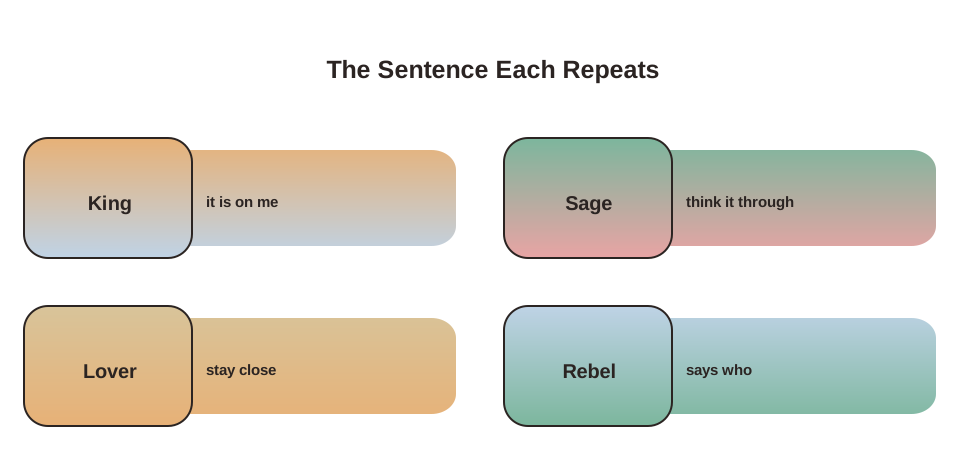
Each of the 12 male archetypes runs on one repeatable sentence — the King's “it's on me”, the Sage's “think it through”, the Lover's “stay close”, the Rebel's “says who”. Below, every archetype gets its core energy, its shadow distortion, the exact inner-voice line, and the growth shift that loosens it.
The King: Personalization
Core energy: Order, responsibility, stewardship
Shadow distortion: Personalization
Inner voice:
“It's on me.”
The King absorbs pressure so nobody else has to. That works until every outcome in the room feels like his verdict — including the ones he never controlled. Personalization is the distortion that quietly turns stewardship into a life sentence: rest starts to read as negligence, and asking for help as abdication.
Growth shift: From "it's on me" to "which part of this is actually mine?" Authority and openness aren't opposites. A king nobody can reach isn't strong — he's alone.
The Warrior: "Should" statements
Core energy: Discipline, drive, advancing through resistance
Shadow distortion: "Should" statements
Inner voice:
“Push through.”
The Warrior treats resistance as information about effort, never about limits. The tell is a sentence built from should: I should be further along, I should handle this better, I should be over it by now. Should is not a plan. It's a way of hitting yourself with a standard you never agreed to.
Growth shift: From "I should be handling this" to "what does this actually need?" Discipline aimed at a real target compounds. Discipline aimed at yourself just erodes.
The Protector: Catastrophizing
Core energy: Vigilance, loyalty, holding the line
Shadow distortion: Catastrophizing
Inner voice:
“Not on my watch.”
The Protector's whole value is seeing the threat early — which means his brain is rewarded for running worst-case scenarios. Catastrophizing isn't a malfunction here; it's the strength with the volume stuck on. The problem is that a mind scanning for danger always finds some, and it never files an all-clear.
Growth shift: From "what if it all goes wrong" to "what's actually likely, and what would I do?" Vigilance with an off-switch is protection. Without one, it's just fear doing overtime.
The Sage: Analysis paralysis
Core energy: Wisdom, depth, seeing beneath the surface
Shadow distortion: Analysis paralysis
Inner voice:
“Think it through.”
The Sage's instinct is to understand before acting — genuinely useful, right up until understanding becomes the substitute for acting. Thinking feels like progress because it's effortful. But past a point, more analysis stops producing new information and just produces more analysis.
Growth shift: From "I need to think about this more" to "what would I do if I already understood it?" Depth is a tool. It was never meant to be a waiting room.
The Magician: Fallacy of control
Core energy: Transformation, mastery, making the impossible practical
Shadow distortion: Fallacy of control
Inner voice:
“There's a way.”
The Magician has solved enough unsolvable things to believe every problem has a lever — so when something won't move, the conclusion isn't "this is outside my control," it's "I haven't found the angle yet." That belief builds remarkable skill and quietly makes acceptance feel like failure.
Growth shift: From "there's a way" to "is this mine to move?" Mastery includes knowing what doesn't respond to mastery.
The Creator: Discounting the positive
Core energy: Craft, vision, building what he imagines
Shadow distortion: Discounting the positive
Inner voice:
“Build it better.”
The Creator sees the gap between what he made and what he pictured — always. That gap is the engine of craft, and it's also why finishing never feels like anything. Discounting the positive means the work lands, people respond, and he's already looking at the flaw only he can see.
Growth shift: From "it could be better" to "it could be better, and it's good." Both are true. Only one of them gets said out loud.
The Lover: Mind-reading
Core energy: Depth, devotion, feeling life at full volume
Shadow distortion: Mind-reading
Inner voice:
“Stay close.”
The Lover reads a room faster than anyone in it — tone, pause, the half-second before a reply. That sensitivity is real, and it's also why he'll build a whole verdict out of a short text. Mind-reading is the assumption that the flicker you caught means what you fear it means.
Growth shift: From "they've gone quiet on me" to "I noticed something and I don't know what it means yet." Attunement is a gift. Certainty about other people's heads is a guess wearing a gift's clothes.
The Caregiver: Fallacy of fairness
Core energy: Steadiness, generosity, showing up every time
Shadow distortion: Fallacy of fairness
Inner voice:
“They need me.”
The Caregiver keeps an unspoken ledger: I show up, so it should come back. When it doesn't, the hurt has nowhere to go — because naming it would break the deal he never told anyone he'd made. Being needed also becomes the safest way to be close without being known.
Growth shift: From "after everything I do" to "I want this, and I can ask." Generosity you can't say no to isn't generosity. It's a bill.
The Jester: Minimization
Core energy: Levity, timing, lightness in heavy rooms
Shadow distortion: Minimization
Inner voice:
“Keep it light.”
The Jester can defuse anything, and the timing is genuine skill. The cost is that the joke arrives half a second before the feeling does — every time. Minimization means it never gets bad enough to mention, because the bit lands first and everyone moves on, including him.
Growth shift: From "it's not a big deal" to "it's not a big deal, and it's bothering me." The room doesn't need saving from you being serious for one minute.
The Rebel: All-or-nothing thinking
Core energy: Autonomy, edge, answering to himself
Shadow distortion: All-or-nothing thinking
Inner voice:
“Says who?”
The Rebel's independence is real, and it has a failure mode: if accepting help means being controlled, then every offer is a threat and there's no middle setting. All-or-nothing thinking turns a spectrum — some input, some autonomy — into two doors, both bad.
Growth shift: From "nobody tells me" to "whose call is this, actually?" Autonomy you have to defend constantly isn't autonomy. It's a fight you scheduled with yourself.
The Explorer: Fortune-telling
Core energy: Momentum, curiosity, the edge of the map
Shadow distortion: Fortune-telling
Inner voice:
“What's next?”
The Explorer is certain the next thing will feel different — the next city, role, version of his life. Fortune-telling is predicting a future you have no data on, and it's how momentum becomes motion. He isn't running toward the map's edge so much as away from the room he's in.
Growth shift: From "what's next" to "what's here that I haven't looked at?" Some things only open up when you stop leaving.
The Hero: Labeling
Core energy: Courage, proof, rising to the moment
Shadow distortion: Labeling
Inner voice:
“Prove it.”
The Hero rises when it counts — and quietly concludes that's the only reason he counts. Labeling collapses a performance into an identity: the bad quarter doesn't mean the quarter was bad, it means he's a failure. Worth becomes a scoreboard that resets every morning.
Growth shift: From "I failed, so I'm a failure" to "that went badly, and I'm the same person." One is a result. The other is a verdict, and you handed it down yourself.
Quick reference: all 12 at a glance
All 12 male archetypes sit in one table below, one row each — the sentence his inner voice repeats and the cognitive distortion hiding inside it. Find your line in the middle column; the row that reads like a quote is usually your archetype.
| Archetype | Inner voice | Distortion |
|---|---|---|
| The King | “It's on me.” | Personalization |
| The Warrior | “Push through.” | "Should" statements |
| The Protector | “Not on my watch.” | Catastrophizing |
| The Sage | “Think it through.” | Analysis paralysis |
| The Magician | “There's a way.” | Fallacy of control |
| The Creator | “Build it better.” | Discounting the positive |
| The Lover | “Stay close.” | Mind-reading |
| The Caregiver | “They need me.” | Fallacy of fairness |
| The Jester | “Keep it light.” | Minimization |
| The Rebel | “Says who?” | All-or-nothing thinking |
| The Explorer | “What's next?” | Fortune-telling |
| The Hero | “Prove it.” | Labeling |
Where King, Warrior, Magician and Lover fit
If you've read anything about masculine psychology you've met four of these already. King, Warrior, Magician and Lover come from the Moore–Gillette model of the mature masculine, and they're the reason most men have heard of archetypes at all.
All four are here — but four categories put very different men in the same box. The twelve sort into four families that keep the original logic while giving it resolution: the King family (King, Warrior, Protector) organises and defends; the Sage family (Sage, Magician, Creator) understands and builds; the Lover family (Lover, Caregiver, Jester) connects and attunes; the Rebel family (Rebel, Explorer, Hero) breaks out and proves.
Why this matters more than a label
A type is a nice thing to know and a useless thing to own. The reason to identify your archetype is not so you can put it in a bio — it's that knowing your default distortion tells you what to check first when your head gets loud.
If you're a Protector, the question isn't "am I anxious?" It's "am I catastrophizing again — what's actually likely here?" If you're a Hero, it's "did that go badly, or have I just labelled myself?" You stop arguing with the whole feeling and start checking one specific, named error. That's a much smaller job, and it's one you can actually do at 11pm.
How to retrain your archetype's inner voice
Retraining an archetype's inner voice works the same way whichever of the twelve you scored — you catch the exact sentence the voice repeats, name the cognitive distortion inside it, and reframe that sentence without deleting the strength underneath it.
Three things, in order, and none of them involve becoming a different man:
1. Catch the sentence. Not the mood — the sentence. "It's on me." "I should be past this." "Not on my watch." The distortion travels in specific words, and you can't examine a fog.
2. Name the distortion. Personalization. Should statement. Catastrophizing. Naming it does something odd and reliable: it turns the thought from a fact you're inside into an object you're looking at.
3. Reframe without deleting the strength. This is where most advice fails men — it tells the Warrior to stop pushing, which he correctly ignores. The move isn't to lose the drive. It's to aim it at something real instead of at yourself.
The mechanism underneath this is ordinary and well-evidenced: thought patterns are habits, and habits respond to repetition. Not to insight. You don't think your way out of this in one good session — you catch the sentence a hundred times and it gets quieter. That loop — catch, name, reframe, repeat — is cognitive restructuring, the core of CBT, and a review of 269 meta-analyses found its strongest support in exactly the problems men bring here: anxiety, anger, and general stress[3].
How MindLift helps
Catching your archetype's sentence is exactly the job MindLift does. You type the actual line — "I should have handled that better", "it's all on me", whatever yours is — and within 60 seconds you get three structured reframes: Realist, Growth, and Compassionate, each tagged with the distortion underneath it. No session to book, nothing to say out loud.
Over time the tagging is the point. You start recognising your own pattern before the app names it, which is the entire goal — needing the tool less, not more. Free to start.
Find yours
Reading the twelve and picking the one you like is the wrong method — men reliably choose the archetype they admire over the one they run.
The male archetypes quiz asks how you actually respond when something goes wrong. It's free, takes about five minutes, needs no email, and gives you your archetype immediately. You can also read all twelve in depth on the male archetypes hub.
Final thought
You are not your archetype. You're the one who noticed it — and noticing is the whole opening. The voice that says "push through" got you here. It just doesn't get to run the place unsupervised.
Frequently asked questions
What are the 12 male archetypes?
King, Warrior, Protector, Sage, Magician, Creator, Lover, Caregiver, Jester, Rebel, Explorer, and Hero. Each represents a recurring pattern of motivation and self-talk rather than a personality type — a default way of interpreting pressure. They group into four families: King, Sage, Lover, and Rebel.
How do male archetypes relate to King, Warrior, Magician, Lover?
King, Warrior, Magician and Lover come from the Moore–Gillette model of the mature masculine, and all four appear here. This set extends that framework to twelve, because four categories force very different men into the same box. The King family covers King, Warrior and Protector; the Sage family covers Sage, Magician and Creator; the Lover family covers Lover, Caregiver and Jester; the Rebel family covers Rebel, Explorer and Hero.
What is the shadow side of a male archetype?
It isn't a separate dark half. The shadow is the same strength running without a limit: the Protector's threat-detection becomes catastrophizing, the Creator's standards become an inability to register that anything is finished, the King's responsibility becomes carrying what was never his. That's why the shadow is hard to spot from inside — it feels like your best quality.
Can you change your male archetype?
You're not trying to. An archetype isn't a cage — it's a default. What changes is the distortion attached to it: the Warrior can keep the drive and drop the should, the Hero can keep the courage and stop grading his worth on it. The pattern is a habit of thought, and habits of thought respond to practice.
Is there a free male archetypes test?
Yes — the male archetypes quiz is free, needs no email, and gives you your result immediately. It has 36 questions in two stages: the first 24 find your archetype family and the last 12 statements you rate pick one of the 12 archetypes, based on how you actually respond under pressure rather than how you would like to.
Like what you're reading?
Accelerate your growth journey
Reframe the patterns that hold you back — and watch your Top Pattern change over time.


Free to start · no account required
- Beck, A. T. (1963). Thinking and depression: I. Idiosyncratic content and cognitive distortions. Archives of General Psychiatry, 9(4), 324–333. — DOI (opens in a new tab)
- Rnic, K., Dozois, D. J. A., & Martin, R. A. (2016). Cognitive distortions, humor styles, and depression. Europe's Journal of Psychology, 12(3), 348–362. — DOI (opens in a new tab)
- Hofmann, S. G., Asnaani, A., Vonk, I. J. J., Sawyer, A. T., & Fang, A. (2012). The efficacy of cognitive behavioral therapy: A review of meta-analyses. Cognitive Therapy and Research, 36(5), 427–440. — DOI (opens in a new tab)
Mental Wellness Writers
The MindLift Wellness Team writes evidence-based content on CBT, self-talk, and everyday mental health tools.
Was this article helpful?