Most people know their attachment style. Few know what it does to their mind when things get hard.
About 2 minutes6 questions
Start with question 1 of 6
You send an important message and don't hear back for hours. Your first thought is:
About this quiz
Your Attachment Style Under Stress
Most people know their attachment style. Few know what it does to their mind when things get hard.
Anxious. Avoidant. Secure. You've probably heard the terms — maybe taken a quiz.
But attachment style doesn't just show up in romantic relationships. It shows up in the thoughts your brain runs on loop when things start to fall apart.
For each scenario, pick the response that feels most honest — not the one you wish were true.
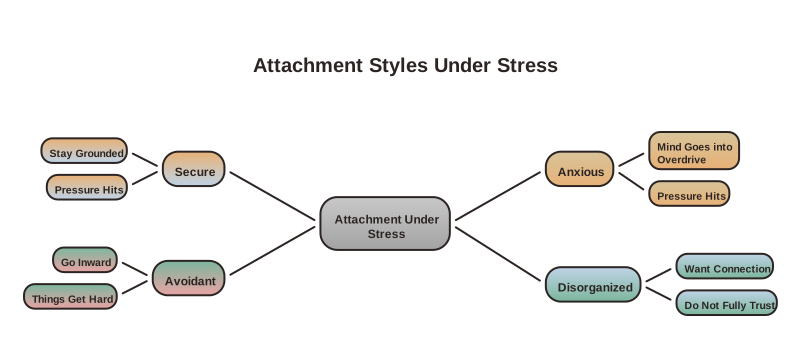
The four styles under stress — the quiz tells you which one runs your mind when pressure hits.How does this quiz work?
How does this quiz work?
Answer 6 questions about how you usually react, not how you would like to. About 2 minutes is the usual time to finish, there are no right answers, and Your Attachment Style Under Stress scores your result on your device — free, no email, no signup.
You send an important message and don't hear back for hours. Your first thought is:
They're probably busy. I'll hear from them when they can.
Did I say something wrong? Maybe I came on too strong.
Fine. I'll just handle everything myself anyway.
I'm annoyed — but I won't say anything. It's not worth the conflict.
You're going through something hard. Your instinct is to:
Reach out to someone I trust and talk it through.
Talk about it a lot — but feel like no one really gets it.
Go quiet and process alone until I've figured it out.
Downplay it, say I'm fine, and deal with it privately.
When someone close to you pulls back or seems distant, you:
Give them space and check in when it feels right.
Immediately try to reconnect — the distance feels unbearable.
Pull back too, sometimes further than they did.
Feel hurt but say nothing and act unbothered.
During a conflict, your mind goes to:
How do we solve this together?
Are they going to leave? Is this the end of us?
I don't need this. I'm better off handling things alone.
If I just stay calm and don't react, this will pass.
After a stressful social interaction, you typically:
Feel okay — maybe a little drained, but not spiraling.
Replay every word, worry about how you came across.
Feel relieved to be alone again, away from the noise.
Feel numb or disconnected, not sure what you actually felt.
When you're overwhelmed, the thought that hits hardest is:
This is tough, but I'll get through it.
No one really understands what I'm going through.
I can't rely on anyone but myself.
I don't even know what I'm feeling right now.
What results can you get?
What results can you get?
Your answers sort you into one of 4 results — Secure Under Stress, Anxious Under Stress, Avoidant Under Stress, Disorganized Under Stress. Each result comes with a description of its thinking pattern and one growth move you can practise this week, plus the answer mix that produced it.
Result
Who gets it
What it looks like
Secure Under Stress
Mostly A answers
You stay grounded when pressure hits
Anxious Under Stress
Mostly B answers
Your mind goes into overdrive when pressure hits
Avoidant Under Stress
Mostly C answers
When things get hard, you go inward
Disorganized Under Stress
Mostly D answers
You want connection — but don't fully trust it
Secure Under Stress
You stay grounded when pressure hits
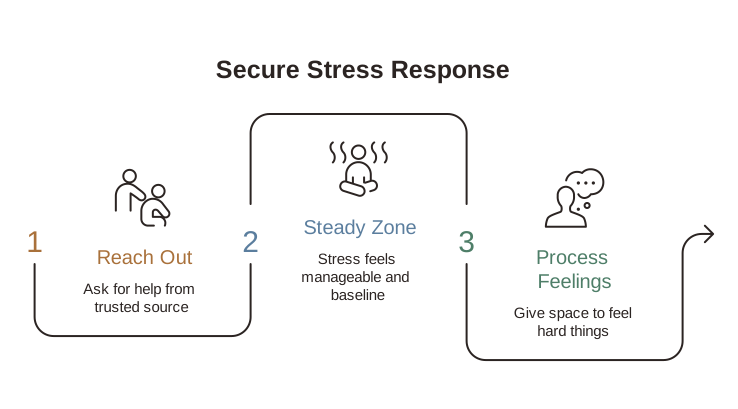
When things get hard, your nervous system stays regulated. You can ask for help without it feeling like failure, sit with discomfort without catastrophizing, and return to baseline faster than most.
Stress feels manageable, not catastrophic
You reach out and receive support without drama
You return to baseline relatively quickly
This doesn't mean you don't struggle — it means your brain has learned that connection is safe and stress is temporary.
Watch for: sometimes you move on before you've really processed. Secure doesn't mean immune. Give yourself space to feel hard things before filing them away.
Your stress response, from pressure to reset — secure doesn't mean skipping the processing.
Anxious Under Stress
Your mind goes into overdrive when pressure hits
Under pressure, your brain scans for signs that something is wrong — that someone is pulling away, that you've done something to cause this. The uncertainty feels unbearable, so your mind fills it with worst-case scenarios.
Hypervigilance: scanning for rejection or abandonment cues
Replaying conversations, second-guessing your words
Needing reassurance more than usual
This isn't neediness. It's a nervous system that learned connection was unpredictable — and it's trying to protect you by staying alert.
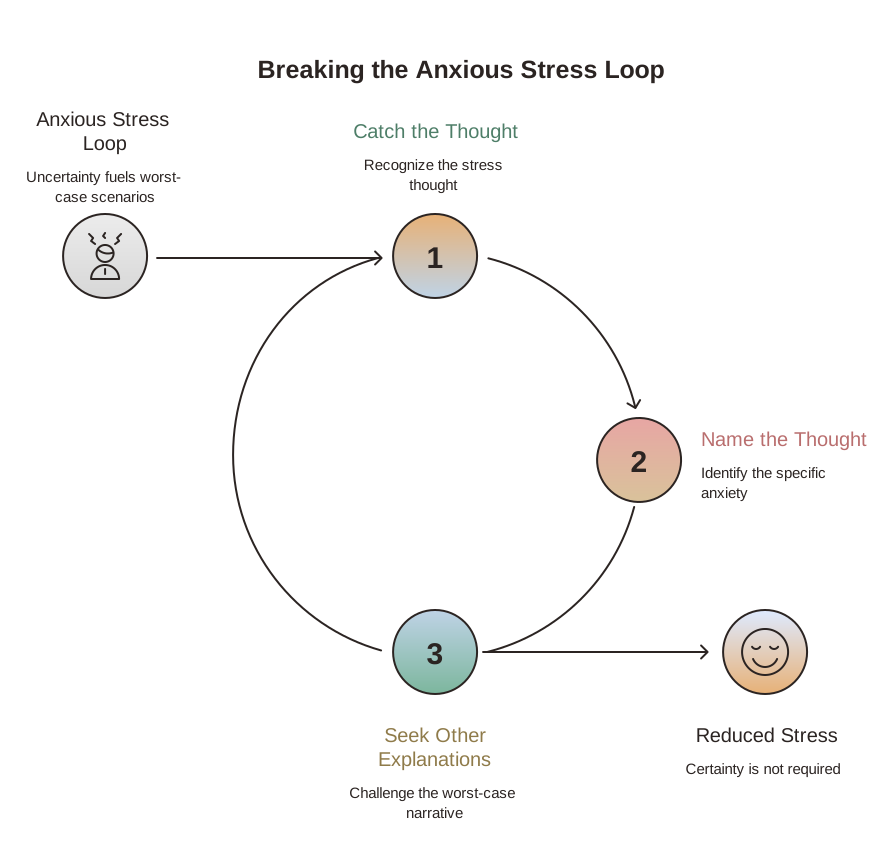
Your stress thought: "Something is wrong and it's probably my fault." Catch that thought the moment it fires. Name it. Ask: what's one other explanation? You don't need certainty — just a crack in the story.
The exit from the anxious stress loop — you don't need certainty, just a crack in the story.
Avoidant Under Stress
When things get hard, you go inward
You handle it yourself. Ask for less than you need. Sometimes push people away before they can disappoint you. Independence feels safe. Vulnerability doesn't.
Self-sufficiency as a default (even when it costs you)
Discomfort with needing others or being needed
Distance feels safer than closeness under pressure
This pattern usually comes from learning that relying on others led to let-downs — so you stopped.
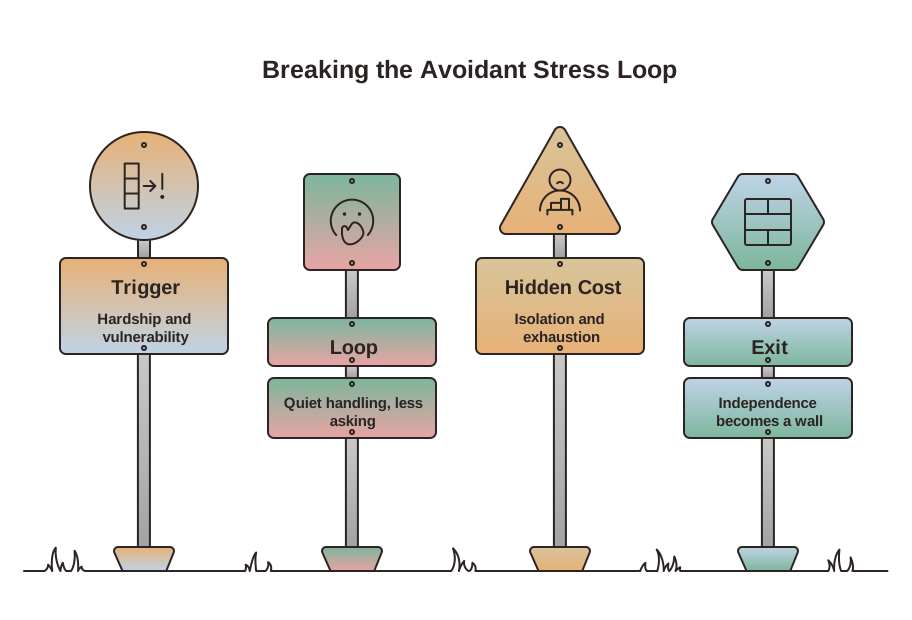
Your stress thought: "I'm better off dealing with this alone." Notice when self-sufficiency becomes isolation. Those thoughts feel like protection — but they often just keep you stuck and exhausted.
Your stress loop, from trigger to exit — self-sufficiency becomes isolation quietly.
Disorganized Under Stress
You want connection — but don't fully trust it
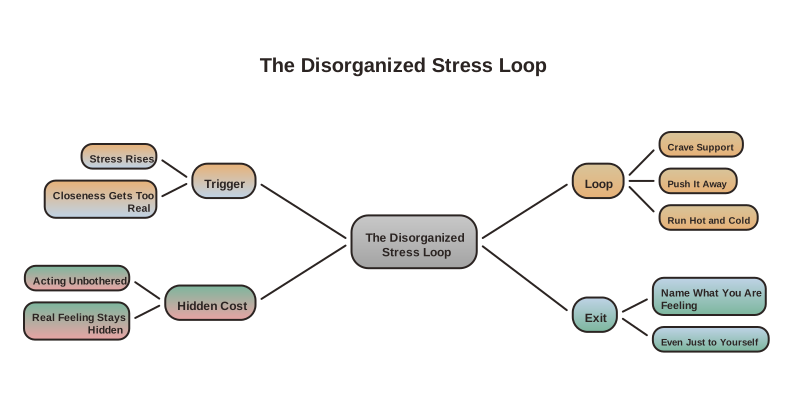
You might go hot and cold — craving closeness, then pulling back when it gets too real. Under stress, you often disconnect from your own feelings before others can see them.
Conflicting impulses: wanting support while pushing it away
Emotional numbness or disconnection under pressure
Acting unbothered when you're not
This is the most misunderstood pattern. It doesn't mean you're chaotic — it means your nervous system received mixed signals about whether people were safe.
Your stress thought: "I don't know what I need — and I'm not sure I should ask." Start with the smallest possible act of honesty: name, even just to yourself, what you're actually feeling right now.
Your stress loop, mapped — the exit starts with the smallest possible act of honesty.Frequently Asked Questions
Frequently Asked Questions
What does this quiz measure?
This quiz maps your instinctive responses to 6 stress scenarios to reveal which attachment pattern drives your thinking under pressure. It identifies whether your default pattern is Secure, Anxious, Avoidant, or Disorganized — based on the specific thoughts and behaviors you recognize in yourself.
Is this a clinical assessment?
No. This is an educational self-reflection tool inspired by attachment theory and CBT principles. It helps you understand your stress thought patterns but is not a diagnostic instrument and should not replace professional mental health support.
Can my attachment style under stress change?
Yes. Attachment patterns are learned responses, not personality traits. Research in CBT and neuroplasticity shows that consistently catching and reframing the specific thoughts your attachment pattern generates can gradually shift how your nervous system responds — especially to uncertainty and conflict.
What if I relate to more than one result?
That's common. Most people carry more than one attachment pattern depending on context — one might dominate in relationships, another at work, another when you're exhausted. The result you got reflects your most automatic response under general stress.
Is this a clinical diagnosis?
No. This is an educational self-reflection tool inspired by attachment theory and CBT principles. It is not a diagnostic instrument and should not replace professional mental health support.
Can attachment styles change?
Yes. Attachment patterns are learned, not fixed. CBT research shows that identifying and reframing the specific thoughts your pattern generates — in real time — gradually shifts how your nervous system responds under pressure.
Keep exploring
If you are in crisis or thinking about harming yourself, call or text 988 (US) or find a local line at findahelpline.com. MindLift is a self-help tool and not a replacement for professional care.