About this result
Low HFA Traits
One of 4 results in High-Functioning Anxiety Test.
Your drive isn't anxiety-driven
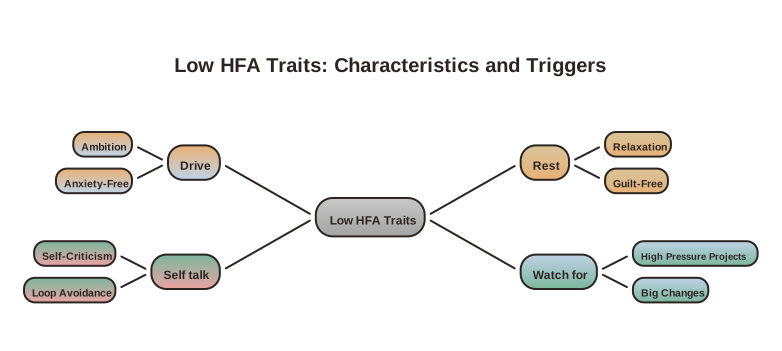
Your motivation comes from genuine engagement, not fear of failure. You can rest without guilt, finish things without catastrophizing, and tolerate uncertainty without spiraling.
Drive and ambition without anxiety as the engine
Able to rest without significant guilt
Self-critical moments don't become loops
You experience stress without being consumed by it.
Notice the moments when the pattern shifts — high-pressure projects or significant changes can temporarily push low-HFA traits higher. That's normal, not a diagnosis.
Other results in this quiz
Frequently Asked Questions
Frequently Asked Questions
What does Low HFA Traits mean?
Drive and ambition without anxiety as the engine
What can I do if my result is Low HFA Traits?
Notice the moments when the pattern shifts — high-pressure projects or significant changes can temporarily push low-HFA traits higher. That's normal, not a diagnosis.
If you are in crisis or thinking about harming yourself, call or text 988 (US) or find a local line at findahelpline.com. MindLift is a self-help tool and not a replacement for professional care.
Sources
The questions and result descriptions in this quiz draw on the studies below. The quiz is a self-reflection tool, not a diagnosis, and none of these papers tested this quiz itself.
- Carpenter JK et al. (2018). Cognitive behavioral therapy for anxiety and related disorders: A meta-analysis of randomized placebo-controlled trials. Depression and Anxiety. — DOI
- Cuijpers P et al. (2016). How effective are cognitive behavior therapies for major depression and anxiety disorders? A meta-analytic update of the evidence. World Psychiatry. — DOI