The 6 Style Archetypes
Your style archetype isn't about clothes — it's about how you see yourself. Each of the six feminine style types has a gift, a shadow, and an inner voice: the sentence it repeats when getting dressed turns into self-criticism. Find yours, then learn where it grows.
What are the style archetypes?
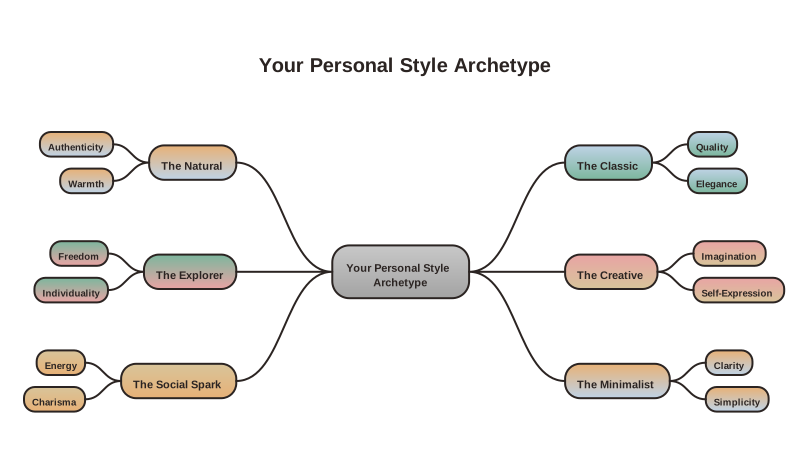
Style archetypes — sometimes called feminine style types — are recurring patterns in how people express themselves through what they wear: the Natural's ease, the Classic's polish, the Explorer's freedom, the Creative's originality, the Social Spark's warmth, the Minimalist's intention.
You aren't assigned one; one simply becomes your default — the pattern that decides what feels "like you" in a fitting room, and what quietly gets vetoed before you've thought about it.
Here's the part most style guides skip: your archetype is really a mirror of your self-perception. What you reach for — and what you won't let yourself wear — encodes how you handle visibility, control, perfectionism, and other people's expectations. That's why each archetype page in this guide covers three things: the gift (what this style pattern does brilliantly), the shadow (the moment the style impulse becomes self-criticism — the Minimalist's "nothing feels right", the Classic's fear of getting it wrong), and the inner voice — the exact thought the shadow generates, because a thought you can catch is a thought you can reframe.
The six archetypes pair into three families below. Read the one whose shadow stings a little — that's usually yours — or take the free quiz and get your dominant style archetype in about two minutes. For each archetype's snag thought, the loop it starts and a reframe that answers it, see your style archetype's snag thought.
The Effortless family
The Effortless family — the Natural and the Explorer — dresses for ease and authenticity: these are the archetypes that dress for the life they're actually living rather than the one they are performing.
The Refined family
The Refined family — the Classic and the Minimalist — dresses with structure and intention: these are the archetypes that choose carefully, mean every piece, and feel the shadow as the fear of getting it wrong.
The Expressive family
The Expressive family — the Creative and the Social Spark — dresses with color and energy: these are the archetypes whose style speaks before they do and who use what they wear to say something.
All 6 style archetypes at a glance
The same six, side by side — each with its family and the sentence it repeats in front of the closet.
| Style archetype | Family | What it looks like | The inner voice |
|---|---|---|---|
| The Natural | Effortless | Authenticity over trends — warmth over performance | “I don't want to make a thing of it.” |
| The Classic | Refined | Quality, elegance, and timeless choices | “What if I get it wrong?” |
| The Explorer | Effortless | Freedom matters more than fitting in | “There's something better out there.” |
| The Creative | Expressive | Style as an extension of imagination | “If it's not original, it's not me.” |
| The Social Spark | Expressive | Energy that changes the room | “I have to bring the energy.” |
| The Minimalist | Refined | Clarity, simplicity, and deep intention | “Nothing feels right.” |
How to find your style archetype
To find your style archetype, don't pick the one you'd like to be — look for the one whose shadow you recognise. The gift is easy to claim; the shadow is the tell. If "standing in front of a full closet feeling like nothing feels right" makes you wince, you've found yours.
From there, the quiz separates the neighbouring archetypes (a Natural and a Minimalist both love simplicity but criticise themselves differently), and each archetype page shows the growth edge: how to keep the gift without paying the shadow's price.
Common questions
What are the 6 style archetypes?
The Natural and the Explorer (the Effortless family — ease and freedom); the Classic and the Minimalist (the Refined family — quality and intention); and the Creative and the Social Spark (the Expressive family — originality and energy). Each one pairs a core gift with a predictable shadow pattern.
What is a feminine style type?
A feminine style type is a recurring pattern in how you express yourself through what you wear — the values, energy, and self-image underneath your aesthetic choices, not a dress code. Knowing yours makes dressing easier and, more usefully, shows you where your style impulses turn into self-criticism.
Can you be more than one style archetype?
Yes — most people are a blend of two, like Classic-Minimalist or Creative-Natural. What matters is the dominant one: the pattern that decides what feels "like you" before you've consciously chosen. That's the archetype whose shadow is worth learning, because it's the one writing your inner commentary in the mirror.
Is this about fashion or psychology?
Both — but the useful half is the psychology. Style archetypes are a self-reflection framework, not a clinically validated measure: treat yours as a mirror, not a diagnosis. The value is in recognising the thought patterns it names (especially the shadow), which you can then work with directly using evidence-based tools like CBT reframing.
Every style archetype repeats one sentence. The Natural's:
“I don't want to make a thing of it.”
Type the sentence into MindLift and get a kinder, believable response in about 60 seconds. Free to start.
Get MindLift — free to start
Take the free style archetype quiz
Which style archetype is deciding what feels "like you"? The free personal style archetype quiz takes about 2 minutes — 12 questions, no email, instant results with your dominant archetype, its strengths, and a growth insight.
Style archetypes describe how you show up on the outside; the 12 female archetypes map the deeper personality patterns underneath — the Queen's authority, the Seeker's independence, the Healer's empathy — each with its own gift, shadow, and inner voice. If this page felt like reading your own diary, that guide goes one layer down. You can also jump straight to the free female archetype quiz.