
What are the feminine archetypes?
The feminine archetypes — also called female archetypes — are recurring personality patterns that show up across cultures, stories, and generations. The framework traces back to Carl Jung's idea that we all carry universal characters: the sovereign who takes charge, the healer who absorbs everyone's pain, the seeker who can't sit still.
You aren't assigned one at birth. One simply becomes your default — the pattern that runs first under pressure, shapes what you apologise for, and writes the sentence your inner voice repeats at 2am.
Each archetype in this guide covers three things: the gift (what this pattern does brilliantly), the shadow (how the same strength turns on you under stress — the Queen's leadership becomes control, the Healer's empathy becomes self-erasure), and the inner voice — the exact thought the archetype generates, because that thought is the practical thing you can catch and reframe.
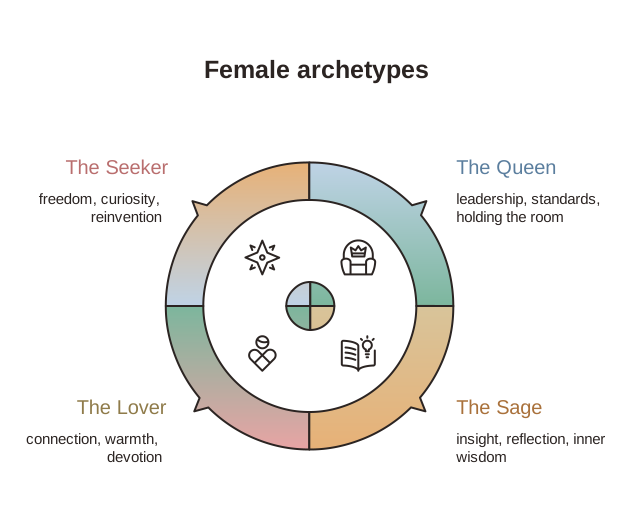
The twelve archetypes group into four families below. Read the one that stings a little — that's usually yours — or take the free quiz and get your dominant archetype in about three minutes.
Where the feminine archetypes come from
The feminine archetypes come from Carl Jung's theory of archetypes — universal patterns he described in The Archetypes and the Collective Unconscious. Later authors turned the idea into named female types: Jean Shinoda Bolen's Goddesses in Everywoman (1984) and Carol S. Pearson's twelve-archetype model in Awakening the Heroes Within (1991).
Jung never published a list of 12 female archetypes, so any "Carl Jung's 12 female archetypes" you see online is a modern arrangement, not a quotation. The 12 on this page use the names most quizzes share, group them into four families, and add the layer Jung didn't have: each archetype's shadow written as a specific thinking error you can catch and reframe.
Treat the framework as a mirror, not a measurement. Archetypes are a tool for self-reflection, not a validated personality test — the practical value is in the thought pattern each one names, which is something CBT techniques can work on directly.
The Queen family
The Queen family covers leadership, stability, and protection — the archetypes that hold things together. Three of the twelve belong here: the Queen, the Warrior, and the Protector.
The Sage family
The Sage family covers wisdom, intuition, and vision — the archetypes that understand and imagine. Three of the twelve belong here: the Sage, the Mystic, and the Dreamer.
The Lover family
The Lover family covers connection, care, and warmth — the archetypes that make people feel seen. Three of the twelve belong here: the Lover, the Healer, and the Radiant.
The Seeker family
The Seeker family covers growth, independence, and creation — the archetypes that expand and build. Three of the twelve belong here: the Seeker, the Rebel, and the Creator.
All 12 archetypes at a glance
All 12 female archetypes sit side by side in the table below — each with its family and the sentence it repeats when it's running the show.
| Archetype | Family | What it looks like | The inner voice |
|---|---|---|---|
| The Queen | Queen | Leadership, stability, sovereignty | “If I don't handle it, it won't get done.” |
| The Warrior | Queen | Courage, drive, rising through fire | “Push harder.” |
| The Protector | Queen | Loyalty, strength, guarding what matters | “I must keep everyone safe.” |
| The Sage | Sage | Wisdom, knowledge, seeking truth | “Think more.” |
| The Mystic | Sage | Intuition, depth, seeing beyond the surface | “Something feels off.” |
| The Dreamer | Sage | Idealism, imagination, living in possibility | “One day…” |
| The Lover | Lover | Passion, connection, feeling life deeply | “Do they still care?” |
| The Healer | Lover | Compassion, nurturing, a presence that soothes | “I'll fix it.” |
| The Radiant | Lover | Optimism, charisma, brightening every room | “Stay positive.” |
| The Seeker | Seeker | Growth, expansion, constant evolution | “There's more.” |
| The Rebel | Seeker | Independence, disruption, rewriting rules | “No one controls me.” |
| The Creator | Seeker | Expression, originality, shaping beauty | “Is this good enough?” |
How to find your archetype
Don't pick the archetype you'd like to be — look for the one whose shadow you recognise. The gift is easy to claim; the shadow is the tell. If reading "she says yes before checking whether she has the capacity" makes you wince, you've found your family.
From there, the quiz separates the neighbouring archetypes (a Queen and a Protector share a family but sabotage themselves differently), and each archetype page shows the growth edge: how to keep the gift without paying the shadow's price.
Already know your calm-day archetype? The second quiz in the ladder, which archetype do you become under pressure?, names the pattern that takes over when you feel threatened — often a different family from the one you lead with — and what that switch is protecting.
Common questions
What are the 12 feminine archetypes?
The 12 feminine archetypes — also called the 12 female archetypes — are the Queen, Warrior, and Protector (the Queen family — leadership and stability); the Sage, Mystic, and Dreamer (wisdom and vision); the Lover, Healer, and Radiant (connection and warmth); and the Seeker, Rebel, and Creator (growth and independence). Each one pairs a core gift with a predictable shadow pattern.
Are feminine archetypes the same as female archetypes?
Yes — "feminine archetypes" and "female archetypes" are two names for the same 12 patterns, and this guide uses both. There is also a separate framework that describes 7 feminine archetypes; that one is a different, shorter system, not a subset of these 12.
Can you be more than one archetype?
Yes — almost everyone carries two or three strongly. What matters is the dominant one: the pattern that runs first under pressure, before you've chosen a response. That's the archetype whose shadow is worth learning, because it's the one making decisions when you're tired, stressed, or hurt.
Are female archetypes scientifically proven?
Archetypes come from Jungian psychology — a framework for self-reflection, not a clinically validated personality measure. Treat your archetype as a mirror, not a diagnosis: the value is in recognising the thought patterns it names (especially the shadow), which you can then work with directly using evidence-based tools like CBT reframing.
What is an archetype's shadow?
The shadow is the same core strength turned against you under stress. The Queen's decisiveness becomes control; the Healer's empathy becomes self-abandonment; the Seeker's independence becomes running from depth. Each archetype page maps the shadow's specific thoughts so you can catch them in the moment instead of only recognising them in hindsight.
Go deeper
Once you know your archetype, these guides take the framework further — the shadow work, the inner voice, and how the feminine archetype systems compare.
Your archetype and your inner voice
The sentence each of the 12 archetypes repeats at 2am — and how to talk back to it.
The shadow side of every female archetype
How each archetype's core gift turns against her under stress, pattern by pattern.
How rare is your archetype?
Which of the 12 patterns show up everywhere — and which are genuinely uncommon.
The 7 feminine archetypes vs the 12
Two frameworks share a name. How they differ, and which one you're actually looking for.
Feminine archetype quizzes, compared
What the popular quizzes measure, how they differ, and what to check before taking one.
Where to take a female archetypes quiz free
What a good free quiz should give you — no email, instant results, a real growth edge.
Take the free archetype test
The free feminine archetype quiz (a 12 female archetypes test) names the archetype running your life in about 4 minutes — 34 questions, no email, instant results with your dominant archetype, its shadow, and a growth reframe.
Exploring the framework for someone else — or curious about the other side? See the 12 male archetypes or take the male archetype test. Prefer a version without the feminine/masculine framing? Try the general 12 archetypes test. Want the full map? The complete archetypes guide covers all 12 types, shadows, and quizzes.