Discover your dominant feminine archetype — instant results
About 5 minutes46 questions
Start with question 1 of 46
When faced with conflict, you:
About this quiz
12 Female Archetypes Quiz & Test
Discover your dominant feminine archetype — instant results
Feminine archetypes are recurring character patterns — the Queen, the Healer, the Rebel and nine more — that describe how a woman tends to lead, love, create and protect. The idea comes from Carl Jung's archetypes; this model groups the 12 into four families of three.
Every woman carries multiple archetypes. Some lead. Some nurture. Some create. Some rebel. Some see beyond the visible.
This feminine archetype quiz reveals your dominant female archetype, your secondary archetype, your shadow pattern, and how your inner voice reflects it.
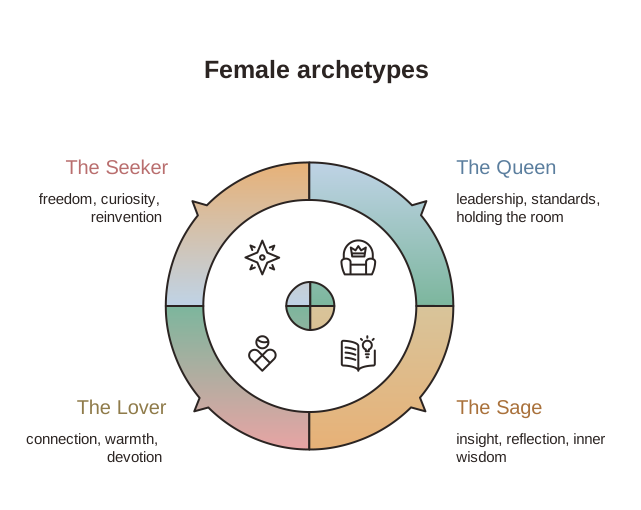
The four energy families the quiz finds first — each holds three of the twelve archetypes, and the final statements pick one.
A reflection model built on Jung's archetypes grouped into four families — an educational self-discovery tool, not a validated psychometric or clinical assessment.
The 12 female archetypes at a glance
Four energy families, three archetypes each. The first 34 questions find your family; the 12 rated statements pick the archetype inside it. Each name links to its full page with the shadow, inner voice and growth move.
The 12 Female Archetypes Quiz has 46 questions and takes about 5 minutes. The first 34 questions place you in one of four energy families: Queen, Sage, Lover or Seeker. The last 12 are statements you rate from "Not me" to "Exactly me", and the highest-rated statement inside your family names your dominant archetype.
Your result can also name a secondary archetype, the top-rated one inside your runner-up family, plus the shadow pattern your archetype tends to fall into under stress and the inner-voice sentence it repeats, such as the Queen's "If I don't handle it, it won't get done." There are no right answers, so answer for how you usually react, not how you would like to.
Answers are scored on your device, with no email or signup. The quiz is an educational self-discovery tool built on Jung's idea of archetypes, not a clinical assessment.
Updated
When faced with conflict, you:
Your natural role in a group:
Your biggest strength:
When someone disappoints you:
Your ideal environment:
Your inner voice usually says:
You feel most alive when:
Your fear:
When stressed:
People admire your:
You handle heartbreak by:
Your energy in a room:
Your relationship style:
When insecure:
Your dream life includes:
Your intuition:
You value most:
When criticized:
Your creative outlet:
Your hidden side:
In friendships, you:
Your shadow shows up as:
You recharge by:
Deep down, you want to:
Your approach to personal growth:
How you make big decisions:
Your relationship with ambition:
When you need to heal, you:
Others would say you're most powerful when:
Your relationship with rules:
What drains you the most:
Your greatest gift to others is:
When you look back on your life, you want to have:
Which phrase resonates with you most?
I feel steadiest when I'm the one holding things together.
I trust my intuition, even when I can't explain where it comes from.
I'm usually the one who lifts the mood, even on days I'm not feeling it.
I'm always reaching for what's next — a new place, a new idea, a new version of me.
When I'm exhausted, my instinct is still to push harder.
I spend a lot of time in the life I imagine, not only the one I'm in.
Being deeply close to someone matters more to me than almost anything.
When a rule makes no sense, I'd rather break it than live with it.
I feel responsible for keeping the people I love safe.
I'd rather understand something fully than act on it quickly.
When someone I care about is hurting, my first instinct is to make it better.
I feel most like myself when I'm making something.
What results can you get?
What results can you get?
Your answers sort you into one of 12 results — The Queen, The Warrior, The Protector, The Sage, The Mystic, The Dreamer, and 6 more. Each result comes with a description of its thinking pattern and one growth move you can practise this week, plus the answer mix that produced it.
Result
Who gets it
What it looks like
The Queen
Queen family, top-rated statement
Leadership, stability, sovereignty
The Warrior
Queen family, top-rated statement
Queen family · Courage, drive, rising through fire
The Protector
Queen family, top-rated statement
Queen family · Loyalty, strength, guarding what matters
The Sage
Sage family, top-rated statement
Wisdom, knowledge
The Mystic
Sage family, top-rated statement
Sage family · Intuition, depth, seeing beyond the surface
The Dreamer
Sage family, top-rated statement
Sage family · Idealism, imagination, living in possibility
The Lover
Lover family, top-rated statement
Passion, connection
The Healer
Lover family, top-rated statement
Lover family · Compassion, nurturing, a presence that soothes
The Radiant
Lover family, top-rated statement
Lover family · Optimism, charisma, brightening every room
The Seeker
Seeker family, top-rated statement
Growth, expansion
The Rebel
Seeker family, top-rated statement
Seeker family · Independence, disruption, rewriting rules
The Creator
Seeker family, top-rated statement
Seeker family · Expression, originality, shaping beauty
All 12 female archetypes: core drive, shadow pattern and the inner-voice sentence each one repeats
Archetype
Core drive
Shadow pattern
Inner voice
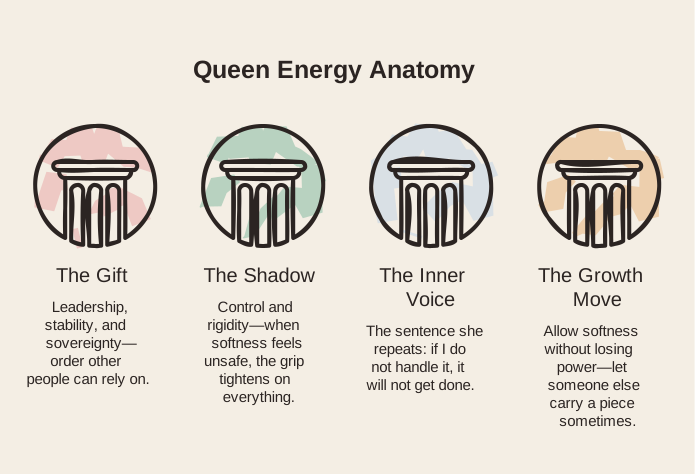
The Queen
Leadership, stability, and sovereignty — you create order other people can rely on.
Control and rigidity: when softness feels unsafe, you tighten your grip on everything.
"If I don't handle it, it won't get done."
The Warrior
Courage and drive — you move toward hard things instead of away from them.
Burnout and self-pressure; you mistake exhaustion for proof that you tried hard enough.
"Push harder."
The Protector
Loyalty and strength — you stand between the people you love and whatever threatens them.
Hyper-responsibility: you carry burdens that were never yours to hold.
"I must keep everyone safe."
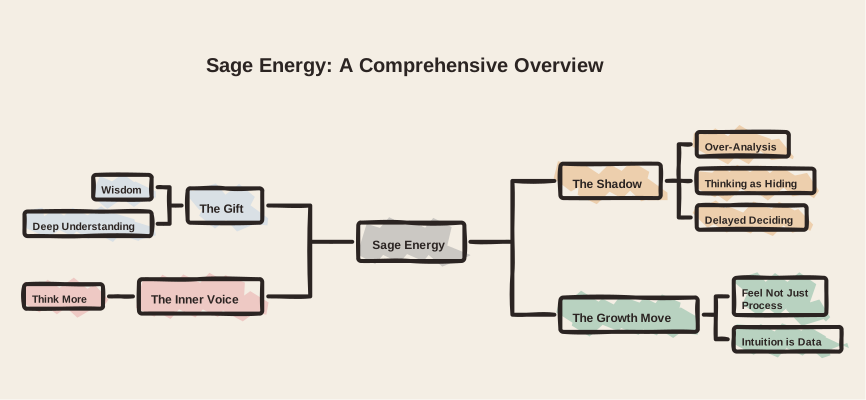
The Sage
Wisdom and knowledge — you understand things deeply before you act on them.
Over-analysis: thinking becomes a place to hide from feeling and from deciding.
"Think more."
The Mystic
Intuition and depth — you sense what hasn't been said out loud yet.
Isolation: trusting only your inner world, you can quietly pull away from people.
"Something feels off."
The Dreamer
Idealism and imagination — you can picture how much better things could be.
Escapism: the dream becomes more comfortable than the work of building it.
"One day…"
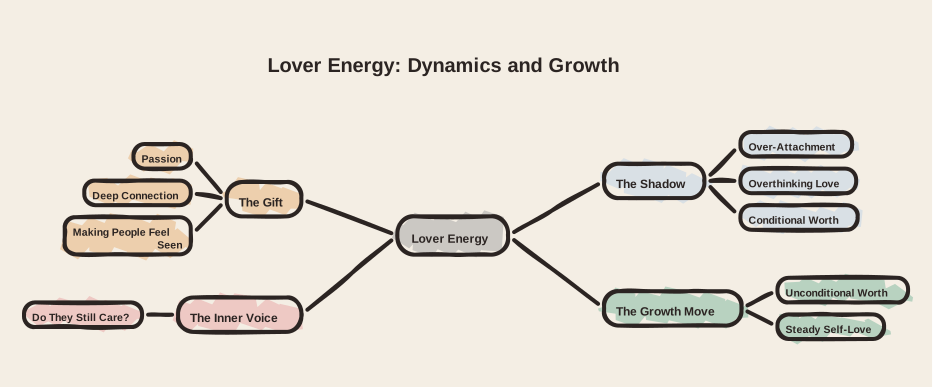
The Lover
Passion and connection — you love deeply and make people feel truly seen.
Over-attachment and overthinking love: your worth gets tied to how loved you feel.
"Do they still care?"
The Healer
Compassion and nurturing — you instinctively tend to other people's pain.
Self-sacrifice: you pour into everyone else until your own cup is empty.
"I'll fix it."
The Radiant
Optimism and charisma — you bring warmth and lightness into every room.
Avoidance of deeper emotions: staying positive becomes a way to skip the hard feelings.
"Stay positive."
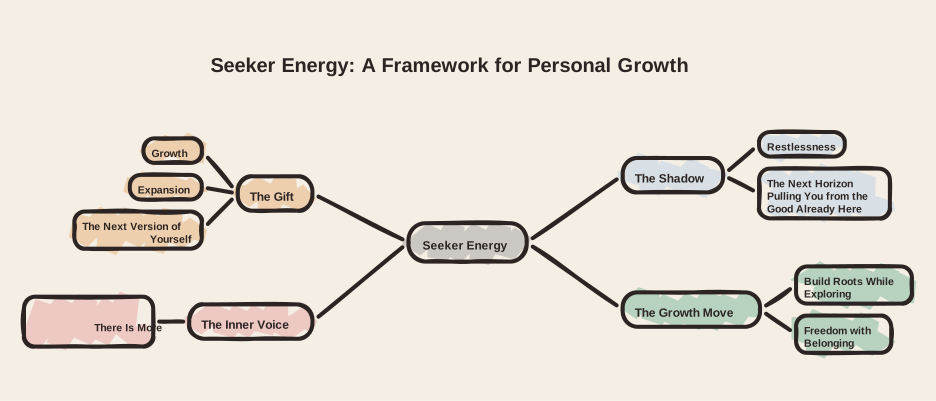
The Seeker
Growth and expansion — you're always reaching for the next version of yourself.
Restlessness: the next horizon pulls you away from the good that's already here.
"There's more."
The Rebel
Independence and disruption — you question the rules instead of obeying them.
Emotional detachment: pushing people away to prove no one has a hold on you.
"No one controls me."
The Creator
Expression and originality — you turn what you feel into something you can make.
Self-doubt: "is this good enough?" stops the work before it ever gets out.
"Is this good enough?"
The Queen
Leadership, stability, sovereignty
You embody authority — and your inner voice insists, "If I don't handle it, it won't get done." Your growth lives in the space between control and trust.
You lead. Whether or not you asked for the role, people look to you to hold things together — and you usually do. Stability follows you because you create it: you plan, you decide, you carry the weight others set down. At your best, you turn chaos into something people can stand on. In relationships, the Queen leads with loyalty and clear expectations, and can mistake being needed for being loved.
Your inner voice runs on responsibility: "If I don't handle it, it won't get done." Sometimes that's simply true. But repeated often enough, it quietly teaches you that rest is dangerous and that needing help is failing — so you take on far more than is ever yours to carry.
Your shadow is control. Under pressure, softness feels like a risk, so you tighten your grip — on plans, on people, on yourself. The cost isn't your competence; it's your closeness. People can lean on a Queen for years without ever getting near her.
Growth edge: power and softness aren't opposites. You can stay the steady one and still let something be imperfect, still let someone else carry a piece. When control kicks in, try asking — "Is this mine to hold, or am I holding it because letting go feels unsafe?"
here's one thing to try tonight: Allow softness without losing power. The next time your grip tightens, name it — then choose one thing to let be imperfect, or one task to hand off. Delegating isn't losing control; it's trusting your foundation enough to share it.
Queen family · Courage, drive, rising through fire
You rise through fire — and your inner voice has one instruction: "Push harder." Your growth lives in learning that stopping can be a strong move, not a lost one.
You take ground. Where the Queen holds things steady, you go after what needs doing — the difficult conversation, the ambitious goal, the fight worth having. Effort is your native language, and setbacks tend to become fuel rather than verdicts. When something scares you a little, that's usually your cue to move. In relationships, the Warrior shows up fully and pushes through hard seasons, and can keep working at the bond long past the point where it needs rest more than effort.
Your inner voice runs on drive: "Push harder." It's the voice behind most of what you're proud of. But it has no off switch — it treats every finish line as a new starting line, and slowly teaches you that tired means weak and that rest is something you have to earn.
Your shadow is burnout and self-pressure. You can mistake exhaustion for proof you tried hard enough, as if depletion were a receipt for effort. From the outside you look fine right up until you aren't — and when there's nothing to fight toward, you may not be sure who you are.
Growth edge: rest is strength, not surrender. Recovery is part of the work, not a break from it — the way it is for anyone who trains seriously. When the push arrives on an empty tank, try asking — "Is this the fight that matters, or is it just the voice that's never satisfied?"
here's one thing to try tonight: Rest is part of the work. This week, schedule one block of recovery before your body forces one on you — and when "push harder" shows up during it, name it ("there's the push") and keep the block anyway.
Queen family · Loyalty, strength, guarding what matters
You guard what matters — and your inner voice stands watch: "I must keep everyone safe." Your growth lives in the space between protecting people and carrying them.
You stand between the people you love and whatever threatens them. You notice risk before anyone else feels it, absorb stress so others don't have to, and you're the first call when something goes wrong. The Queen looks after the whole kingdom; your focus is narrower and fiercer — your people. Loyalty, for you, is close to sacred. In relationships, the Protector is fiercely loyal and the first to step in, and can take on a partner's worries so completely that nobody thinks to ask about the Protector's own.
Your inner voice keeps watch: "I must keep everyone safe." It sounds noble, and often it is. But "everyone" quietly leaves you out, and "must" leaves no room for the truth that some things were never yours to prevent — so every bad outcome nearby starts to feel like your failure.
Your shadow is hyper-responsibility: carrying burdens that were never yours to hold. Every problem in your orbit becomes your problem. And the hidden cost is that no one protects the Protector — you train the people around you to bring you their weight, and to assume you have none of your own.
Growth edge: you are not responsible for everything, and keeping yourself safe counts too. Let the people you guard carry their own share, and let someone guard you now and then. When the weight piles up, try asking — "Did this come to me, or did I go and get it?"
here's one thing to try tonight: Hand one burden back this week. Pick one worry you've been holding on someone else's behalf, say it out loud to them or give it back — and notice what happens when you're not the only one holding it.
You seek truth, and your inner voice rarely rests: "Think more." Understanding is your gift — and, sometimes, the place you hide.
You want to understand. Before you act, you study — reading the room, the pattern, the deeper why. People come to you for perspective because you see what they miss, and you're rarely fooled by the surface of things. Clarity feels like safety to you. In relationships, the Sage offers perspective and a steady, thoughtful presence, and can be so busy understanding a partner that the Sage's own feelings stay unspoken.
Your inner voice says "Think more" — as if the right amount of analysis could remove all risk. So you turn decisions over and over, gathering one more angle, one more data point, long after you already know enough.
Your shadow is over-analysis. Thinking becomes a place to hide from feeling, and from acting. You can spend so long understanding a problem that you never actually move through it — mistaking insight for change.
Growth edge: feel, don't just process. Your intuition is data too. When you notice yourself looping, try naming the feeling underneath the analysis, then take one small action before you feel fully ready — clarity often arrives after the step, not before it.
here's one thing to try tonight: Feel, don't just process. Your insight is real — but trust what you sense, not only what you can explain. When you catch yourself analyzing in circles, name the emotion under it and take one concrete step before you feel certain.
Sage family · Intuition, depth, seeing beyond the surface
You see beyond the surface — and your inner voice often notices first: "Something feels off." Your growth lives where what you sense meets what you're willing to check.
You sense what hasn't been said out loud yet — the tension under a friendly conversation, the decision someone has made but not announced. The Sage thinks her way to the truth; you tend to feel your way there, and your knowing often arrives ahead of your reasons. Depth is your element: small talk drains you, real conversation brings you back to life. In relationships, the Mystic reads a partner's mood before a word is said, and can treat an unchecked hunch about distance as proof that the distance is there.
Your inner voice is a quiet alarm: "Something feels off." Often it's right. But it can't always tell perception from projection — and when a hunch goes unchecked, a flicker of unease can harden into a story you're certain of before anyone has said a word.
Your shadow is isolation. Trusting only your inner world, you can quietly pull away from people — not in conflict, just a slow retreat. The more you withdraw, the stranger the outer world feels, and the harder coming back becomes.
Growth edge: ground your intuition in action. Treat what you sense as a hypothesis, not a conclusion — ask the question out loud, name the tension, check the hunch. And keep two or three people close enough that solitude stays a choice. When the feeling rises, try asking — "What would I need to see to know whether this is true?"
here's one thing to try tonight: Test one hunch this week. When something feels off, say it out loud to the person involved — as a question, not a verdict — and let their answer count as data too.
Sage family · Idealism, imagination, living in possibility
You live in possibility — and your inner voice keeps the future close: "One day…" Your growth lives in turning someday into one real step.
You can picture, vividly, how much better things could be — the life not yet lived, the version of you not yet built, a world a little kinder than this one. The Sage understands what is; you see what could be. You notice potential in people and places others have written off, and hope tends to find its way back to you even after disappointment. In relationships, the Dreamer sees who a partner could become and loves generously on that basis, and can end up more attached to the potential than to the person who is actually there.
Your inner voice speaks softly: "One day…" It's a beautiful voice — and a comfortable place to wait. It soothes the discomfort of an unlived plan just enough to keep it unlived, so the dream stays vivid while the first step keeps sliding to next month.
Your shadow is escapism: the dream becomes more comfortable than the work of building it. Planning the future can replace living the present. And disappointment tends to land twice — once in real life, and once in the gap between real life and the version you'd already lived in your head.
Growth edge: anchor your dreams in reality. A vision loses nothing when it gets a next step; it gains a way in. Today-sized beats someday-sized. When "one day" comes up, try asking — "What's the smallest piece of this I could actually touch this week?"
here's one thing to try tonight: Give one dream a date. Choose the smallest real piece of it — an email, a sign-up, a first draft, one conversation — and put it on a specific day this week. A dream with a date on it starts becoming a plan.
You feel life deeply, and your inner voice keeps checking the bond: "Do they still care?" Your love is a gift — and it doesn't have to cost you yourself.
You feel everything in full color. Connection is where you come alive — you love hard, notice the small shifts in people, and make others feel truly seen. Relationships aren't a part of your life; for you, they're often the point of it. In relationships, the Lover gives warmth, attention and real presence, and can tie feeling okay to feeling reassured, so a quiet day reads as a cooling-off.
Your inner voice scans for safety in love: "Do they still care?" You read tone, timing, the gap between texts — looking for proof that the bond is secure. When you find reassurance, you relax. When you don't, the worry can take over.
Your shadow is over-attachment — outsourcing your worth to how loved you feel in any given moment. You can overthink a relationship so thoroughly that you stop being present inside it, anxious about losing something you actually have.
Growth edge: your worth isn't conditional on how much you're loved right now. Practice letting a quiet moment be just quiet, not evidence of distance. The steadiest love you'll ever have is the one you give yourself when no one is reassuring you.
here's one thing to try tonight: Your worth isn't conditional on how much you're loved in any given moment. When the "do they still care?" spiral starts, pause before seeking reassurance and ask what you actually need — then offer a little of it to yourself first.
Lover family · Compassion, nurturing, a presence that soothes
Your presence soothes — and when someone's hurting, your inner voice is already moving: "I'll fix it." Your growth lives in caring for others without disappearing from your own care.
You notice pain early and move toward it. People exhale around you before they know why; you're the one they fall apart in front of, the one who checks in, the one who remembers. The Lover seeks closeness — you offer care. Giving is how you love, and the people in your life are steadier because of it. In relationships, the Healer notices what a partner needs before they do and quietly provides it, and can slip into caretaking until being useful replaces being known.
Your inner voice speaks fast, often before anyone has asked: "I'll fix it." It makes you indispensable. Repeated often enough, it also makes you invisible — everyone's pain gets tended except yours, and being useful starts to feel like the price of being wanted.
Your shadow is self-sacrifice: pouring into everyone else until your own cup is empty, then pouring anyway. Your needs start to feel less urgent than anyone else's — partly because you've taught everyone, including yourself, that you don't have many. Then exhaustion or resentment arrives, seemingly out of nowhere.
Growth edge: care for yourself too — you can't pour from an empty cup. Letting someone sit with their own pain sometimes isn't abandonment; not every hurt in the room is your assignment. When the urge to rescue kicks in, try asking — "Is this mine to fix, or can I care about it without carrying it?"
here's one thing to try tonight: Name one need while it's still small. This week, before you say "I'll fix it", pause and ask what you need today — then say it to one person, or give yourself ten minutes of the care you'd give them.
Lover family · Optimism, charisma, brightening every room
You brighten spaces — and your inner voice has one rule for the dark days: "Stay positive." Your growth lives in letting your light have some depth behind it.
You bring warmth into a room and the room changes. Conversations open, newcomers relax, the mood lifts. The Lover connects one-to-one; you lift the whole room. Your optimism isn't naivety — it's a real orientation toward what's good, and it often survives news that flattens other people. In relationships, the Radiant brings ease, warmth and a sense that things will be okay, and can smooth over a hurt with a bright side before it has been felt or said.
Your inner voice gives a kind instruction: "Stay positive." Over time, kind instructions can harden into rules. This one starts policing your inner life — turning grief, anger and fear into silver linings before you've actually felt them, until sadness itself feels like a failure of character.
Your shadow is avoiding deeper emotions. Staying positive becomes a way to skip the hard feelings — yours most of all. Everyone gets your light; almost no one gets your weather. You can be surrounded by people who adore you and still feel known by very few of them.
Growth edge: depth strengthens your light — feeling the hard things isn't pessimism. Let one or two safe people see the unlit version of you. When you catch yourself reaching for the bright side, try asking — "Have I let myself feel this yet, or am I skipping straight to the silver lining?"
here's one thing to try tonight: Say one hard thing plainly this week. When something hurts, tell one safe person how it actually feels before you reframe it — the reframe tends to land better once the feeling has been felt.
You evolve constantly, pulled forward by a restless "There's more." Your hunger to grow is real — and so is your need for somewhere to land.
You're built for growth. Wherever you are, part of you is already scanning the horizon for the next idea, place, or version of yourself. Routine bores you fast; possibility lights you up. You've probably reinvented yourself more than once — and you'll do it again. In relationships, the Seeker brings curiosity, novelty and growth, and can read ordinary steadiness as the start of settling, reaching for the exit just as something real begins to take root.
Your inner voice whispers "There's more" — more to learn, more to become, more out there. It's what keeps you expanding. It's also what makes "enough" feel suspiciously like settling.
Your shadow is restlessness. The next horizon can pull your attention away from the good that's already here, so people, places, and wins start to feel temporary — left behind before they're fully lived. Freedom can quietly become avoidance.
Growth edge: build roots as you explore. Freedom and belonging aren't opposites. Before you reach for the next thing, try asking whether you're moving toward something real — or just away from the discomfort of staying. Some growth only happens when you stay long enough to let it.
here's one thing to try tonight: Build roots as you explore — freedom and belonging are not opposites. When the urge to move on hits, pause and ask: am I moving toward something, or just away from the discomfort of staying? Some growth only comes from staying long enough to let it.
Seeker family · Independence, disruption, rewriting rules
You rewrite rules — and your inner voice draws the line early: "No one controls me." Your growth lives in learning that closeness you choose is not a cage.
You question the rules instead of obeying them — not for the thrill of breaking things, but because you refuse to live a life assembled from other people's instructions. The Seeker heads for the next horizon; you tend to stay and rewrite the rules where you are. You're direct, unafraid of disapproval, and quick to defend anyone being forced into a box. In relationships, the Rebel is honest, direct and protective of both people's freedom, and can hear a simple request for closeness as an attempt at control.
Your inner voice guards your freedom: "No one controls me." It's true, and it has kept you yourself. But left unchecked, it stretches into "no one gets close to me either" — because the voice can't always tell the difference between a cage and an embrace.
Your shadow is emotional detachment: pushing people away to prove no one has a hold on you. Needing someone starts to feel like being controlled by them, so even the people you love stay at arm's length. And independence can turn reflexive — opposing things just because they're expected, which is only obedience in a mirror.
Growth edge: vulnerability isn't weakness — letting people in is its own kind of courage. Real freedom includes the option to agree, and to let someone matter enough to change your mind. When you feel yourself pulling away, try asking — "Am I choosing this freely, or just choosing the opposite of what's expected?"
here's one thing to try tonight: Let one person past your edge this week. Tell someone you trust something you'd normally handle alone, or ask them for one small thing — and notice that choosing to need someone is still your choice.
Seeker family · Expression, originality, shaping beauty
You shape beauty — and just before the work gets out, your inner voice asks, "Is this good enough?" Your growth lives between having taste and letting yourself finish.
You turn what you feel into something you can make — writing, a room, a meal, a business, a life with a particular shape to it. The Seeker explores and the Rebel disrupts; you build, turning restless energy into finished form. Your work is recognisably yours, and making things is how you process being alive. In relationships, the Creator loves with originality and attention to the small, particular things, and can keep the unpolished parts hidden until a partner only ever meets the edited version.
Your inner voice arrives right before the work is done: "Is this good enough?" Asked of finished work, it's a standard. Asked before the work exists, it's a brake — and it quietly teaches you that unshared is safer than imperfect, so drafts pile up and projects stall near the finish.
Your shadow is self-doubt. The gap between your taste and your current skill can read as proof you're not the real thing. And because your work is made of you, every critique of it lands as a critique of you — which makes not showing it feel safest of all.
Growth edge: create without waiting for perfect — finished and real beats flawless and unmade. The work is something you made, not something you are, so feedback can become information instead of injury. When the doubt shows up, try asking — "Is this a standard that will make the work better, or a reason to keep it hidden?"
here's one thing to try tonight: Finish one thing on purpose this week — and let it be imperfect. Pick a small piece, set a "done" point you can actually hit, share it with one person, and judge it against your last piece, not against your ideal.
Jean Shinoda Bolen's Goddesses in Everywoman describes seven Greek goddess archetypes. They map loosely onto this model's four families and twelve archetypes. Treat the table as a nearest-match guide, not an equivalence: the two models were built for different purposes.
Goddess archetype (Bolen)
Nearest family
Nearest of the 12
Hera — commitment, partnership, the queen
Queen family
The Queen (nearest match)
Athena — strategist, wisdom, craft
Sage family
The Sage (nearest match)
Artemis — huntress, independence, goals
Queen or Seeker family
The Warrior (drive) or the Seeker (independence)
Aphrodite — lover, beauty, creative spark
Lover family
The Lover (nearest match)
Demeter — mother, nurturer
Lover family
The Healer (nurturing) — the Protector shares the guarding instinct
Persephone — maiden, receptivity, inner world
Sage family
The Dreamer or the Mystic (nearest match)
Hestia — hearth, inner life, solitude
Sage family
The Mystic (nearest match)
Four of the twelve — the Radiant, the Rebel, the Creator and the Protector — have no single goddess counterpart. Bolen's model has seven figures and this one twelve, so some archetypes split or merge across the two.
Now find out who you become under pressure
Now find out who you become under pressure
Your dominant archetype is the version of you that leads when you feel safe. A different one takes over when you feel insecure — and it is scored against your archetype family, so you can see the switch. 10 situations, about 2 minutes.
Want to answer the inner voice your archetype runs on? MindLift walks you through a 60-second CBT reframe — free to start, on the App Store · Google Play
Frequently Asked Questions
Frequently Asked Questions
What are the 12 female archetypes?
The 12 female archetypes are: Queen, Warrior, Lover, Healer, Mystic, Sage, Dreamer, Protector, Radiant, Seeker, Rebel, and Creator. Each represents a distinct pattern of feminine energy, inner voice, and behavior drawn from Jungian archetype theory.
Is the 12 female archetypes quiz really free?
Yes — free to take, with no email required, no signup, and no paywall on your result. The quiz is 46 questions and takes about 5 minutes. Your results — dominant archetype, secondary archetype, shadow pattern, and inner voice — are shown immediately.
How does this archetype test work?
46 questions. The first 34 find your energy group (Queen, Sage, Lover or Seeker). The last 12 are statements you rate; the highest-rated one inside your group is your archetype.
Can I have more than one archetype?
Yes! Most women carry a dominant archetype and a secondary one. If two scores are close, you have a dual archetype — which is very common and means you draw from multiple sources of feminine energy.
What's the difference between feminine archetypes and goddess archetypes?
Feminine archetypes describe psychological patterns in modern women's behavior, personality, and inner voice — grounded in Jungian psychology. Goddess archetypes are mythological figures (like Athena, Aphrodite, or Artemis) used as symbolic representations of those same patterns. This quiz uses the psychological framework, not the mythological one, though the patterns often overlap.
Is the female archetype test scientifically valid?
No. The 12 Female Archetypes Quiz is not a validated psychological measure or a diagnosis. It is a self-reflection tool, and its results have not been tested for reliability or validity the way a clinical measure would be. The framework comes from Carl Jung's theory of archetypes, set out in The Archetypes and the Collective Unconscious (Collected Works, Vol. 9, Part 1; Princeton University Press, 1959). Later writers turned the idea into named female types: Jean Shinoda Bolen in Goddesses in Everywoman (Harper & Row, 1984) and Carol S. Pearson in Awakening the Heroes Within (HarperSanFrancisco, 1991). Jung never published a list of 12 female archetypes, so grouping 12 archetypes into four families is a modern arrangement, not a quotation from Jung. Use your result to notice the sentence your inner voice repeats under pressure, then practice answering it with a kinder, more accurate response.
Keep exploring
If you are in crisis or thinking about harming yourself, call or text 988 (US) or find a local line at findahelpline.com. MindLift is a self-help tool and not a replacement for professional care.