
Turn this into a daily habit — free to start in the MindLift app:
Your heart is going faster than it should. Your chest feels tight. The thought that set this off is still looping, and your body has decided something is wrong — even if nothing around you has actually changed.
In that moment, “just calm down” is useless. You can't think your way out of a body that's already in fight-or-flight. What you need is something physical, simple, and immediate — something that gives your hijacked attention a job it can actually do.
That's what the 5-4-3-2-1 grounding technique is for. It's one of the most widely taught anxiety tools for a reason: it's quick, it needs nothing but your own senses, and you can do it anywhere — in a meeting, on a train, lying awake at 2am — without anyone noticing.
What the 5-4-3-2-1 technique actually is
It's a sensory grounding exercise. You walk your attention down through your five senses, naming what each one is picking up right now:
- 5 things you can see
- 4 things you can feel
- 3 things you can hear
- 2 things you can smell
- 1 thing you can taste
That's the whole technique. No app, no equipment, no quiet room required. The descending count gives it structure — a clear beginning and end — so your mind has somewhere to go instead of back to the spiral.
Why it works
Anxiety almost always lives somewhere other than the present. It's rehearsing a future that hasn't happened, or replaying a past you can't change. Your senses, on the other hand, can only report on one thing: what's happening right now.
When you deliberately direct your attention to concrete sensory input, you're competing for the same mental bandwidth the spiral is using. It's genuinely hard to catalogue the exact texture of the chair under your hands and catastrophize about tomorrow's conversation at the same time. The grounding wins because it's specific and the worry is vague.
There's a nervous-system reason too. When you're anxious, your threat-detection system is running the show. Giving it a small, achievable, low-stakes task — “find five things you can see” — signals that you're safe enough to focus on ordinary details. It's a way of telling an over-activated body, gently, that there's no tiger in the room.
How to do it, step by step
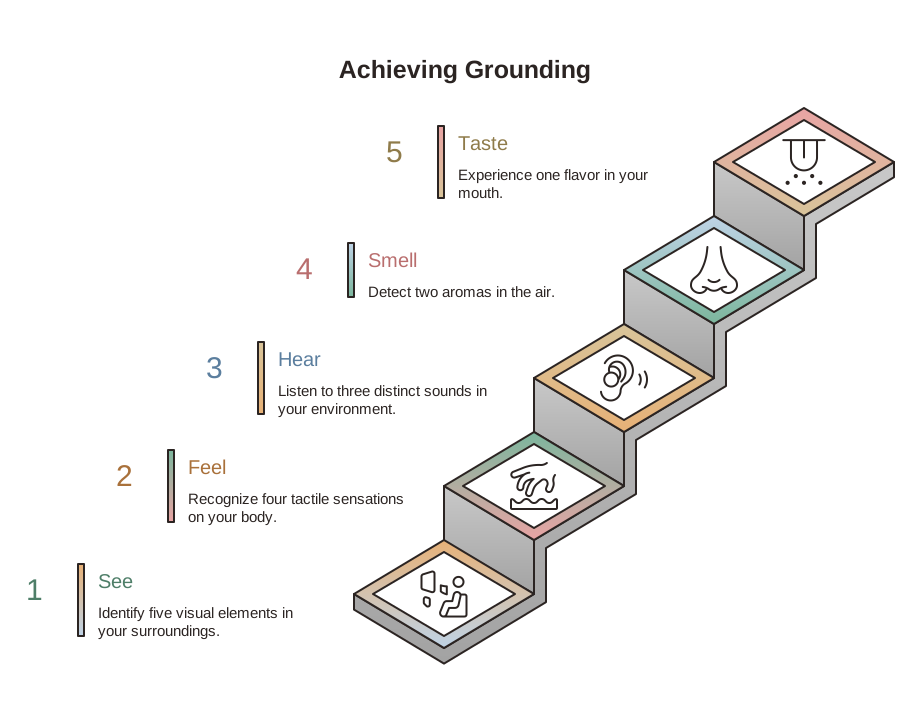
The technique is simple, but how you do it matters more than people expect. Go slowly. Rushing it turns it into a checklist, and a checklist won't pull you out of a spiral.
5 — things you can see
Look around and name five things, one at a time. Don't just count them — describe them. Not “a mug,” but “the chipped blue mug with the coffee ring near the handle.” The detail is the point. It forces your attention to land fully on each object instead of skating past it.
4 — things you can feel
Notice four physical sensations of contact: your feet inside your shoes, the weight of your phone in your hand, the seam of your jeans against your leg, the air on the back of your neck. These are happening constantly, but you've tuned them out. Tuning back in is the work.
3 — things you can hear
Close your eyes if you can. Listen for three distinct sounds — the hum of a fridge, traffic outside, your own breathing. Let them be ordinary. You're not judging the sounds, just registering that they're here, in this room, with you.
2 — things you can smell
This is the one people stall on, and that's fine — the slight effort of searching is itself grounding. Coffee, soap on your hands, fresh air, the faint smell of the room. If you genuinely can't find two, name two scents you like instead. The goal is engagement, not perfection.
1 — thing you can taste
Notice whatever's already in your mouth — coffee, toothpaste, just the neutral taste of your own mouth. Or take a sip of water and pay attention to it. One is enough. By now your attention has spent close to a minute somewhere other than the spiral.
When to use it
The best time is early — at the first physical signal that you're tipping into anxiety, before the spiral builds momentum. Common moments:
- The first flush of a panic attack, when your body floods before your thoughts catch up — we've also built a 60-second CBT exercise specifically for that moment.
- Lying awake at night with your mind running through everything that could go wrong.
- The minutes before something stressful — an interview, a difficult conversation, a flight.
- Mid-overthinking, when you notice you've been replaying the same scene for twenty minutes.
You don't have to wait until you're in crisis. Used as a small reset during an ordinary tense day, it stops anxiety from quietly accumulating.
What to do when it doesn't work
Plenty of people try 5-4-3-2-1 once, feel no different, and conclude grounding “doesn't work for them.” Usually one of these is happening:
You're rushing. Sprinting through the list to get back to worrying defeats the purpose. Slow down. Spend a real breath on each item.
You're expecting it to erase the anxiety. It won't, and it's not supposed to. Grounding turns the volume down and buys you a clearer moment — it doesn't delete the feeling. Aim for “a notch calmer,” not “completely fine.”
You only ever try it mid-panic. Mid-panic is the hardest time to learn anything. Practise it when you're calm — on a walk, in a queue — so the pattern is automatic and available when you actually need it.
The thought is the real driver. This is the big one. Grounding is brilliant at calming a reactive body, but if a specific belief is fuelling the spiral — I'm going to mess this up, they're angry at me, something's wrong with me — that thought is still sitting there when the grounding ends, ready to spike you again.
Grounding gets you calm. A reframe keeps you there.
Think of the two as a sequence. First you ground, because you can't reason with a body in fight-or-flight — the thinking part of your brain is barely online. Once you're a notch calmer, you have just enough room to look at the thought that started all this and ask whether it actually holds up.
That second step is where the lasting change happens. “They haven't replied, so something is wrong” is an interpretation, not a fact. Examined honestly, most spiral-thoughts turn out to be worst-case guesses dressed up as certainty. Replacing one with a more accurate, more grounded version is what stops it from pulling you straight back in — and it's a different skill from grounding, one worth building alongside it.
Make it a skill, not an emergency tool
The people who get the most out of 5-4-3-2-1 aren't the ones who discover it during a panic attack. They're the ones who've run it enough times in calm moments that it's become a reflex — something their body knows how to drop into without much thinking.
So practise it when you don't need it. Once a day, for a week, while you're waiting for the kettle. You're not trying to feel anything in particular — you're building a path your attention can find quickly later, when the spiral hits and you can't think clearly. Like any skill, it gets stronger every time you use it.
Anxiety will still show up. That's not the problem grounding solves. What it gives you is a reliable way back — a few specific things you can see, feel, hear, smell, and taste — that returns you to the one place anxiety can't follow: right now.
Frequently asked questions
What is the 5-4-3-2-1 grounding technique?
It is a sensory grounding exercise used to interrupt anxiety or a panic spiral. You deliberately notice five things you can see, four you can feel, three you can hear, two you can smell, and one you can taste. Anchoring your attention to concrete sensory input pulls your mind out of anxious thinking and back into the present moment.
Why does the 5-4-3-2-1 technique work?
Anxiety lives in imagined futures and replayed pasts. Your senses only report on right now. By forcing your attention onto specific, present-moment input, you interrupt the brain’s threat loop — it is very hard to catalogue your surroundings in detail and catastrophize at the same time. It also gives an over-activated nervous system a simple, achievable task.
When should I use the 5-4-3-2-1 technique?
Use it the moment you notice the physical signs of anxiety — racing heart, tight chest, spinning thoughts — or at the start of a panic attack. It also helps with nighttime spirals, pre-event nerves, and intrusive overthinking. The earlier you start, the more effective it is, because you are interrupting the spiral before it builds momentum.
What if the 5-4-3-2-1 technique doesn’t work for me?
The most common reasons it fails are rushing it, doing it once and expecting it to erase the anxiety, or only practising it mid-panic when it is hardest. Slow down, name each item out loud or in detail, and practise it when you are calm so the skill is automatic when you need it. Grounding settles your body — but if a specific thought is driving the spiral, you may also need to reframe that thought.
Is grounding the same as a reframe?
No. Grounding calms your body and interrupts the spiral; a reframe changes the thought that started it. They work best together: ground first to get out of fight-or-flight, then reframe the specific thought so it stops pulling you back in. Grounding without a reframe can leave the original worry intact, ready to spike again.
Like what you're reading?
Continue your wellness journey
Reframe negative thoughts in 60 seconds — free to start in the MindLift app.


Free to start · no account required
CBT & Self-Talk Researchers
MindLift content is grounded in cognitive behavioral therapy principles and designed to help you shift harsh self-talk in real time. Our guides focus on practical, evidence-based techniques you can use in the moment.
Was this article helpful?