
Turn this into a daily habit — free to start in the MindLift app:
You analyze every decision until the simple ones feel impossible. You replay conversations hours after they ended, hunting for the thing you said wrong. You plan for problems that never arrive. And somewhere in the middle of it, you've asked yourself the obvious question: why do I overthink everything?
The first thing worth saying is that you're not broken, and you're not doing this on purpose. Overthinking isn't a character flaw or a lack of willpower. It's a pattern — one your brain learned for understandable reasons — and patterns can be changed once you understand what's driving them.
What overthinking actually is
Overthinking is when thinking stops being useful and starts being a loop. Normal thinking has a destination: you consider something, reach a conclusion or a decision, and move on. Overthinking circles the same material — the same worry, the same choice, the same replayed moment — without ever landing.
It tends to take two forms. There's rumination, which looks backward (replaying what happened, what you said, what went wrong), and there's worry, which looks forward (rehearsing everything that could go wrong next). Most chronic overthinkers do both. What they share is the loop: lots of mental activity, very little resolution.
The real reasons you overthink everything
Overthinking isn't random. It usually traces back to a handful of drivers — and you'll probably recognize more than one.
1. Your brain is trying to keep you safe
At its root, overthinking is a safety behavior. Your threat-detection system treats analysis as protection: if you can just think through every angle, anticipate every problem, and spot every way things could go wrong, then maybe you can prevent them. The intention is good. The method is broken — because you can't think your way to certainty, so the system never gets the “all clear” and keeps running.
2. You can't tolerate uncertainty
This is the big one. Most overthinking is an attempt to make the unknown known — to think hard enough that you finally feel sure. But life doesn't offer that kind of certainty, so the search never ends. If not knowing how something will turn out feels genuinely unbearable, your mind will keep grinding away at it, mistaking the discomfort of uncertainty for a problem that more thinking can solve.
3. You're afraid of making the wrong choice
For a lot of people, overthinking spikes hardest around decisions. Underneath is a belief that there's a single right answer and a catastrophic wrong one — and that picking wrong would be unbearable or unforgivable. So you keep weighing, comparing, and second-guessing, trying to think your way to a guarantee that simply doesn't exist. Perfectionism pours fuel on this: if any mistake feels like proof of inadequacy, no amount of analysis ever feels like enough.
4. You're trying to control what you can't
Overthinking often shows up exactly where your actual control is lowest — what other people think of you, how an event will unfold, whether someone will text back. The mind reaches for the one lever it always has: more thinking. It feels like doing something. But analyzing a thing you can't influence doesn't give you control over it; it just keeps you tangled in it.
5. You learned it early
If you grew up somewhere unpredictable — where you had to read the room, anticipate moods, or stay one step ahead to feel safe — overthinking may have started as a genuinely useful skill. Back then, scanning for problems protected you. The pattern outlived the situation that created it, and now it runs even when there's nothing to scan for.
Is overthinking the same as anxiety?
They're close relatives, not the same thing. Anxiety is the state — the racing heart, the dread, the unease. Overthinking is one of the main behaviors the anxious brain uses to try to manage that state. Anxiety asks “what if something's wrong?” and overthinking answers by analyzing it from every direction, which briefly feels productive and then makes the anxiety worse.
That's the cruel loop: overthinking is supposed to reduce anxiety, but it actually feeds it. The more you analyze a worry, the more real and urgent it feels, and the more your nervous system stays switched on. You don't have to have an anxiety disorder to overthink — but if the overthinking is constant, distressing, and getting in the way of your life, it's worth taking seriously.
Why “just stop overthinking” never works
If telling yourself to stop worked, you'd have stopped already. It doesn't work for two reasons.
First, overthinking is a habit, not a decision. Every time analyzing something briefly lowers your anxiety — even for a second — your brain logs that overthinking “helped,” and reinforces it. You're not choosing the loop each time; it's a groove your mind falls into automatically.
Second, suppression backfires. Trying not to think about something reliably makes you think about it more — the classic “don't picture a white bear” effect. So willpower aimed at stopping the thoughts tends to amplify them. The way out isn't forcing the thoughts to stop. It's changing what you do when they show up.
How to actually quiet your mind
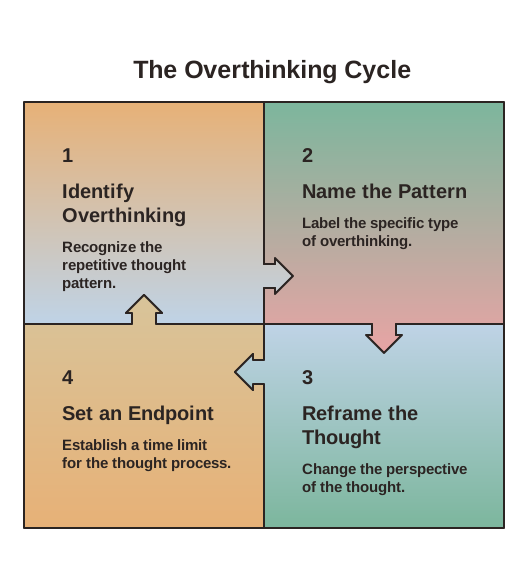
Notice and name it
You can't interrupt a loop you're lost inside. The moment you catch it — “I'm overthinking this” — you step from being in the thought to observing it, and that small distance is where every other technique becomes possible.
Ask if it's going anywhere
One honest question cuts through most overthinking: is this thinking taking me somewhere, or just in circles? Productive thinking moves toward a decision or an action. If you've been over the same ground repeatedly and you're no closer to anything but more anxious, it's a loop — and loops don't get solved by more laps.
Set a “good enough” threshold
Because so much overthinking is a hunt for certainty, decide in advance what enough looks like. “I'll gather these three pieces of information, then I'll choose.” Most decisions are reversible, and most are far less consequential than the overthinking implies. Practising “good enough” on small choices builds the tolerance for uncertainty that drains overthinking of its fuel.
Reframe the specific thought
Generic advice (“think positive,” “let it go”) doesn't touch overthinking because it never engages the actual thought. What works is taking the specific thought that's looping — in your own words — and replacing it with one that's more accurate and more grounded. Not a forced positive, just a truer version. That's what interrupts the loop, because your brain can actually accept and hold a thought that feels real.
Give it an action, or let it go
If there's a real next step hiding in the worry, name it and decide when you'll do it — the loop often quiets once your brain has somewhere to put the concern. If there genuinely isn't an action — if it's outside your control or already in the past — then the work is accepting the discomfort rather than solving it, because more thinking won't produce an answer it hasn't already failed to find.
The pattern underneath
If you overthink nearly everything, it's worth looking at what your loops have in common. Overthinking usually clusters around a few deep beliefs — I have to get it right, a mistake would be catastrophic, I can't handle not knowing, if I'm not vigilant, something bad will happen.
You won't think your way out of those beliefs — thinking is the very tool that keeps them running. But every time you catch a loop, question the specific thought, and choose to act or let go before the spiral builds, you're quietly teaching your brain something new: that you can tolerate uncertainty, that a mistake isn't the end, that you don't have to analyze everything to be safe.
The goal was never to stop thinking. Thinking is one of your best tools. The goal is a mind that can consider something and then put it down — that can engage with a hard question without getting trapped in it. That capacity is a skill, not a personality you're stuck with, and it gets stronger every time you interrupt a loop early enough to offer it something more grounded to hold.
Frequently asked questions
Why do I overthink everything?
Overthinking is usually your brain’s threat-detection system working overtime. It treats analysis as safety — if you can think through every angle and every thing that could go wrong, it feels like you can prevent it. The most common drivers are intolerance of uncertainty, fear of making the wrong decision, perfectionism, and a need to control outcomes. It is a learned habit, not a flaw in who you are.
Is overthinking a sign of anxiety?
Overthinking and anxiety are closely linked and often feed each other, but they are not the same thing. Anxiety is the emotional and physical state; overthinking is a mental behavior the anxious brain uses to try to feel safe. Not everyone who overthinks has an anxiety disorder, but persistent, distressing overthinking is one of the most common features of anxiety and responds well to the same techniques.
How do I stop overthinking everything?
Start by noticing it and naming it, which creates enough distance to question the thought. Ask whether your thinking is actually going somewhere or just circling. Set “good enough” thresholds for decisions instead of chasing certainty. And interrupt specific spiral-thoughts with a specific reframe in the moment, rather than waiting for a calmer time that never quite comes.
Why can’t I just stop overthinking?
“Just stop” fails because overthinking is a reinforced habit, not a conscious choice you can override with willpower. Every time analysis briefly lowers your anxiety, your brain learns that overthinking “worked,” so it does it more. Trying to suppress the thoughts tends to make them louder. What works is changing how you respond to the thoughts, not trying to force them to stop.
Does overthinking mean I’m intelligent?
Overthinking is sometimes linked to traits like conscientiousness and a tendency to analyze, but it is not a sign of intelligence and it is not productive. It feels like careful thinking, yet it usually produces more anxiety and worse decisions, not better ones. The goal is not to think less because you are smart — it is to think in a way that actually moves you forward.
Like what you're reading?
Stop the spiral in real time
MindLift gives you a gentle CBT-based reframe the moment your thoughts start looping.


Free to start · no account required
CBT & Self-Talk Researchers
MindLift content is grounded in cognitive behavioral therapy principles and designed to help you shift harsh self-talk in real time. Our guides focus on practical, evidence-based techniques you can use in the moment.
Was this article helpful?