
Turn this into a daily habit — free to start in the MindLift app:
You woke up with that feeling again.
Not a thought exactly. Just a weight. A low hum of dread that arrived before you were fully conscious, before you'd checked your phone or remembered anything specific to worry about.
And then, almost immediately, your brain started searching. Something must be wrong. What is it? What did I miss?
Maybe you found something — a conversation you could reinterpret, a deadline you could catastrophise, a silence from someone that could mean almost anything. Maybe you didn't find anything concrete, and that made it worse. The anxiety was looking for a reason to exist, and when it couldn't find one, it generated one.
This is one of the most exhausting cognitive patterns there is. And it has a name.
What emotional reasoning actually is
Emotional reasoning is a cognitive distortion — a systematic error in thinking that feels completely logical while it's happening. The pattern is simple: I feel it, therefore it's true.
- Anxious? Something must be wrong.
- Guilty? You must have done something bad.
- Convinced a relationship is failing? It must be.
- Certain you're about to be found out? You probably will be.
The emotion becomes the evidence. And because the emotion is real — because you genuinely feel it, in your body, right now — the conclusion feels real too.
This is what makes emotional reasoning so difficult to argue with. You can't tell someone their anxiety isn't real. It is real. You're feeling it. The feeling is happening. What's not real is the logical leap the feeling is triggering — the part where feeling anxious becomes proof that something is wrong.
Those are two separate things. But emotional reasoning collapses them into one.
What is emotional reasoning?
Emotional reasoning is a cognitive distortion where a feeling is treated as proof of a fact — 'I feel anxious, so something must be wrong.' The emotion becomes the evidence. The feeling is real; what's distorted is the leap from feeling anxious to concluding something is actually wrong. CBT separates the feeling from the conclusion and examines the conclusion on its own.
Why your brain does this
It's not irrational. In fact, it's an extremely efficient cognitive shortcut that served humans well for a long time.
Emotions evolved as information. Fear meant danger was near. Dread meant something in the environment warranted attention. Guilt meant a social bond was at risk. The brain learned to treat strong emotion as reliable signal — and for most of evolutionary history, it was.
The problem is that anxiety, specifically, doesn't operate on the same logic as those older emotional signals. Anxiety is anticipatory. It's designed to generate threat responses before the threat arrives, so you're ready if it does. That means it routinely fires in the absence of actual danger. It produces the full physiological and emotional signature of a threat — the weight, the dread, the certainty that something is wrong — when the threat is hypothetical, unlikely, or entirely constructed.
When you treat that feeling as evidence, you're trusting a system that was built to generate false positives. Not because your brain is broken — because it's doing exactly what anxiety is designed to do. The error is in treating the output as fact.
What it sounds like in practice
Emotional reasoning rarely announces itself. It sounds like clarity. It sounds like realism. It sounds like finally seeing things as they actually are.
"I just have a bad feeling about this."
"I can't explain it, I just know something is off."
"I feel like I'm going to fail, so I probably will."
"The anxiety is there for a reason — I must be missing something."
"I feel guilty, so I must have done something wrong."
"I feel like they're pulling away. That feeling doesn't come from nowhere."
None of these sound like distorted thinking. They sound like self-awareness. They sound like someone paying attention to themselves. And that's precisely why emotional reasoning is so persistent — it disguises itself as insight.
The tell is the logical structure underneath each statement. In every case, the evidence for the conclusion is the feeling itself. Not an event. Not a pattern of behaviour. Not something someone said or did. The feeling.
Emotion as signal vs emotion as evidence
This is the distinction that changes everything — and it's a fine one.
Emotions can be signals. A persistent sense of unease in a relationship might be worth examining. Guilt after a specific action might be pointing to something real. Dread before a conversation you've been avoiding might be accurate feedback that the conversation needs to happen.
The question isn't whether to take your emotions seriously. It's whether you're treating them as a starting point for examination or as a conclusion that closes the case.
Signal
"I feel anxious. What's actually going on here? Is there something specific that warrants attention?"
Evidence
"I feel anxious. Something must be wrong."
The first opens an inquiry. The second forecloses one. And when anxiety is involved, foreclosing the inquiry almost always means the anxiety fills in the answer — which is whatever version of wrong feels most threatening. If you're not sure which one you're doing, our "signal or noise" overthinking quiz can help you spot the pattern.
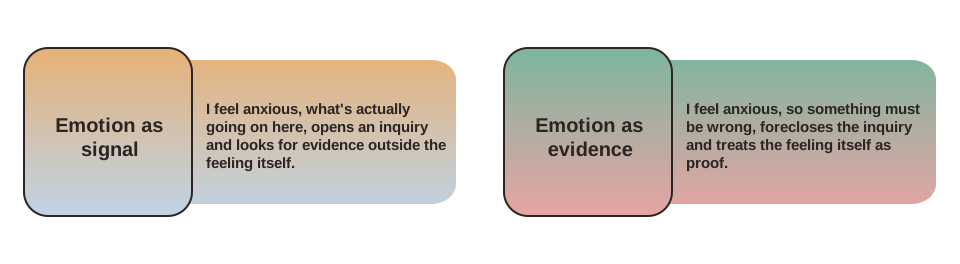
Emotional reasoning skips the inquiry entirely. The feeling arrives, the conclusion follows, and the brain goes looking for confirmation rather than examination — often by catastrophising the first thing it lands on.
Why examining the evidence is harder than it sounds
CBT's core intervention for emotional reasoning is evidence examination: you identify the conclusion the feeling is generating, then look for actual evidence for and against it.
Conclusion: Something is wrong.
Evidence for: I feel strongly that it is.
Evidence against: Nothing specific has happened. The last three times I felt this way, nothing was actually wrong. This feeling tends to peak in the morning and ease by afternoon.
On paper, this is straightforward. In practice, when you're in the middle of the feeling, it's genuinely difficult for two reasons.
First, the feeling makes the conclusion feel self-evident. You're not starting from a neutral position. You're starting from a state of physiological activation — elevated heart rate, cortisol, the cognitive narrowing that comes with anxiety — and trying to reason your way to a more accurate conclusion from inside that state. The brain doesn't operate neutrally under those conditions. It searches for confirmation.
Second, finding no concrete evidence doesn't necessarily resolve the feeling. Anxiety is comfortable with absence of evidence. It just shifts: I can't find anything specific, which means I'm probably missing something. The lack of a reason becomes its own reason. This is one of the more relentless types of overthinking — the loop never runs out of fuel because the absence of a problem is reinterpreted as a hidden one.
This is why the timing of intervention matters. The earlier you catch the thought — before it's had time to compound, before it's recruited additional evidence, before it's generated five follow-up questions — the more workable it is.
The one-sentence reframe that breaks emotional reasoning
When the feeling arrives and the conclusion follows, the single most effective interruption is to separate them explicitly. Not to dismiss the feeling. To question the conclusion.
"I feel anxious" — true, valid, real.
"Therefore something is wrong" — this is the assumption. Where's the evidence outside the feeling itself?
You're not telling yourself the anxiety doesn't exist. You're refusing to let it serve as its own evidence. You're treating the conclusion as a hypothesis, not a fact, and asking what you'd need to see to confirm or disconfirm it.
Sometimes this surfaces something real — a genuine concern that deserves attention, now that it's separated from the emotional charge. Often it surfaces nothing concrete, which is itself useful information. The feeling is real. The conclusion it generated is not supported. That's not toxic positivity. That's not telling yourself everything is fine. It's honest examination — which is what the feeling was asking for all along.
What gets in the way
Two things make this harder than it needs to be.
The first is timing. These thoughts don't arrive during calm moments when you have time to examine them. They arrive at night, mid-conversation, in the three seconds before you walk into a room. By the time you could journal about it, the feeling has either compounded or faded — and if it faded, you file it away as resolved when it isn't. It'll be back tomorrow morning.
The second is language. Emotional reasoning is specific. "Something is wrong" is not the same thought as "my relationship is failing" or "I'm going to be found out at work" or "I've done something to push them away." The reframe has to match the actual thought — the specific version of wrong your brain generated — to break the specific assumption underneath it.
Generic reassurance doesn't work here. "Everything will be fine" is not a response to "I feel like they're pulling away." It doesn't engage with the thought. It just overlays it with something more comfortable, and the original thought remains underneath, unexamined. What works is a reframe that takes your exact words, names the hidden assumption, and examines it directly. That's a different thing entirely.
The 167 hours between sessions
If you work with a therapist, you probably recognise emotional reasoning from your sessions. It's one of the most common patterns CBT addresses — and most people who have it can identify it in retrospect, after the fact, when the feeling has passed and the clarity returns.
The problem is that insight in a therapy session on Tuesday doesn't automatically transfer to 6am on Thursday when the dread arrives and the conclusion follows before you're fully awake. The gap between when you understand a pattern and when you can interrupt it in real time is where most people stay stuck.
MindLift was built for that gap. You type the exact thought — "I feel like something is wrong but I don't know what" or "I feel like they're pulling away" or "I woke up with this feeling and now I can't shake it" — and within 60 seconds you get three structured reframes in response to your specific words.
The Realist card challenges the assumption underneath the feeling. The Growth card names one concrete thing you can examine or do. The Compassionate card acknowledges what you're actually carrying without telling you the feeling is wrong to have.
It's not therapy. It's not journaling. It's the structured interruption that catches the thought before it compounds — in the moment it actually arrives, not the following Tuesday.
The anxiety is real. The conclusion it's generating deserves to be examined. That's not pessimism — it's the most honest thing you can do with a feeling that's trying to tell you something.
MindLift helps you find out what that something actually is.


Frequently asked questions
What is emotional reasoning in CBT?
Emotional reasoning is a cognitive distortion where you treat a feeling as proof of a fact: 'I feel anxious, so something must be wrong.' The emotion becomes the evidence. The feeling is real — what's distorted is the logical leap that turns feeling anxious into proof that something is actually wrong. CBT separates the two and examines the conclusion on its own merits.
Does feeling anxious mean something is actually wrong?
Not necessarily. Anxiety is anticipatory — designed to produce the full sensation of threat before a threat arrives, so you're ready if it does. That means it routinely fires in the absence of real danger. The feeling is genuine, but it's an unreliable measure of whether something is actually wrong. It's a starting point to examine, not a verdict.
How do I know if my anxiety is a real signal or just noise?
Ask whether there's evidence outside the feeling itself — a specific event, a pattern of behaviour, something someone said or did. Signal: 'I feel anxious, what's actually going on here?' Noise dressed as signal: 'I feel anxious, therefore something is wrong.' The first opens an inquiry; the second forecloses it and lets anxiety fill in the answer.
What's the fastest way to break emotional reasoning in the moment?
Separate the feeling from the conclusion explicitly. 'I feel anxious' is true and valid. 'Therefore something is wrong' is an assumption — treat it as a hypothesis and ask what evidence outside the feeling would confirm or disconfirm it. You're not denying the anxiety; you're refusing to let it serve as its own proof.
Like what you're reading?
Continue your wellness journey
Reframe negative thoughts in 60 seconds — free to start in the MindLift app.
Free to start · no account required
CBT & Self-Talk Researchers
MindLift content is grounded in cognitive behavioral therapy principles and designed to help you shift harsh self-talk in real time. Our guides focus on practical, evidence-based techniques you can use in the moment.
Was this article helpful?