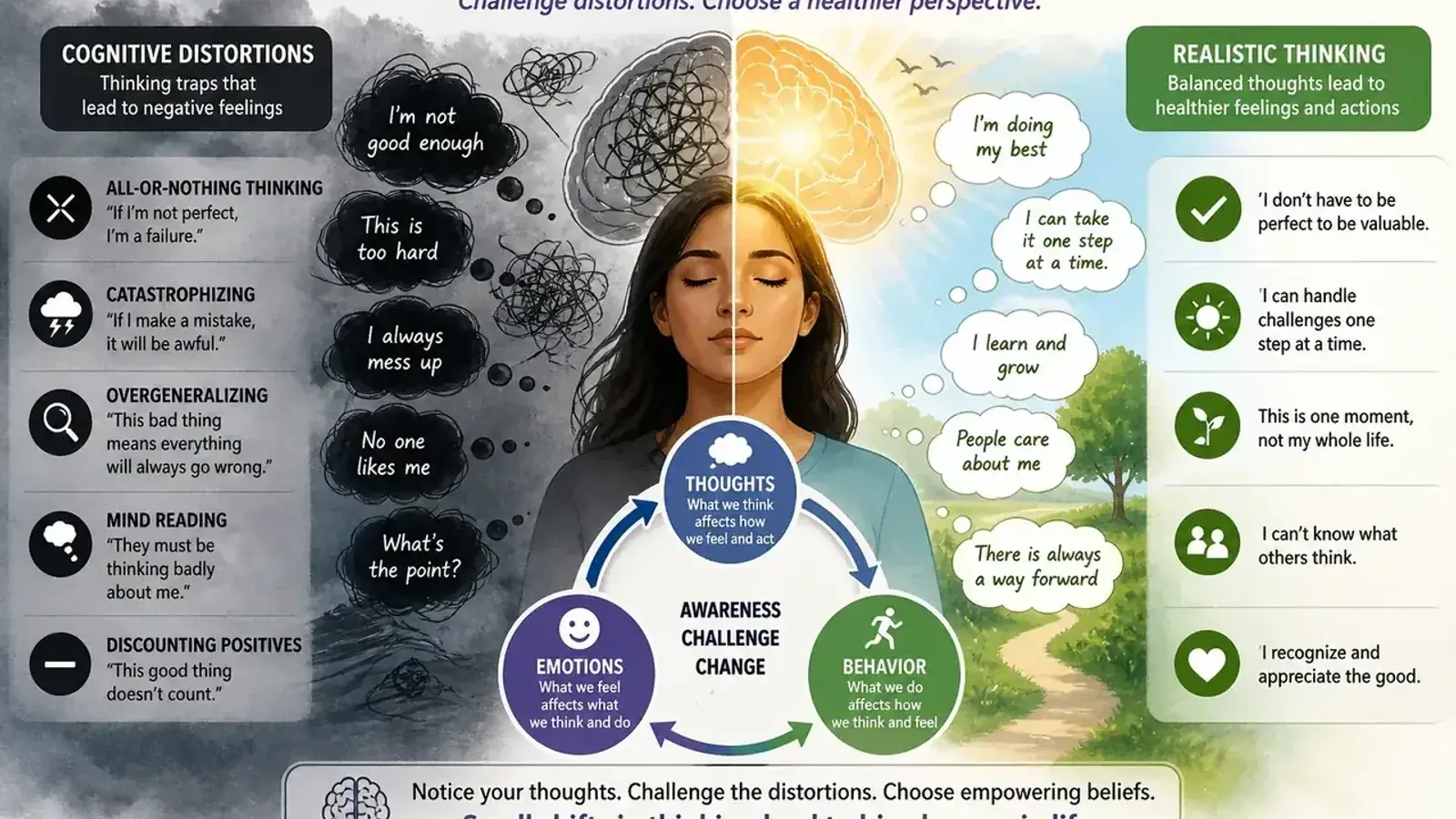
Turn this into a daily habit — free to start in the MindLift app:
You sent the text. It's been two hours. No response.
And somewhere between checking your phone and trying to focus on something else, your brain has already run the full scenario: they're annoyed at you. No — they're done with you. This is how it ends. You were always too much, or not enough, and now they finally see it.
Nothing has happened. There's no evidence. And yet the conclusion feels absolutely real.
That's catastrophizing — and if it sounds familiar, you're not dramatic or broken. You're running one of the most common cognitive patterns in the human brain, one that CBT has a name, a mechanism, and a clear set of tools for.
This article breaks all of it down: what catastrophizing actually means, what other words people use for it, what it looks like in real everyday situations, why the brain does it, and what actually helps interrupt it.
What catastrophizing means: the definition
Catastrophizing is a cognitive distortion in which the mind automatically jumps to the worst possible outcome of a situation — and then treats that outcome as likely, or even inevitable.
It has two moving parts that compound each other:
- Probability overestimation — you treat an unlikely bad outcome as though it's probable or certain.
- Cost overestimation — you inflate how terrible that outcome would be, while simultaneously underestimating your ability to cope with it.
When both happen at once, a small, unlikely problem becomes an enormous, inevitable one — and your nervous system responds with real anxiety to an imagined emergency.
The term comes from the word catastrophe (an event of great and usually sudden damage or suffering), with the suffix -ize meaning to make or treat as. To catastrophize is to make a catastrophe out of something — often something that, by any realistic measure, doesn't qualify as one.
The verb was coined by psychologist Albert Ellis, the founder of Rational Emotive Behavior Therapy, a form of CBT designed to help people identify and challenge the self-defeating thought patterns that drive emotional distress. Ellis identified catastrophizing as one of the most common and destructive of those patterns. In CBT, catastrophizing is classified as a type of cognitive distortion — a mental shortcut that feels accurate but consistently misrepresents reality.
Catastrophizing synonyms: other words for the same pattern
Depending on context, people and clinicians use several different terms for catastrophizing. They're not all identical, but they overlap significantly:
- Awfulizing — coined by Albert Ellis alongside catastrophizing. The tendency to rate something as "awful," "terrible," or "unbearable" beyond any rational scale. Where catastrophizing focuses on predicting bad outcomes, awfulizing focuses on the emotional magnitude of how bad those outcomes are rated.
- Catastrophic thinking — the most common clinical synonym, used interchangeably with catastrophizing in most CBT literature.
- Magnification — the CBT term used in Aaron Beck's cognitive model. It refers to enlarging the significance of negative events while shrinking the significance of positive ones. Catastrophizing is the extreme end of magnification.
- Making a mountain out of a molehill — the everyday phrase for the same pattern. Less clinical, same mechanism.
- Worst-case thinking — a descriptive synonym for the habit of mentally defaulting to the most negative possible scenario.
- Doomsday thinking — informal, typically used when catastrophizing extends to chronic, pervasive fears rather than situation-specific spirals.
- "What if" spiraling — not a clinical term, but widely recognized as the characteristic movement of catastrophizing: one "what if" triggering the next, each worse than the last, until the endpoint is disaster.
All of these point at the same core mechanism: the mind's tendency to run toward the worst possible conclusion and treat it as real.
Why the brain does this: the actual mechanism
Catastrophizing isn't a personality flaw or a sign of weakness. It's an evolutionary misfiring.
Your brain's threat-detection system — centered in the amygdala — evolved in an environment where physical dangers were immediate and real. Being alert to worst-case scenarios was genuinely adaptive: it kept you scanning for predators, preparing for food shortages, anticipating social rejection before it happened (which in early human communities could be literally life-threatening).
The problem is that the same system is now running in a world where most of the "threats" it detects are social, professional, or relational — and where the worst-case scenario is rarely as catastrophic as the brain rates it.
When you read a terse email from your manager, your amygdala doesn't distinguish that from a physical threat. It fires the same alarm, floods the body with stress hormones, and initiates the same scanning behavior: assess the danger, prepare for the worst.
Brain imaging research shows overactivation in the regions responsible for emotion regulation and pain perception in people who catastrophize frequently. This means catastrophizing isn't "just overthinking" — it has a real neurobiological basis, and it's often compounded by past experiences. People who grew up in unpredictable or unstable environments often develop catastrophic thinking because their nervous systems were trained to stay on high alert. It was adaptive then. It costs them now.
Real-life examples of catastrophizing
Catastrophizing tends to follow a chain structure: one real (if small) event triggers a cascade of increasingly negative conclusions, each one feeding the next. Here's what that looks like across different areas of life:
Work
The chain: My manager noticed → they think I'm incompetent → they'll stop trusting me with important projects → I'll get passed over for the promotion → I'll be stuck here forever → I should have just stayed in my last job.
What's actually likely: Your manager may have noticed, may not have, and either way considers it a minor mistake. The conclusion — professional stagnation — is seventeen logical steps away from the trigger.
Relationships
The chain: They're annoyed with me → I did something wrong and don't know what it is → they're pulling away → this is the beginning of the end → I'll be alone again → I always end up here.
What's actually likely: They had a hard day at work and they're tired. Their internal state has nothing to do with you.
Health
The chain: This isn't normal → something is wrong → it could be serious → what if it's neurological → what if I need tests → what if the tests find something.
What's actually likely: Tension headache, dehydration, poor sleep, or screen time — the explanations that account for the vast majority of headaches in otherwise healthy people.
Social situations
The chain: Everyone noticed → they think I'm weird → they're judging me → they'll talk about it later → no one actually likes me → I've been misreading my social relationships for years.
What's actually likely: Most people were too busy thinking about themselves to retain your awkward comment for longer than about thirty seconds.
The missed message
The chain: They're ignoring me → they're upset → I've done something wrong → this relationship is damaged → I'm too much → I always push people away.
What's actually likely: They're busy, their phone is on do not disturb, or they started typing a reply and got distracted.
In every example, the structure is the same: a real (if minor) event, a chain of worst-case interpretations, and a conclusion that is emotionally devastating but bears almost no relationship to the available evidence.
How to tell if you're catastrophizing in the moment
Catastrophizing often doesn't announce itself. It feels like realistic concern, not distortion. Here are the signals to watch for:
- The "what if" chain. Thoughts that keep escalating — what if this, then what if that — with each link worse than the last.
- The leap to the worst endpoint. Skipping from the current situation directly to the most extreme possible conclusion. A missed call becomes someone in hospital.
- The certainty feeling. A sense that the conclusion is not just possible but inevitable. "I just know something is wrong." The emotional conviction feels like evidence.
- Underestimating your own coping. Not just that the bad thing will happen, but that if it did, you wouldn't be okay. This double-punch is what makes catastrophizing so depleting.
- The spiral exhaustion. You've been turning the same thought over for an hour and it's getting worse, not better. Ordinary worry tends to resolve; catastrophizing loops.
What actually helps: the CBT approach
The goal isn't to replace catastrophic thoughts with forced positivity. It's to bring them back to accuracy. These are the techniques CBT uses — not because they feel good, but because they work.
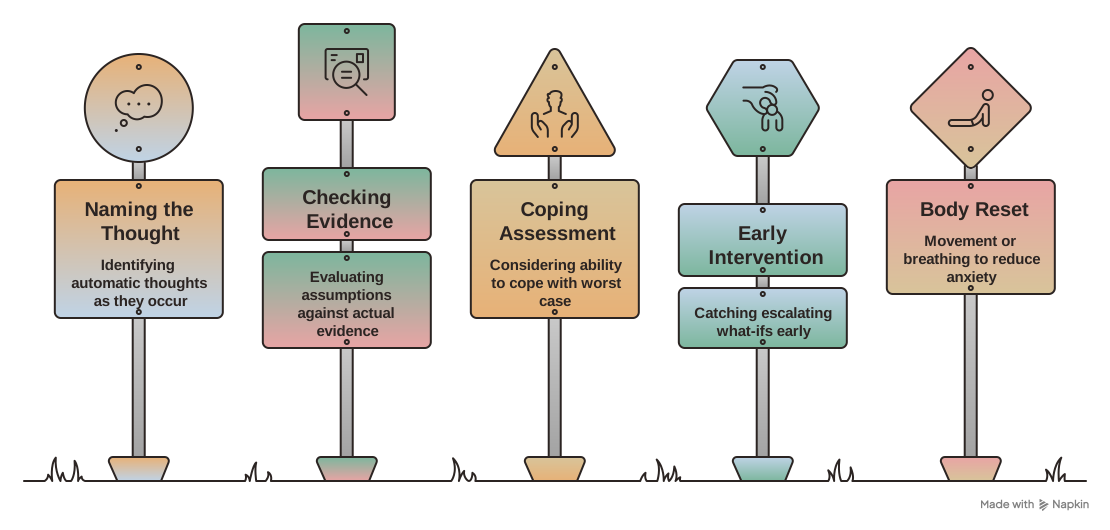
1. Name it
The first intervention is simple: catch the thought and label it. "I'm having a catastrophic thought" is different from "this is true." Naming the pattern interrupts the automatic quality of the spiral — you're no longer inside the thought, you're observing it. This is called cognitive defusion: creating distance between you and the thought rather than treating the thought as reality.
2. Run the three-question check
This is the core CBT decatastrophizing technique — three questions that work best in writing:
- What is the worst-case outcome I'm predicting? Write it out explicitly. Putting it into words already reduces its power.
- What is the most realistic outcome? Not the best case. The genuinely most probable one, if you were advising a friend rather than yourself.
- If the worst case did happen, could I cope? This is the step most people skip. Catastrophizing requires believing both that the worst will happen and that you couldn't survive it. Most people, when they actually think it through, find they have more coping resources than the catastrophizing mind assumes.
3. Check the evidence
The catastrophizing conclusion usually arrived before any evidence was gathered. Go backwards: What do I actually know, versus what am I assuming? What are alternative explanations? Have I been in situations like this before, and what actually happened? This isn't about dismissing the concern — it's about matching the level of alarm to the level of evidence.
4. Interrupt the chain early
Catastrophizing is much easier to interrupt at link two or three than at link eleven. Once the chain has run for a while, the emotional state is already high and the thoughts feel more real. Catching the first "what if" before it triggers the next is the skill that pays out most over time — and it builds with repetition.
5. Do something physical
The catastrophizing spiral is partly a body state. Anxiety has a physiological component — elevated heart rate, shallow breathing, muscle tension — that the mind then tries to explain with more catastrophic thoughts. Movement, cold water, slow breathing, or just standing up and changing rooms interrupts the physical loop that sustains the mental one.
Why catastrophizing is particularly hard to interrupt alone
Here's the part most articles skip: catastrophizing is hard to challenge from inside the spiral. When you're mid-spiral, the catastrophic thought doesn't feel like a distortion — it feels like clarity. That quality is what makes it sticky. You can know, intellectually, that catastrophizing is a thinking pattern, and still find it almost impossible to dispute the thought in real time, with your nervous system elevated, alone with your own head.
The most effective interventions are the ones that happen at the moment the spiral starts — not an hour later in a journal, not in a therapy appointment next week. In the window between the trigger and the full catastrophic conclusion, there's a brief opportunity to introduce a different perspective. That window closes fast.
How MindLift was built for exactly this window
MindLift is a free-to-start CBT-based app that does one thing: takes the thought you're stuck in and gives you three ways to look at it differently — realistic, growth-oriented, and compassionate — in under 60 seconds.
You type the actual thought — "she hasn't texted back in two hours and I know something is wrong" — and MindLift reframes it back to you using your own words, not generic affirmations. A realistic angle that challenges the probability assumption. A growth angle that addresses the underlying pattern. A compassionate angle that meets the emotion without reinforcing the catastrophe.
It's not therapy. It's the 60-second intervention for the 167 hours between sessions — the moment the spiral starts, when the usual advice is hardest to apply.
The key thing to remember
Catastrophizing is not a character flaw. It's a pattern — and patterns have mechanisms, and mechanisms can be interrupted. The mind that sprints to worst-case scenarios is trying to protect you. It's running an old piece of software in a new environment. The goal isn't to silence it. It's to build enough awareness of how it operates that you can meet it with something more accurate than agreement. That starts with knowing the name. Now you do.
If you want to see which cognitive distortion runs your brain most often — catastrophizing is just one of several — take the free Thought Distortion Quiz. If you already know it is catastrophizing and want to know how far it goes, the worst-case thinker quiz shows which of three levels you run. And if summer is bringing its own specific flavour of anxiety and spiraling, this article on why summer plans make you anxious is worth reading.
Frequently asked questions
What is the definition of catastrophizing?
Catastrophizing is a cognitive distortion in which the mind automatically jumps to the worst possible outcome of a situation and treats that outcome as likely or even inevitable. It combines probability overestimation (treating an unlikely bad outcome as certain) with cost overestimation (inflating how terrible it would be while underestimating your ability to cope).
What is a synonym for catastrophizing?
Common synonyms include awfulizing (coined by Albert Ellis), catastrophic thinking, magnification (the term in Aaron Beck's cognitive model), worst-case thinking, doomsday thinking, and the everyday phrase "making a mountain out of a molehill." They all point at the same mechanism: running toward the worst conclusion and treating it as real.
What is an example of catastrophizing?
You send an important message and get no reply for a few hours, and your mind concludes: they're ignoring me, they're upset, I've done something wrong, this relationship is damaged, I always push people away. The realistic explanation — they're busy or distracted — is the most likely one, but the catastrophic chain feels completely true.
How do you stop catastrophizing?
The CBT approach is to bring the thought back to accuracy rather than replace it with forced positivity: name the thought ("I'm catastrophizing"), run the three-question check (worst case, realistic case, could I cope?), check the actual evidence, interrupt the "what if" chain early, and reset the body state with movement or slow breathing.
Like what you're reading?
Continue your wellness journey
Reframe negative thoughts in 60 seconds — free to start in the MindLift app.


Free to start · no account required
- Beck, A. T. (1963). Thinking and depression: I. Idiosyncratic content and cognitive distortions. Archives of General Psychiatry, 9(4), 324–333. — DOI (opens in a new tab)
- Sullivan, M. J. L., Bishop, S. R., & Pivik, J. (1995). The Pain Catastrophizing Scale: Development and validation. Psychological Assessment, 7(4), 524–532. — DOI (opens in a new tab)
CBT & Self-Talk Researchers
MindLift content is grounded in cognitive behavioral therapy principles and designed to help you shift harsh self-talk in real time. Our guides focus on practical, evidence-based techniques you can use in the moment.
Was this article helpful?