
Turn this into a daily habit — free to start in the MindLift app:
You spent Saturday in bed. Phone, snacks, four episodes of something you barely remember.
Was that self-care… or a signal?
"Bed rotting" has billions of views on TikTok, and the internet has split into two camps: the ones calling it radical rest, and the ones calling it depression with better branding.
Here's the uncomfortable truth: both camps are right. Bed rotting can be legitimate recovery. It can also be avoidance wearing a self-care costume. The behavior looks identical from the outside — the difference is what's happening underneath.
Why bed rotting went viral (and why that's not a bad thing)
The trend didn't come from nowhere. It's a backlash against a culture that treats every hour as something to optimize. Gen Z watched millennials burn out chasing 5am routines and side hustles, and responded with the opposite: what if I just… didn't?
And there's real psychology backing the instinct. Your nervous system isn't built for constant output. After sustained stress, your body needs genuine downtime to move out of sympathetic activation (fight-or-flight) and into parasympathetic recovery (rest-and-digest). A day of doing nothing after a brutal week isn't laziness — it's physiology.
The problem is that "rest" and "collapse" feel similar in the moment but do very different things to your brain.
Rest vs. avoidance: the distinction that actually matters
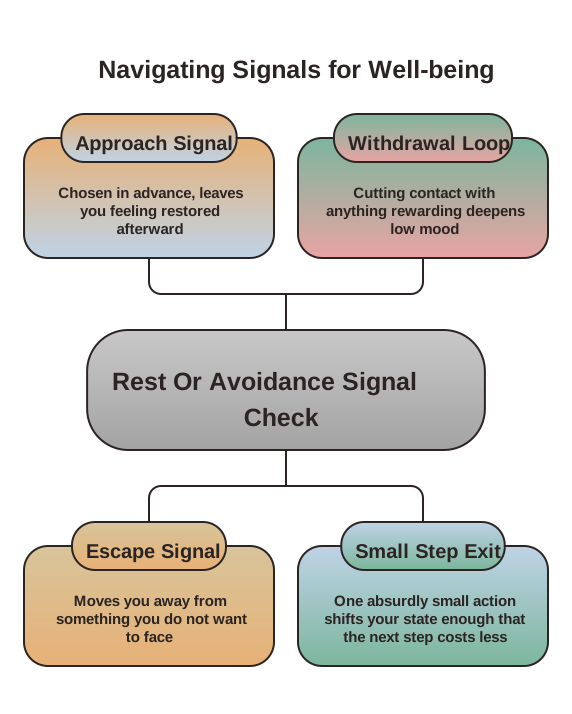
In CBT terms, the question is never "is staying in bed good or bad?" It's what function is the behavior serving?
Rest is approach-oriented. You're moving toward recovery. You chose it, it has a rough endpoint, and you come out the other side feeling at least somewhat restored.
Avoidance is escape-oriented. You're moving away from something — an inbox, a conversation, a feeling. The bed isn't restoring you; it's anesthetizing you. And like all avoidance, it works brilliantly in the short term and makes everything worse in the long term, because the avoided thing grows scarier while your confidence in handling it shrinks.
That isn't just a framing. It's the mechanism behind behavioral activation, built from behavioral theories of depression: withdrawing from activity in response to low mood cuts your contact with anything rewarding, which deepens the low mood, which drives more withdrawal. The loop feeds itself. In a randomised trial comparing behavioral activation, cognitive therapy and antidepressant medication, behavioral activation performed comparably to medication among more severely depressed patients — which tells you withdrawal isn't only a symptom of low mood. It's an engine of it.
The scroll isn't neutral
Bed rotting is rarely lying still. It's lying still with a phone — and that detail does more work than it looks like. Research using both lab experiments and real-time experience sampling found that passive social media use — scrolling and consuming without posting or interacting — predicted declines in how people felt over time. Active use (messaging, posting) didn't produce the same effect. The mechanism was envy: passive scrolling increased it, and the envy drove the mood drop.
Bed-rot scrolling is almost definitionally the passive kind — hours of consumption, no interaction. So the default bed-rot day pairs rest with the exact usage pattern linked to feeling worse at the end of it. That's part of why you can spend nine hours "resting" and get up flatter than you lay down.
It runs on the same engine as procrastination
Researchers stopped treating procrastination as a time-management flaw a long time ago. The dominant model treats it as an emotion-regulation strategy: when a task or a feeling is aversive, delaying it gives you genuine short-term mood relief — and hands the cost to your future self.
That maps onto bed rotting almost exactly. The thing being avoided isn't always a chore. Sometimes it's an email, a conversation, or just the activation energy of being a person today. Getting into bed delivers the same relief as closing the laptop, and defers the same bill. Which reframes the whole thing: it isn't laziness. It's mood repair that works brilliantly for an hour and poorly for a week.
5 signs your bed rotting is genuine rest
- You chose it in advance — "this Saturday is a nothing day" — rather than defaulting into it.
- It has edges. A morning, a day. Not an open-ended blur.
- You feel better afterward — more energy, clearer head, ready to re-enter your life.
- It follows genuine depletion — a heavy work stretch, illness, emotional labor.
- You can leave the bed when something appealing comes up, and sometimes you do.
5 signs it's sliding into avoidance (or low mood)
- It doesn't feel restful anymore. You're numb, not recharged — and often more tired after.
- You're hiding from something specific: messages, deadlines, people, feelings.
- Guilt runs the whole time. Rest with a shame soundtrack isn't rest; it's rumination in a horizontal position.
- It's the default, not the exception. Most free days end up as bed days.
- Other depression signals are showing up: lost interest in things you used to enjoy, disrupted sleep, appetite changes, hopeless self-talk.
If that second list sounds familiar for two weeks or more, that's not a character flaw — it's a pattern worth taking seriously, ideally with a professional. Bed rotting didn't cause it; it's the visible edge of it.
One honest caveat on the research here, since it gets overstated online: reviews describing the link between sleep and depression as complex and bidirectional are about hypersomnia — excessive sleeping — not lying awake in bed scrolling. Those aren't the same behaviour, and nobody has run the study on bed rotting itself. What carries across is the direction of travel: sleep and mood push on each other both ways, so a pattern that reshapes your sleep isn't mood-neutral either.
The shame spiral that keeps you stuck
Here's the loop most people fall into: stay in bed → feel guilty → guilt makes the day feel already ruined → "might as well stay in bed" → repeat.
Notice that the engine of that loop isn't the bed. It's the self-talk about the bed. "I'm so lazy." "I've wasted the whole day." "What's wrong with me?" Each of those thoughts drains exactly the energy you'd need to get up.
This is the part the trend can't see, because it looks like nothing is happening. Bed rotting feels passive, but it's rarely mentally quiet. The research on rumination is consistent: dwelling on how bad you feel, without moving toward problem-solving, reliably makes low mood worse, degrades your ability to actually solve the problem, and suppresses the instrumental action that would fix it. Distraction, by comparison, tends to lift mood. A day framed as "unplugging" often becomes hours of unstructured rumination — the exact response style that extends a low mood rather than resolving it.
CBT calls this the difference between the first arrow (the tiredness) and the second arrow (the story you tell about the tiredness). You can't always dodge the first. The second one is optional.
Gentle exit ramps (no 5am routine required)
If you recognize the avoidance pattern, the fix isn't discipline. It's behavioral activation — the approach that matched antidepressant medication for more severely depressed patients in the randomised trial above — and it works on a principle that surprises most people: action comes before motivation, not after.
Waiting to "feel like it" is a trap, because the feeling arrives only after you've started. So start absurdly small:
- Sit up and drink a glass of water. That's it. That's the whole task.
- Open a window or step outside for 60 seconds. Light and air shift your physiology faster than willpower does.
- Five-minute shower. Not "get ready for the day." Just water.
- One reframe. Swap "I've wasted the day" for "the day isn't over, and the next hour is mine to choose."
- Text one person — not to make plans, just contact. Isolation and low mood feed each other.
Each tiny step nudges your state, and from the new state the next step costs less. That's the entire mechanism. No transformation montage needed.
Keep the rest, lose the rot
The healthiest response to the bed rotting debate isn't picking a side. It's building intentional rest into your life so your body never has to seize it through collapse.
Schedule the nothing-day before you're wrecked. Protect it without guilt. And when you notice the bed becoming a hiding place instead of a recharging station, meet yourself with a small step and a kinder sentence — not a lecture.
Wondering if your exhaustion runs deeper than a busy week? Take the free Am I Burnt Out? quiz — three minutes, and it maps where your energy is actually going.
Rest is a skill. Like every skill, it gets better when you do it on purpose.
Frequently asked questions
What is bed rotting?
Bed rotting is the practice of spending extended time in bed doing low-effort activities — scrolling, snacking, watching shows — as intentional rest. The term went viral on TikTok as a form of self-care that rejects hustle culture. Psychologically, it can be genuine recovery or a sign of avoidance and low mood, depending on how it feels and how often it happens.
Is bed rotting bad for your mental health?
Occasional bed rotting after a demanding stretch is a normal recovery behavior and can genuinely restore energy. It becomes a concern when it's the default rather than the exception: when it stops feeling restful, when you're avoiding specific tasks or people, or when it comes with guilt, numbness, or worsening sleep. Frequency and how you feel afterward matter more than the behavior itself.
How do I know if my bed rotting is actually depression?
Ask three questions: Do I feel better or worse afterward? Am I choosing this or does everything else feel impossible? Is it occasional or most days? Rest leaves you somewhat restored and is a choice. If staying in bed feels like the only option, lasts most of the day for two weeks or more, and comes with loss of interest, hopelessness, or changes in appetite and sleep, those are depression signals worth discussing with a professional.
How do I stop bed rotting without shaming myself?
Skip the drill-sergeant approach — shame fuels the avoidance loop. Instead use tiny activation steps: sit up and drink water, open a window, take a 5-minute shower. Behavioral activation research shows action precedes motivation, not the other way around. One small step shifts your state enough that the next one gets easier. The goal isn't banning rest; it's making rest a choice again.
Like what you're reading?
Take control of your mental wellness
Reframe the thought that started it — personalized CBT reframes in the MindLift app.


Free to start · no account required
- Dimidjian, S., Hollon, S. D., Dobson, K. S., Schmaling, K. B., Kohlenberg, R. J., Addis, M. E., et al. (2006). Randomized trial of behavioral activation, cognitive therapy, and antidepressant medication in the acute treatment of adults with major depression. Journal of Consulting and Clinical Psychology, 74(4), 658–670. — DOI (opens in a new tab)
- Verduyn, P., Lee, D. S., Park, J., Shablack, H., Orvell, A., Bayer, J., Ybarra, O., Jonides, J., & Kross, E. (2015). Passive Facebook usage undermines affective well-being: Experimental and longitudinal evidence. Journal of Experimental Psychology: General, 144(2), 480–488. — DOI (opens in a new tab)
- Sirois, F. M., & Pychyl, T. A. (2013). Procrastination and the Priority of Short-Term Mood Regulation: Consequences for Future Self. Social and Personality Psychology Compass, 7(2), 115–127. — DOI (opens in a new tab)
- Nolen-Hoeksema, S., Wisco, B. E., & Lyubomirsky, S. (2008). Rethinking Rumination. Perspectives on Psychological Science, 3(5), 400–424. — DOI (opens in a new tab)
- Dauvilliers, Y., Lopez, R., Ohayon, M., & Bayard, S. (2013). Hypersomnia and depressive symptoms: methodological and clinical aspects. BMC Medicine, 11, 78. — View source (opens in a new tab)
Mental Wellness Writers
The MindLift Wellness Team writes evidence-based content on CBT, self-talk, and everyday mental health tools.
Was this article helpful?