
Turn this into a daily habit — free to start in the MindLift app:
Your nervous system doesn't care about your to-do list.
It cares that you didn't cry before coffee.
There's a reason Bare Minimum Mondays exploded on social media:
Mondays have become the emotional equivalent of staring at a browser with 47 tabs open — none of them loading.
But what if the point of a Bare Minimum Monday wasn't to manage your work…
but to manage your mind?
What if the real productivity hack wasn't grinding harder —
but starting the week in a way your nervous system can actually tolerate?
This isn't laziness.
This is psychology with boundaries.
Let's break down why Bare Minimum Mondays are good for your brain — and how to turn them into a mental health ritual that actually resets your week.
1. Your Brain Can't "Start Strong" When You're Still in Survival Mode
Most people enter Monday already depleted:
- poor sleep
- leftover stress from the weekend
- emotional hangover from last week
- decision fatigue
- anxiety about what's coming
Launching into "high performance mode" on Monday morning is like trying to sprint with your shoe halfway on.
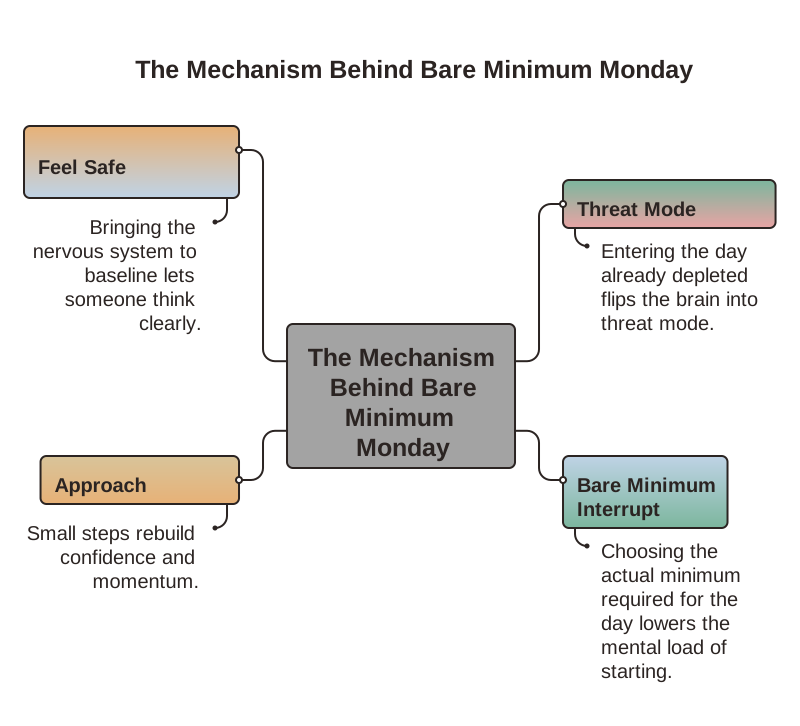
CBT research shows that when your stress levels spike immediately at the start of the day, your brain switches into threat mode:
tight chest, negative thoughts, impulsive avoidance, perfectionism.
A Bare Minimum Monday interrupts that cycle.
It tells your nervous system:
"We're safe. We're starting slow."
2. The "Bare Minimum" Is Actually the Optimal Minimum
Soft productivity isn't giving up.
It's dropping the unrealistically high standards that create burnout.
When you choose the bare minimum — the actual minimum required for the day to function — you reduce:
- cognitive load
- emotional overwhelm
- avoidance behavior
- the spiral of "I'm already behind"
And you shift into what CBT calls approach behavior:
small steps that rebuild confidence and momentum.
It turns out that showing up for 20% of your tasks on Monday means you'll show up better for 100% of your tasks by Wednesday.
3. Mondays Don't Need Motivation — They Need Regulation
A lot of people think they need motivation to start the week.
But motivation is unreliable.
It's fragile.
It depends on mood.
Regulation, on the other hand?
It's stable.
It's physiological.
It's the ability to bring your nervous system to baseline so you can think clearly.
You don't need to feel inspired.
You need to feel safe enough to begin.
That's the true spirit of Bare Minimum Monday.
4. So What Does a "Mental Health Bare Minimum Monday" Look Like?
Not "slacking."
Not "quiet quitting."
Not "pretending emails don't exist."
It looks like this:
✔ One grounding ritual before touching your phone
(Your brain deserves a moment of humanity.)
✔ A to-do list with only 1–3 actual priorities
Not aspirational tasks — realistic ones.
✔ Permission to start slowly and imperfectly
No "all or nothing." No guilt.
✔ One kindness toward your future self
Refill your water bottle. Clear your desk. Choose your outfit for tomorrow. Small actions that stabilize your mind.
✔ A boundary: "I don't make major decisions on Mondays."
Your prefrontal cortex thanks you.
5. How This Helps Break Perfectionism
Perfectionism peaks on Monday:
New week, new chance to be flawless.
Bare Minimum Mondays break that loop by lowering the cost of beginning.
CBT calls this reducing activation energy — making the first step easy so the rest become possible.
When you're no longer trying to "win Monday," you're actually more likely to:
- start tasks without fear
- finish what you begin
- think clearly
- avoid burnout
- stay consistent
Perfectionism is loud.
Bare Minimum Monday turns the volume down.
6. The Best Part — The Calm Follows You Into the Week
When you start the week gently, everything else feels softer:
- Tuesday feels manageable.
- Wednesday feels less chaotic.
- By Thursday, you feel competent again.
- Friday stops being a collapse.
This is nervous system regulation disguised as a productivity trend.
7. A Mini Script for Your Bare Minimum Monday
Use this like a grounding check-in:
Morning:
"I don't have to shock my system to prove my worth."
Midday:
"One tiny step is enough for today."
Afternoon:
"I can end the day proud of any effort I made."
Evening:
"I didn't sprint. I didn't collapse. I took care of myself."
That's a successful Monday.
8. Make It a Weekly Ritual, Not a One-Time Fix
The power of this practice isn't in the trend —
it's in the consistency.
Every Monday you choose the bare minimum, you teach your brain:
- less panic
- less perfectionism
- less urgency
- more self-trust
- more clarity
- more emotional regulation
You're not lowering your potential.
You're lowering the pressure that keeps you from reaching it.
Final Thought
Your boss might want a motivated employee.
Your brain wants a regulated human.
Productivity is easier when your nervous system isn't begging for a break.
So if you start this Monday softly?
That's not failure.
That's intelligent self-preservation.
Frequently asked questions
What is Bare Minimum Monday?
Bare Minimum Monday is a practice where people intentionally limit their work output on Mondays to ease into the week without stress. It originated as a response to Sunday anxiety and the pressure to start the week in peak productivity mode. From a mental health perspective, it's a form of nervous system regulation.
Is Bare Minimum Monday good for productivity or does it hurt performance?
Research on energy management suggests that strategic low-output periods can improve overall weekly performance by preventing burnout. Monday overexertion often leads to mid-week crashes. Bare Minimum Monday isn't laziness — it's pacing. Most productivity loss comes from fatigue, not starting slowly.
What is nervous system regulation and why does Monday anxiety happen?
Nervous system regulation refers to the body's ability to shift between stress activation and calm. Monday anxiety — sometimes the Sunday scaries carried forward — occurs when anticipatory stress triggers a cortisol spike before the week begins. Intentionally lowering Monday demands helps the nervous system reset.
How do I practice Bare Minimum Mondays without falling behind at work?
Identify your one non-negotiable Monday task — the thing that would cause actual problems if undone. Do that. Everything else can be rescheduled or done Tuesday. This preserves momentum without requiring peak performance before your nervous system is ready.
Like what you're reading?
Continue your wellness journey
Reframe negative thoughts in 60 seconds — free to start in the MindLift app.


Free to start · no account required
Mental Wellness Writers
The MindLift Wellness Team writes evidence-based content on CBT, self-talk, and everyday mental health tools.
Was this article helpful?