
Turn this into a daily habit — free to start in the MindLift app:
Spend Saturday in bed and people worry about you. Spend Saturday in a deck and people call you driven.
Same move. Same function. One gets a concerned text; the other gets a promotion. Work is the best-camouflaged escape there is — the only avoidance behaviour with a compensation package attached.
Is overworking a form of avoidance?
It can be, and it hides better than any other kind. Avoidance is defined by what it does, not by how it looks: it delivers immediate relief from something uncomfortable, and the relief is what keeps it running. Work delivers that relief AND social approval, so it never gets flagged. The test isn't hours. It's what surfaces when you stop — if the quiet gets loud, the work was doing a second job.
The camouflage is the problem
We're good at spotting avoidance when it looks lazy. Bed rotting gets called out precisely because it's visibly unproductive — nobody has to be persuaded that lying in bed for nine hours might be about something other than rest.
Overworking gets a free pass, because the output is real. The deck exists. The bug is fixed. The client is happy. And that output functions as an alibi: it's very hard to argue that a thing which produced results was an escape.
But avoidance isn't defined by whether the activity is worthwhile. It's defined by what the activity is for. If opening the laptop reliably ends a feeling you don't want to have, the laptop is doing two jobs, and only one of them is on your job description.
What the work is standing in front of
It's rarely dramatic. Usually it's one of a few very ordinary things.
An unstructured hour. Nothing to do and nobody needing anything is when the thoughts get their turn. Work is a legitimate reason to never have that hour.
A relationship that needs attention. Not a crisis — a conversation you don't want to start. Being busy is the most socially acceptable way to not be available.
A question about the shape of your life. Whether this is what you wanted. That one only gets asked when the room is quiet, so the room never gets quiet.
Yourself, without the output. The big one. If your worth has been running on delivery for long enough, stopping doesn't feel like rest — it feels like exposure.
"I can't say no" is anxiety, not capacity
Watch the actual mechanics of an ask. Someone requests something. There's a beat where you could say no — and in that beat you have to sit with a specific discomfort: a pause on the call, a reaction you're now imagining, a version of yourself that disappointed someone.
"Yes" ends that discomfort instantly. Completely. It's the most effective relief available, and it costs nothing now — the bill goes to a version of you three weeks out who has to deliver the thing at midnight and who, crucially, isn't in the room.
That's short-term mood repair, and it's the same trade procrastination runs — just pointed in the opposite direction. The procrastinator buys relief by not starting. You buy it by agreeing. Both of you are managing a feeling and calling it a decision about work.
The belief underneath: "if I stop, it all falls apart"
This is the load-bearing thought, and it's two distortions fused into one sentence.
Catastrophizing: the outcome will be total. Not "some things slip" — falls apart.
Personalization: and it'll be my fault, because it's all on me. Which quietly assumes an organisation where you are the only load-bearing wall.
What makes it so durable is that it never gets tested. The prediction says stopping is catastrophic; you never stop; the prediction never gets to be wrong. It has a perfect record precisely because it's never played a game.
The people who do stop — forced by illness, a holiday they couldn't cancel — almost universally report the same thing. It wobbled. Someone covered badly. A deadline moved. It did not fall apart. That's the data the belief has spent years avoiding.
How to tell which one you're doing
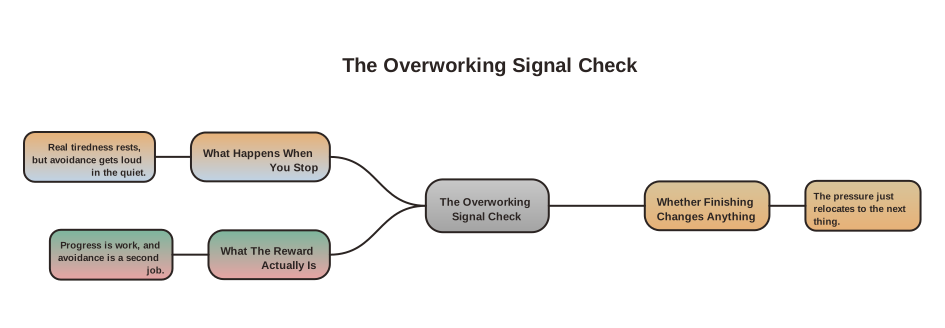
Not by hours. Plenty of people work long hours because the work is genuinely interesting or the season is genuinely heavy. Hours don't separate anything.
By what happens when you stop. Real tiredness rests. It takes the evening gratefully. Avoidance gets loud in the quiet — you sit down and within ten minutes there's an itch, a task you remembered, a reason the laptop should be open. The discomfort arriving in the gap is the whole answer, because it tells you what the work was keeping at a distance.
By whether finishing changes anything. If the deadline passes and the pressure just relocates to the next thing within a day, the deadline was never the point.
By what the reward is. Ask what you get out of the last two hours, honestly. If the answer is progress, that's work. If the answer is that you didn't have to think about the other thing — that's the second job.
Sometimes the job is just too big
This has to be said clearly, because everything above could be misread as blaming you for a workload someone else designed.
If the role is scoped for two people and you're one of them, "I can't keep up" isn't a distortion. It's arithmetic. If the deadlines are set by someone who has never done the work, staying late isn't avoidance — it's the only way the thing ships. Structural problems don't respond to reframing, and dressing one up as a personal thinking error is how people burn out while apologising for it.
The distinction is testable. A distortion falls over when you check it: you stop, and the catastrophe doesn't come. A real overload doesn't — you stop, and things genuinely, measurably break, because there was never enough person for the job. If it's the second one, the conversation to have is about scope, headcount, or the exit — and no amount of thought work substitutes for it.
The takeaway
Overworking is the one escape nobody stages an intervention about. It looks like the virtue. It pays. And the output is real enough to end any argument that it might be doing something else.
The question was never how hard you work. It's what happens in the quiet — and whether you've arranged a life where the quiet never comes. If you'd rather open the laptop than find out, that's not a work ethic. That's the answer.
Worth finding out what the work is standing in front of. The free work anxiety quiz names the pattern — Mind Reader, Fortune Teller, Catastrophizer or Overfunctioner — in about two minutes, no email. If you recognised yourself here, you already know which one. And if what you recognised was the saying-yes reflex rather than the hours, the people pleaser quiz is the sharper one.
Frequently asked questions
Is overworking a form of anxiety?
It can be. Work is one of the few avoidance behaviours that gets rewarded, so it hides well — the same escape that looks like a problem when someone spends Saturday in bed looks like ambition when they spend it in a deck. The distinguishing question isn't how many hours you did. It's what happens when you stop: if the quiet gets loud, the work was doing something other than work.
Why can't I say no to more work?
Usually because "no" produces immediate discomfort — a pause, a reaction you have to imagine, a version of yourself that disappoints someone — and "yes" makes that discomfort stop instantly. That is textbook short-term mood repair. The cost lands on a future version of you who has to actually do the thing, which is precisely why the trade keeps looking good in the moment.
How do I know if I'm overworking or just busy?
Busy has an endpoint and survives contact with rest. Overworking-as-avoidance doesn't get quieter when the deadline passes — it finds the next thing, because the point was never the deadline. Test it by stopping deliberately for an evening. If what surfaces is relief, you were busy. If what surfaces is dread looking for a task, that's the answer.
What does "if I stop it all falls apart" really mean?
It's usually two distortions fused: catastrophizing (the outcome will be total) and personalization (and it will be my fault). It stays convincing because it's never tested — you never stop, so the prediction never gets to be wrong. Most people who do stop discover the thing wobbles rather than collapses, which is information the belief has been carefully avoiding.
What if my workload genuinely is too much?
Then it's a resourcing problem and no amount of reframing fixes it. This matters: if the job is designed for two people and you're one of them, the thought "I can't keep up" isn't a distortion — it's arithmetic. The response is a conversation about scope, headcount, or an exit. Treating a structural problem as a personal thinking error is how people burn out while blaming themselves for it.
Like what you're reading?
Continue your wellness journey
Reframe negative thoughts in 60 seconds — free to start in the MindLift app.


Free to start · no account required
CBT & Self-Talk Researchers
MindLift content is grounded in cognitive behavioral therapy principles and designed to help you shift harsh self-talk in real time. Our guides focus on practical, evidence-based techniques you can use in the moment.
Was this article helpful?