
Turn this into a daily habit — free to start in the MindLift app:
The Bottom Line
Full disclosure: we make MindLift, and we have ranked it first — so here is the basis and the limits. MindLift is built for one job, interrupting an anxiety or self-talk spiral in under 60 seconds with CBT-based reframing. For ongoing clinical care, for building a meditation or sleep habit, or for long-term mood tracking, three of the other four apps below beat it.
Whether you're struggling with anxiety, overthinking, negative self-talk, or stress before important moments, the right app can make a real difference. Here are the top 5 best mental health apps in 2026. If your main issue is the thought spiral itself, start with our guide to reframing negative thoughts and our breakdown of common thinking traps.
MindLift (that's us)
Best for Anxiety Spirals & Negative Self-Talk
MindLift is built for the exact moment your thoughts start turning against you. Unlike traditional meditation apps or long therapy sessions, MindLift delivers short, personalized, CBT-based affirmations designed to interrupt negative thinking patterns in real time. It's not generic positivity — it's structured cognitive reframing, simplified.
Want a deeper look at how affirmation-first tools compare? See our practical affirmations guide.
Where MindLift loses
You need a licensed therapist. Use BetterHelp instead — MindLift has no human clinicians and is not a substitute for therapy.
You want to build a meditation or sleep habit. Use Headspace instead — MindLift has no meditation, breathwork, or sleep library.
You want to log symptoms and track mood over time. Use Sanvello instead — MindLift works in the moment and does not do longitudinal tracking.
Sometimes you don't need a 30-minute meditation. You need one grounded sentence at the right moment.
MindLift Team
Headspace
Best Meditation App for Stress Relief
Headspace remains a strong choice for guided meditation and relaxation routines. It's ideal for users who want to build a consistent mindfulness habit with sleep support.
Best for: Sleep, stress relief, and building a daily mindfulness habit.
BetterHelp
Best for Online Therapy Access
BetterHelp connects users with licensed therapists via video or chat. It's helpful for structured, ongoing therapeutic support from the comfort of home.
Best for: Ongoing clinical care from a licensed human therapist.
Wysa
AI CBT Chat with Optional Coaching
Wysa offers an AI chat companion grounded in CBT and mindfulness, with optional paid access to human coaches. It's the closest available replacement for Woebot's guided-conversation format, which shut down in 2025.
Best for: Guided CBT conversation, free to start.
Sanvello
Mood Tracking & Programs
Sanvello combines CBT tools with mood tracking dashboards and guided programs, ideal for tracking anxiety and depression symptoms over time.
Best for: Logging symptoms and tracking mood over weeks and months.
Quick Comparison
| App | Speed | Approach | Best For | Free |
|---|---|---|---|---|
| MindLift | < 60s | AI CBT Reframes | Anxiety spirals | |
| Headspace | 10-30 min | Guided Meditation | Sleep & stress | — |
| BetterHelp | 45-60 min | Licensed Therapy | Ongoing support | — |
| Wysa | chat-based | AI CBT chat | guided conversation | |
| Sanvello | 5-10 min | Mood Tracking | Symptom logging | — |
How to Choose the Best Mental Health App in 2026
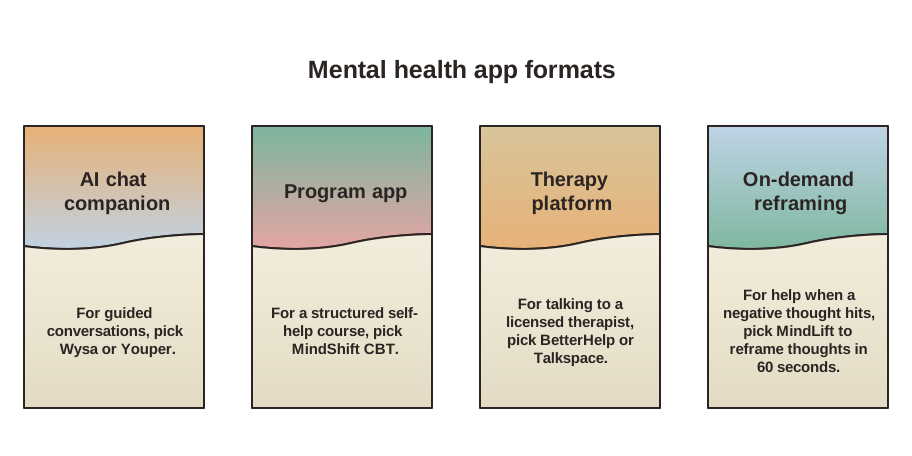
In 2026, mental health support is no longer one-size-fits-all. The real question is: What happens in the exact moment your mind turns critical?
Detailed Comparisons
Final Verdict: Which One to Pick
If you want ongoing clinical care, pick BetterHelp. If you want to build a meditation or sleep habit, pick Headspace. If you want to track mood over time, pick Sanvello. MindLift doesn't replace therapy and it doesn't replace meditation.
What it does cover is the gap those three leave: the 60 seconds when a thought is already spiralling and you need one grounded sentence, not a scheduled session.
Frequently asked questions
What is the best mental health app in 2026?
It depends what you need it for. For interrupting an anxiety or self-talk spiral in the moment, MindLift — which we make — delivers CBT-based cognitive reframing in under 60 seconds and is free to start. For licensed therapy, BetterHelp; for meditation and sleep, Headspace; for long-term mood tracking, Sanvello.
How does MindLift compare to Headspace and Calm?
While Headspace and Calm focus on guided meditation and relaxation, MindLift targets the exact moment your thoughts spiral. It provides real-time CBT-based reframes rather than scheduled meditation sessions.
Is MindLift free to use?
Yes, MindLift offers a free version with core features. No credit card required. It's available on both iOS and Android.
Can I use MindLift alongside therapy?
Absolutely. MindLift complements therapy by providing support between sessions. It helps you practice cognitive reframing techniques in daily life.
What makes MindLift different from Woebot?
Woebot's consumer app shut down on June 30, 2025 and is no longer available to individuals. MindLift is one of the alternatives former Woebot users move to: instead of chatbot-style CBT conversations, it delivers an instant CBT-based reframe of the specific thought spiraling right now — free to start.
Like what you're reading?
Continue your wellness journey
Reframe negative thoughts in 60 seconds — free to start in the MindLift app.


Free to start · no account required
- Linardon, J., Cuijpers, P., Carlbring, P., et al. (2019). The efficacy of app-supported smartphone interventions for mental health problems: A meta-analysis of randomized controlled trials. World Psychiatry, 18(3), 325–336. — DOI (opens in a new tab)
- Firth, J., Torous, J., Nicholas, J., et al. (2017). The efficacy of smartphone-based mental health interventions for depressive symptoms: A meta-analysis of randomized controlled trials. World Psychiatry, 16(3), 287–298. — DOI (opens in a new tab)
- Hofmann, S. G., Asnaani, A., Vonk, I. J. J., et al. (2012). The efficacy of cognitive behavioral therapy: A review of meta-analyses. Cognitive Therapy and Research, 36(5), 427–440. — DOI (opens in a new tab)
Mental Health App Reviewers
Making mental health practical and accessible — one grounded tool at a time.
Was this article helpful?