
Turn this into a daily habit — free to start in the MindLift app:
Your brain doesn't always tell you the truth.
Not because it's broken — but because it takes shortcuts. When you're stressed, tired, or anxious, your brain falls into predictable thinking traps that make everything feel worse than it is.
What Is Cognitive Reframing?
Cognitive reframing is a technique from cognitive-behavioral therapy (CBT) that helps you identify negative or distorted thoughts and replace them with more balanced alternatives.
It's not about pretending everything is fine. It's about seeing situations more clearly.
MindLift is a CBT app for rapid cognitive reframing — the negative thought goes in as you'd say it to yourself, and a balanced, kinder version comes back in your own words in about 60 seconds.
"I'm going to fail this presentation."
Becomes:
"I'm nervous, and that's normal. I've prepared, and I can handle this."
Why Your Brain Gets Stuck in Negative Loops
When your brain detects a threat — real or imagined — it activates a stress response. This narrows your thinking, making it harder to see the full picture.
Common thinking traps include:
- Catastrophizing — assuming the worst will happen
- Mind-reading — believing you know what others think
- All-or-nothing thinking — seeing things as entirely good or bad
- Overgeneralizing — one bad event means everything is bad
These patterns feel automatic because they are. They're shortcuts your brain learned over time. If you want to name them faster, use this thinking traps breakdown.
How to Reframe Negative Thoughts: A Simple Process
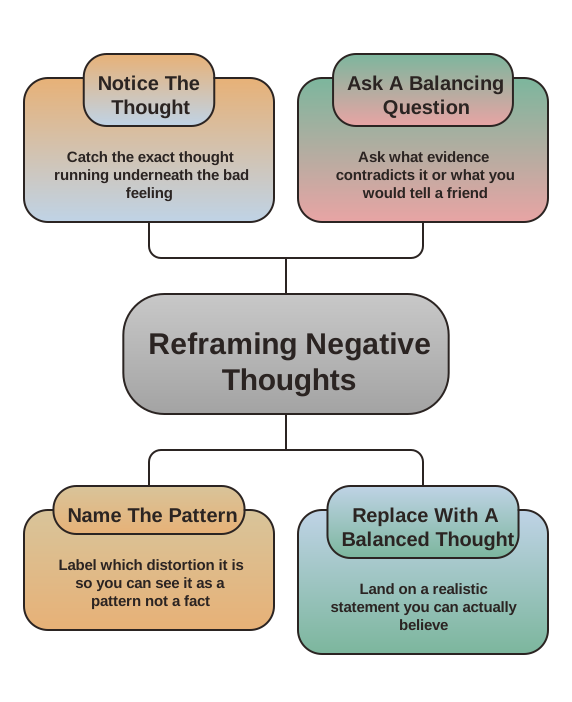
Step 1: Notice the Thought
Awareness is the first step. When you feel a mood shift, pause and ask: "What thought just went through my mind?"
Step 2: Name the Pattern
Identify which thinking trap is at play. Is it catastrophizing? Mind-reading? All-or-nothing?
Naming the pattern creates distance between you and the thought.
Step 3: Ask a Balancing Question
Try one of these:
- "What evidence supports this thought? What evidence contradicts it?"
- "What would I say to a friend in this situation?"
- "Is there a more balanced way to see this?"
Step 4: Replace With a Balanced Thought
Write or say the more balanced version. It doesn't have to be positive — just more accurate.
Reframing in Everyday Life
You can practice reframing in small moments throughout your day:
- Before a meeting: "I don't have to be perfect. I just need to show up."
- After a mistake: "This is information, not a verdict."
- During a spiral: "My brain is doing its protection thing. I can slow down."
Why Small Reframes Work Better Than Big Ones
Your brain rejects thoughts it doesn't believe. That's why "I'm amazing!" doesn't work when you're feeling low.
Small, believable reframes work because they're realistic enough for your brain to accept:
"I'm learning."
"This is hard, and I'm still here."
"I don't have to figure it all out right now."
How MindLift Helps With Reframing
MindLift uses the same cognitive reframing principles to help you interrupt negative thought loops in real time. The app delivers short, believable reframes based on what you're feeling — so your brain gets practice building healthier pathways, one thought at a time. If you want the science underneath that repetition, see how neuroplasticity makes reframing stick.
Final Thought
You can't control which thoughts appear. But you can learn to respond to them differently.
That's what reframing is — not silencing your mind, but teaching it a new language.
Frequently asked questions
What is cognitive reframing?
Cognitive reframing is a technique from CBT that involves identifying negative or distorted thoughts and replacing them with more balanced, realistic alternatives.
Is reframing the same as positive thinking?
No. Reframing doesn't ask you to pretend things are great. It helps you see situations more accurately by removing the distortion.
How long does it take for reframing to work?
It varies from person to person, and there is no fixed timeline. With consistent practice, the shift in thinking patterns builds gradually.
What are some CBT reframe examples?
"I'm going to fail this presentation" becomes "I'm nervous, and that's normal. I've prepared, and I can handle this." "They didn't reply — they're mad at me" becomes "I don't actually know why they haven't replied; most delays have nothing to do with me." A good reframe is believable, not forced positivity.
Like what you're reading?
Take control of your mental wellness
Reframe the thought that started it — personalized CBT reframes in the MindLift app.


Free to start · premium optional