
Turn this into a daily habit — free to start in the MindLift app:
Quick Answer
What are cognitive distortions (thinking traps)?
Cognitive distortions are inaccurate thought patterns that make situations seem worse than they are. Your brain treats them as facts, but they're one interpretation — often shaped by fear. The 10 most common include catastrophizing, mind reading, all-or-nothing thinking, and overgeneralization.
Sometimes the mind behaves like a storyteller that loves drama.
A small situation appears… and suddenly your brain is writing a full disaster movie.
You replay conversations. Predict worst-case scenarios. Assume people are judging you.
Psychology has a name for these mental patterns: cognitive distortions.
Cognitive distortions are predictable thinking errors that twist reality and amplify negative emotions. They are one of the main drivers of:
- Overthinking
- Anxiety
- Self-doubt
- Rumination
The good news? Once you learn to recognize these thinking traps, they become much easier to challenge.
What Are Cognitive Distortions?
Cognitive distortions are inaccurate or exaggerated patterns of thinking that make situations seem worse than they are.
These distortions influence how we interpret events, which in turn shapes our emotions and behavior.
When a distorted thought appears, the brain often treats it as fact. But in reality, it's just one interpretation of a situation.
Learning to spot these patterns is a core part of Cognitive Behavioral Therapy (CBT), one of the most researched psychological approaches for improving mental well-being.
Below are the 10 most common thinking traps that cause mental spirals.
1. Catastrophizing
"Something terrible is going to happen."
This thinking trap jumps straight to the worst possible outcome.
"I made a mistake in that email. Now my boss will think I'm incompetent and I'll probably lose my job."
Reality check: Mistakes happen every day and rarely lead to extreme consequences. Catastrophizing inflates small problems into huge disasters.
2. Mind Reading
"They must think something bad about me."
Mind reading happens when we assume we know what others are thinking.
"They didn't respond to my message quickly. They must be annoyed with me."
The truth is we rarely have enough information to know what someone else is thinking. This distortion is a major driver of social anxiety and relationship overthinking. If this one hits hard, our social anxiety reframing guide shows exactly how to challenge it.
3. All-or-Nothing Thinking
"If it's not perfect, it's a failure."
This pattern divides experiences into extreme categories.
"I didn't perform perfectly in that presentation. That means I completely failed."
But most real situations fall somewhere in the middle. Perfection is rarely the standard for success.
4. Overgeneralization
"This always happens to me."
Overgeneralization turns a single negative event into a permanent rule.
"I got rejected from one job. I'm never going to get hired anywhere."
In reality, one event rarely predicts the entire future.
5. Emotional Reasoning
"I feel it, so it must be true."
Emotional reasoning happens when feelings are used as evidence.
"I feel stupid, so I must be stupid."
But emotions are reactions, not objective facts. Research shows that emotional reasoning is a common driver of anxiety and low self-esteem.
6. Discounting the Positive
"That success doesn't count."
This thinking trap ignores positive experiences or achievements.
"You did a great job on the project."
Response: "They're just being nice."
The mind filters out positive evidence and focuses only on flaws.
7. Personalization
"This must be my fault."
Personalization happens when we assume responsibility for events outside our control.
"My friend seems upset today. I must have done something wrong."
In reality, people's moods are influenced by many factors.
8. Mental Filtering
"The one negative thing is all that matters."
Mental filtering focuses on a single negative detail while ignoring everything else.
You receive ten compliments and one criticism. Your mind replays only the criticism.
This distortion can make generally positive situations feel negative.
9. "Should" Statements
"I should be better than this."
This pattern creates rigid rules for how things must be.
"I should always be confident."
"I should never make mistakes."
When reality doesn't match these rules, people often feel guilt, shame, or frustration.
10. Labeling
"I am a failure."
Labeling turns one mistake into a global identity.
"I messed up that task. I'm an idiot."
Instead of evaluating behavior, the mind assigns harsh identity labels. Over time, these labels can damage self-confidence.
Why Do These Thinking Traps Feel So Real?
The brain evolved to detect potential threats quickly.
This survival mechanism can sometimes misfire. Instead of helping us avoid danger, it creates exaggerated interpretations of everyday situations.
When these patterns repeat often enough, they become automatic thought habits. The next step is learning how to interrupt them with cognitive reframing.
The good news is that habits can change.
In short: Thinking traps feel true because they evolved as fast threat-detection shortcuts — but in modern life, that speed creates distortion, not accuracy.
How Do You Actually Break a Thinking Trap?
Psychologists often recommend a simple process:
- Notice the thought
"I'm going to fail this meeting." - Identify the pattern
This is catastrophizing. - Challenge the interpretation
"What evidence supports this thought?" - Replace it with a balanced thought
"I'm nervous, but I can prepare and do my best."
Over time, practicing this process helps weaken distorted thinking patterns.
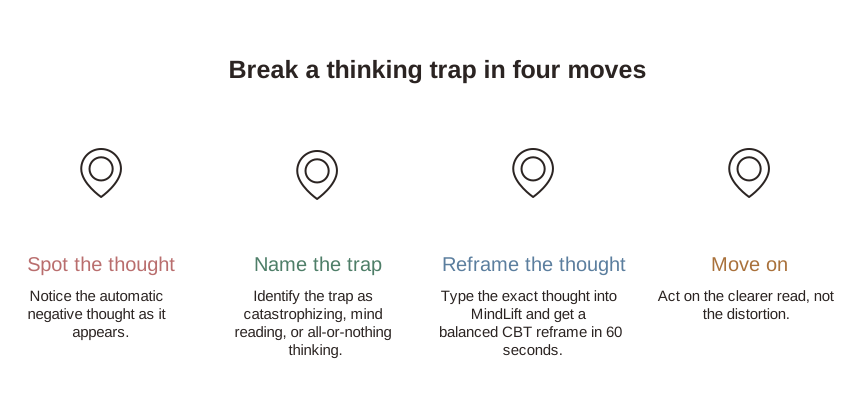
In short: You break a thinking trap by noticing the pattern, questioning the evidence, and replacing the distorted thought with something more balanced — not more positive.
How Can You Catch a Thinking Trap Before It Spirals?
MindLift is designed to help people interrupt negative thought loops in everyday moments. Instead of letting a thought spiral, the app helps you:
- Notice the thought
- Identify the thinking pattern
- Gently reframe the interpretation
- Continue with a clearer perspective
Thought: "Everyone is ahead of me in life."
Realistic reframe: "People move at different speeds."
Growth reframe: "I'm still learning and building my path."
Compassionate reframe: "It's okay to feel uncertain sometimes."
Small shifts like this gradually transform the inner voice from harsh critic to supportive guide.
Discover Your Thinking Pattern
Everyone's mind tends to favor certain thinking traps. Some people catastrophize. Others mind-read or compare themselves constantly.
Understanding your pattern is the first step to changing it.
Frequently asked questions
What are cognitive distortions?
Cognitive distortions are inaccurate or exaggerated thinking patterns that twist reality and amplify negative emotions. They are a core concept in Cognitive Behavioral Therapy (CBT).
What is the most common cognitive distortion?
Catastrophizing and all-or-nothing thinking are among the most common. Many people also experience mind reading and emotional reasoning without realizing it.
Can you fix cognitive distortions?
Yes. Cognitive distortions are thinking habits that can be identified, challenged, and gradually replaced with more balanced interpretations through consistent practice.
How do I know which thinking trap I have?
Most people have 2-3 dominant distortions. A cognitive distortion quiz or self-assessment can help you identify your patterns.
Like what you're reading?
Take control of your mental wellness
Reframe the thought that started it — personalized CBT reframes in the MindLift app.


Free to start · no account required
- Beck, A. T. (1979). Cognitive Therapy of Depression. Guilford Press.
- Burns, D. D. (1980). Feeling Good: The New Mood Therapy. William Morrow.
- Clark, D. A., & Beck, A. T. (2010). Cognitive Therapy of Anxiety Disorders: Science and Practice. Guilford Press.
- Leahy, R. L. (2017). Cognitive Therapy Techniques: A Practitioner's Guide (2nd ed.). Guilford Press.
Mental Wellness Writers
The MindLift Wellness Team writes evidence-based content on CBT, self-talk, and everyday mental health tools.
Was this article helpful?