
Turn this into a daily habit — free to start in the MindLift app:
The dinner ended two hours ago and you're still in it — replaying the joke that landed wrong, the pause that ran long, the moment you talked over someone. Verdict: I'm bad at this. Here's a different reading of the same evening: you're fine at socializing. You're just very good at mind-reading — and mind-reading is a thinking error, not a personality.
Am I actually bad at socializing?
Probably not — the feeling comes from two measurable biases, not from your performance. The spotlight effect makes you overestimate how much others noticed your awkward moments (in studies, by about double), and the liking gap means people systematically underestimate how much their conversation partners actually liked them. What feels like social failure is usually mind-reading: your guess about their opinion, presented to you as their verdict.
Gilovich et al. (2000); Boothby et al. (2018)
Two different problems, and only one is yours
"Bad at socializing" is a skill claim. It says: my inputs — timing, topics, tone — are wrong, and fixing them takes years of practice. But look at where your evidence comes from. Did anyone say the joke landed wrong? Did anyone act differently afterward? Or does the entire case rest on what you assume they thought?
That assumption has a name in CBT: mind-reading — concluding what others think of you without access to their thoughts. It's one of the classic cognitive distortions (we've mapped the full set in the thinking traps guide), and it's uniquely nasty in social settings because it grades an event you were too busy performing in to actually observe.
The spotlight you feel is held by you
In the studies that made the spotlight effect famous, Thomas Gilovich and colleagues had people walk into a room wearing an embarrassing T-shirt, then asked them how many observers noticed. Estimates ran about twice as high as reality. The effect generalizes: your stumbles feel broadcast because your attention was locked on them — everyone else's attention was locked on their own.
Run the test on yourself: you remember nearly everything you said at that dinner. Now list what the person across from you said. The asymmetry you just noticed is universal. Everyone left that table replaying their own lines, not grading yours.
The liking gap: your reviews are better than you think
It gets stronger. When researchers had strangers actually talk — real conversations, then private ratings — people consistently underestimated how much their partner liked them. Erica Boothby and colleagues called it the liking gap, and it held across short chats, long conversations, and real-world settings like dorms. The signals of interest were there; the anxious mind discounted them and kept only the ambiguous bits.
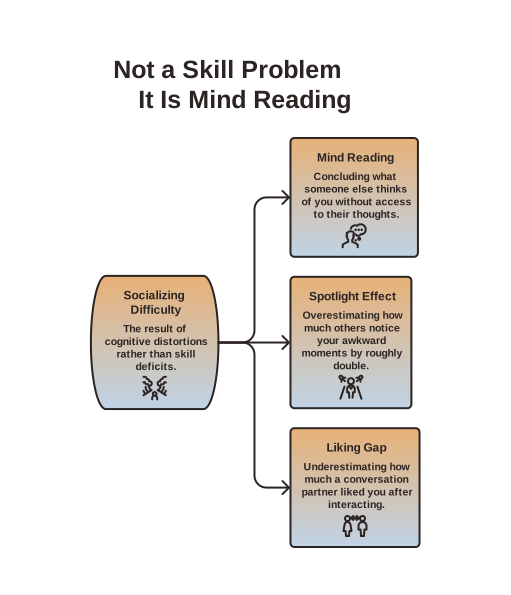
So the honest scoreboard reads: your awkward moments were barely noticed, and you were liked more than you think. Not a guarantee, not always — an average. But your brain's verdict wasn't built on averages. It was built on mind-reading.
The reframe, run on a real thought
The thought, verbatim: "Everyone at that dinner thought I was boring."
The distortion: mind-reading — that's their opinion, reported by you, with no source.
The evidence: nobody said anything of the kind. You remember your every word and almost none of theirs — the spotlight, held by you. And on the research, they likely liked the evening more than you're giving them credit for.
The rewrite: "They were too busy replaying their own lines to grade mine. One long pause in a two-hour dinner isn't a verdict on me."
Notice the rewrite is not "everyone loved you." It's what the evidence supports — which is why you can believe it, and why it holds at 1am when the replay starts again.
If the pattern runs deeper
Mind-reading after social events is often one strand of a wider social anxiety loop — anticipating badly, performing while self-monitoring, then auditing the replay. If that sequence sounds familiar, the CBT approach to social anxiety covers the full loop, and the free social anxiety self-check can help you see which part grips hardest.
And for the ten minutes after the next dinner, when the replay boots up: catch the verdict, name the mind-reading, check the evidence. MindLift walks you through exactly that in about 60 seconds — free to start, no account. Different problem than you thought. Much faster fix.
Frequently asked questions
Why am I so bad at socializing?
You may not be. What most people label "bad at socializing" is the after-effect of two documented biases: the spotlight effect (overestimating how much others noticed your awkward moments) and mind-reading (treating your guess about their opinion as fact). Research on real conversations finds people consistently underestimate how much their partner actually liked them — a "liking gap." The feeling of having failed socially is real; the evidence for the failure usually is not.
What is mind-reading in CBT?
Mind-reading is a cognitive distortion where you conclude what someone else is thinking — usually something negative about you — without evidence. "Everyone could tell I was nervous" and "she thinks I'm boring" are mind-reading: they present your interpretation as their verdict. CBT treats it like any distortion: name it, test it against what was actually observable, and rewrite the thought to fit the evidence.
What is the spotlight effect?
The spotlight effect is the tendency to overestimate how much other people notice about you. In the classic studies (Gilovich, Medvec & Savitsky, 2000), people wearing an embarrassing T-shirt estimated about twice as many observers noticed it as actually did. The effect applies to stumbles in conversation too: your awkward pause was vivid to you and background noise to nearly everyone else.
How do I stop replaying social interactions?
Treat the replay as a thought to examine, not a tape to finish. Catch the verdict your brain attached ("I embarrassed myself"), name the distortions in it (mind-reading, spotlight effect), and test it: what did anyone actually say or do? Then rewrite it to match the evidence. If the replay is a nightly pattern, our article on why thoughts feel worse at night covers the timing side of it.
Like what you're reading?
Continue your wellness journey
Reframe negative thoughts in 60 seconds — free to start in the MindLift app.


Free to start · no account required
- Gilovich, T., Medvec, V. H., & Savitsky, K. (2000). The Spotlight Effect in Social Judgment: An Egocentric Bias in Estimates of the Salience of One's Own Actions and Appearance. Journal of Personality and Social Psychology, 78(2), 211–222. — DOI (opens in a new tab)
- Boothby, E. J., Cooney, G., Sandstrom, G. M., & Clark, M. S. (2018). The Liking Gap in Conversations: Do People Like Us More Than We Think? Psychological Science, 29(11), 1742–1756. — DOI (opens in a new tab)
Mental Wellness Researchers
Part of the MindLift team dedicated to translating psychological research into practical tools for everyday mental wellness.
Was this article helpful?