
Turn this into a daily habit — free to start in the MindLift app:
Somebody cuts the queue, or a text lands wrong, or the printer jams — and suddenly you're not annoyed, you're gone. Your feed has a word for it: crashing out. The clips are funny. The experience, when it's yours, is not. And the interesting part is what the joke gets right about how a mind actually reaches that point.
"Crashing out" is slang for suddenly losing emotional control — an outburst, a rage spiral, an impulsive reaction that's visibly bigger than its trigger. Psychologically, it names a real sequence: stress is suppressed instead of processed, load accumulates, capacity runs out, and the discharge fires at whatever is nearest. The trigger is the occasion; the accumulated load is the cause.
What the slang actually names
A crash-out is a discharge, not an event. The blow-up you see — the snapped reply, the slammed laptop — is the final step of a sequence that started hours or weeks earlier: hold it in, hold it in, hold it in, then one small thing too many. That's why the trigger almost never explains the reaction.
This is the same mechanism behind suppression generally: pushing a feeling down doesn't process it, it defers it — usually with interest. We covered the deferral half of that in the clean-slate fantasy piece; a crash-out is what the repayment looks like when it arrives all at once. The internet didn't discover a new behavior. It gave a very old one a name catchy enough to say out loud — and that's genuinely useful, because a named pattern is one you can catch.
The three thinking traps that load the spring
A crash-out feels physical, but thoughts set the spring. Three distortions do most of the loading: emotional reasoning, magnification, and rigid "should" rules. None of them announce themselves — each one sounds, in the moment, like plain realism. That's what makes them distortions rather than just bad moods.
“I should be able to handle this. I shouldn't need help. I shouldn't complain.”
Show the answer
"Should" statements. Those rules are what forbid releasing pressure earlier, in small doses, when it would have been easy.
Emotional reasoning is the engine of the crash itself: the surge feels enormous, so the situation must be enormous. The feeling gets treated as evidence. Magnification hands the last straw the weight of the whole bale — the jammed printer becomes proof that everything is against you. And "should" statements do the quiet early work: I should be able to handle this. I shouldn't need help. I shouldn't complain. Those rules are what forbid releasing pressure earlier, in small doses, when it would have been easy.
Notice the shape: two of the three traps operate before the crash, not during it. Which is the actual leverage point — by the time you're mid-discharge, thinking is mostly along for the ride.
The reframe: read the crash, don't obey it
The unhelpful conclusion after a crash-out is a character verdict: I'm unstable, I'm a bad partner, I can't cope. The reframe is to treat the crash as data instead — a gauge reading, not an identity. A crash-out tells you exactly one thing with certainty: your load exceeded your capacity today.
That reading is useful in a way the verdict never is. A verdict ends the inquiry — I'm just like this — while a gauge invites questions with answers: what was on the load side this week, what came off the capacity side (sleep? food? one conversation you've been dreading?), and where was the last exit before the spiral? People who reliably stop crashing out don't develop iron self-control in the moment. They get better at reading the gauge earlier — the same move, one step upstream, that we walk through in why a small thing set you off this hard.
A 60-second pre-crash protocol
You get a window before a crash-out — short, but real. Heat in the chest, the urge to type fast, the feeling of one more thing and I swear. This protocol fits inside that window. It won't process the load; its only job is to stop the discharge from choosing your next move for you.
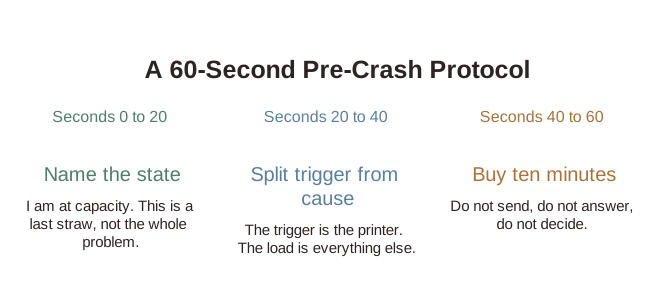
Seconds 0–20: name the state, out loud if you can. "I'm at capacity. This is a last straw, not the whole problem." Naming what's happening re-engages the deliberate part of your thinking that the surge was about to bypass.
Seconds 20–40: split trigger from cause. One sentence: "The trigger is [the printer]. The load is [everything else]." You're not calming yourself down — you're re-aiming the reaction at its actual target, which immediately shrinks the trigger back to its real size.
Seconds 40–60: buy ten minutes. Don't send, don't answer, don't decide. Almost nothing that triggers a crash-out requires a response inside ten minutes, and almost every crash-out regret comes from acting inside them. If the loading thought keeps shouting after that — the I should be able to handle this — that's the one worth writing down and examining properly. MindLift does exactly that one narrow job: you type the thought, it returns a CBT-based reframe of it in about 60 seconds, free to start.
When it's more than a meme
Most people who joke about crashing out are describing an occasional overflow — unpleasant, human, workable with the tools above. But the joke can also be doing what jokes often do online: making something serious feel safely small. There's an honest line between the two, and it's worth knowing where you stand relative to it.
The line isn't intensity — everyone has a bad day that ends loudly. It's pattern and cost. Crash-outs that recur on a schedule, aftermath that keeps damaging the same relationships or your work, exhaustion as your baseline between them, or any urge toward harming yourself or someone else: these aren't things a protocol or an app addresses, and nothing here is a diagnosis of what they are. They're reasons to talk to a professional — who will take the load seriously, which is precisely what the meme format can't do.
A good first step in the meantime is knowing your own sequence. The stress response pattern quiz — free, no email — maps how you typically process pressure before it becomes discharge, and the CBT techniques hub collects the reframing tools that work on the loading thoughts themselves.
Frequently asked questions
What does "crashing out" actually mean?
In current slang, crashing out means suddenly losing emotional control — snapping, raging, saying or doing something impulsive that feels bigger than whatever set it off. The original meaning was simply falling asleep; the newer usage is about an emotional discharge, and it went mainstream because so many people recognized the experience.
Why do I crash out over such small things?
Because the small thing isn't the cause — it's the release valve. Load builds all day from stress you hold in and don't process, and the crash fires at whatever happens to be in front of you when capacity runs out. The size of the reaction tracks the accumulated load, not the trigger. That's also why the guilt afterward feels confusing: you're comparing the reaction to the trigger instead of to the day behind it.
Is crashing out the same as a panic attack?
No. The slang covers a wide range — irritation spikes, angry outbursts, tearful shutdowns — while a panic attack is a specific surge of intense fear with strong physical symptoms. Some people use "crash out" for both, which is part of the problem with slang: it can normalize experiences that deserve a closer look. If what you call crashing out involves racing heart, trembling, or a fear of losing control, it is worth describing precisely to a professional.
How do I stop myself mid crash-out when I can feel it starting?
You have more room before the discharge than during it. When you feel the heat rising, say the load out loud to yourself — "I'm at capacity, this is the last straw, not the whole problem" — and put ten minutes between you and any response. Naming the state engages the part of your thinking the surge was about to bypass. It feels too simple to work; it works because it's simple enough to do while flooded.
When is crashing out a sign of something more serious?
When it stops being an occasional overflow and becomes a pattern you organize your life around — regular blow-ups, aftermath that damages relationships or work, or a baseline of exhaustion between crashes. None of that is a diagnosis, but each is a reason to talk to a professional rather than a meme. Frequent loss of emotional control is a signal worth taking seriously, whatever name your feed gives it.
Like what you're reading?
Take control of your mental wellness
Reframe the thought that started it — personalized CBT reframes in the MindLift app.


Free to start · premium optional