
Turn this into a daily habit — free to start in the MindLift app:
Someone at work let you down — didn't own it, didn't apologize, just moved on like it didn't happen. And you know, rationally, that this is a mildly annoying, fairly ordinary workplace thing. But it didn't feel ordinary. It felt like something cracked open.
Two weeks of low-grade stress. A level of anger that seems out of proportion to a missing “sorry.” And a nagging sense that you're overreacting, which somehow makes it worse.
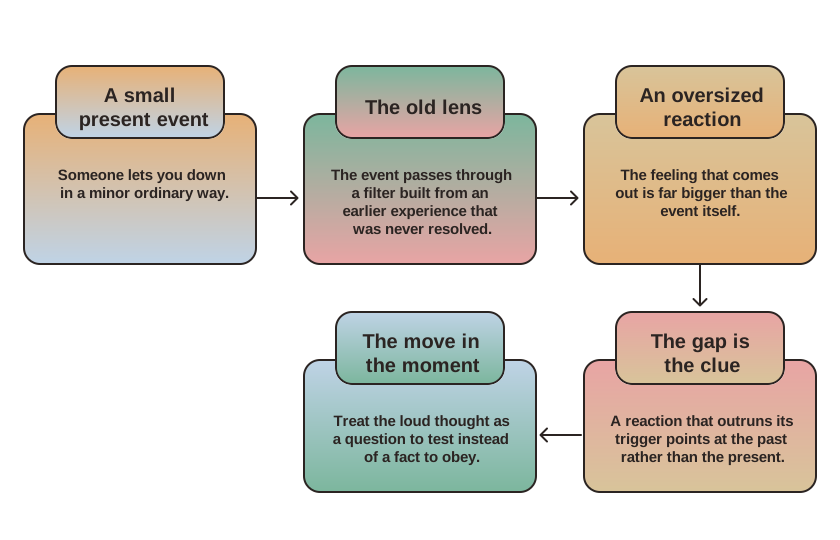
Here's the thing worth knowing before you decide you're just being dramatic: when a reaction is bigger than the event that triggered it, that gap is data. It's usually not about the thing in front of you. It's about something the thing in front of you is standing in for.
The lens you don't know you're looking through
Every experience you have gets filtered before you ever meet it — through your belief systems, your history, the stuff that's still unresolved. Most of the time you don't notice the lens is there; you just experience the reaction and assume it's a clean, proportional response to what's actually happening right now.
This isn't a mystical claim. It's the ordinary machinery of the cognitive model that CBT is built on: situations don't produce feelings directly. They pass through beliefs — many of them formed early, most of them never examined — and those beliefs set the meaning, which sets the size of the feeling. Two people can watch the same colleague shrug off the same mistake and come away with completely different afternoons, because they ran it through different lenses.
So when a reaction is loud enough to surprise you, it's worth asking the question directly: what am I actually reacting to? Not the surface event — the pattern underneath it. Someone not taking accountability might not sting because it's rude. It might sting because it echoes an earlier moment when someone you needed accountability from never gave it to you, and that moment never got resolved. The current person isn't the source of the anger. They just activated it.
The disproportion is the clue. Not the verdict on your character — the clue.
Two different jobs — and only one of them happens in the moment
Figuring out where a pattern like that originally comes from is real work, and it's usually not solo work. That's what therapy is for — tracing the thread back, understanding the original wound, doing the slower excavation that changes the lens itself over time. That's not something you do standing in a hallway, still shaking a little, thirty seconds after the triggering conversation.
But there's a second, completely different job: what do you do with the reaction right now, while it's happening, before you've had six sessions to trace it back? That's not root-cause work. That's damage control for the next ten minutes of your day — a skill on its own, separate from the deeper excavation, and arguably more urgent while the adrenaline is still up.
Confusing the two is why people stall. They decide they can't do anything about today's reaction until they understand its origin, which is a bit like refusing to put pressure on a cut until you know who left the glass on the floor.
The one move that actually helps in the moment
The single most useful habit for the in-the-moment version isn't complicated, but it takes real practice to make automatic: treat the thought as a question instead of a fact. Not “this proves people always let me down,” but “wait — what old relationship am I dragging into this one?” That one-sentence shift is the whole mechanism. It doesn't require finishing the root-cause work first. It just requires catching the thought before it gets treated as settled truth.
This sounds almost too simple to matter, which is exactly why people underrate it. But there's a real difference between a thought you've accepted as fact and a thought you've paused to interrogate — even for five seconds. The first one runs your afternoon. The second one gets a chance to be wrong. (Reading the strength of a feeling as evidence that the thought behind it is true has a name in CBT — emotional reasoning, defined with the other eleven in the glossary.)
If you want to practise the catch itself rather than read about it, the critic-or-coach sorting game is a 30-second drill: you see a line of self-talk and decide, fast, which one it is. It trains the exact reflex — noticing the shape of a thought instead of automatically believing it.
From generic to specific: why “you've got this” stops working
There's a second thread worth pulling here, because it lines up with something we've written about before: the difference between generic self-talk and specific self-talk.
People who build a real practice of talking to themselves kindly — turning the inner heckler into something closer to an inner cheerleader — almost always describe starting with generic lines. “You've got this.” Vague, borrowed-sounding, technically encouraging. And it doesn't land, not really, because it doesn't reference anything true about the actual moment. (If you don't know which heckler you're dealing with, the inner critic type quiz names it in a couple of minutes.)
What changes things is specificity: “you're feeling low today, and that's real, and it's also going to pass — remember what you've already gotten through.” Same intent as “you've got this.” Completely different effect, because it's addressed to something particular, not to a generic version of anyone having a hard day.
That shift — generic to specific — usually takes months of deliberate practice to build as a habit. Most people give up on the vague version long before they ever get to the specific one, because the vague version doesn't work and they conclude the whole exercise doesn't work, rather than that the wording does.
Where MindLift fits
Those months of trial and error are the part MindLift skips, because it starts specific. You're not writing “you've got this” into a notes app and hoping it eventually turns into something that lands. You type the real thought — the actual one, the why does this always happen to me one — and get back a Realist, a Growth, and a Compassionate reframe built from what you specifically wrote, not a script written for anyone. Free to start, premium available.
It isn't root-cause work and it isn't therapy. A therapist has the one hour where the lens itself gets examined; this is for the other 167, when the reaction has already fired and the origin story is still weeks away. Two jobs, both real, and this one only claims the smaller half: keeping a disproportionate reaction from taking the rest of your afternoon with it.
Next time something small sets you off harder than it should, don't wait to figure out why. Type the thought in and get it back specific, not generic — then go back to your afternoon. The reframing skill itself is trainable, and every rep makes the catch a little more automatic.
Frequently asked questions
Why do small things sometimes trigger a huge reaction?
When a reaction feels bigger than the event that caused it, the current situation is often echoing an earlier, unresolved one. In the cognitive model, the present event is filtered through beliefs formed long before it — so the size of the reaction is set by the filter, not by the event. The present moment is the trigger, not necessarily the true source.
Do I have to figure out the root cause before I can feel better in the moment?
No — those are two separate tasks. Root-cause work is usually slower and benefits from a therapist. In-the-moment relief comes from treating the reactive thought as a question rather than a settled fact, which you can do immediately, without having traced the pattern back yet.
Am I overreacting if a minor thing ruins my whole day?
Overreacting implies the reaction came from nowhere. Usually it came from somewhere — just not from the thing in front of you. The useful question isn't "why am I like this" but "what is this reminding me of," which treats the disproportion as a clue instead of a character verdict.
Why doesn't generic positive self-talk ("you've got this") work as well as I'd expect?
Generic phrases don't reference anything specific about your actual situation, so they're easy to dismiss — your mind knows they'd be said to anyone. Specific, believable language tied to what's really happening tends to land, and stick, much better.
Is this a replacement for therapy?
No. This addresses the live moment a reaction fires; therapy addresses where the pattern came from in the first place. They are doing different jobs, and both matter.
Like what you're reading?
Continue your wellness journey
Reframe negative thoughts in 60 seconds — free to start in the MindLift app.


Free to start · no account required
- Beck, J. S. (2020). Cognitive Behavior Therapy: Basics and Beyond (3rd ed.). Guilford Press.
CBT & Self-Talk Researchers
MindLift content is grounded in cognitive behavioral therapy principles and designed to help you shift harsh self-talk in real time. Our guides focus on practical, evidence-based techniques you can use in the moment.
Was this article helpful?