
Turn this into a daily habit — free to start in the MindLift app:
You're sitting with a thought you can't shake. Maybe it's replaying a conversation you had three days ago, or spiraling into worst-case scenarios about something that hasn't happened yet. You know it's irrational. You can't stop anyway.
Most personality tests will tell you what you do. The Enneagram tells you why.
That's what makes it different — and why millions of people take it every year, then feel unsettled by how accurately it describes the thing they've been quietly doing their whole lives.
This guide explains all 9 Enneagram types, what drives each one at the core, and how each type's inner voice tends to work against them. At the end, you'll find a free 27-question test — no email, no signup, instant results.
What Is the Enneagram?
The Enneagram is a personality framework built around nine distinct types, each defined not by surface traits but by a core motivation — the thing underneath everything else you do.
Where MBTI describes how you process information and maps your preferences, the Enneagram maps your avoidance pattern — the fear that quietly shapes your decisions, your relationships, and especially your inner critic.
It was developed through the work of Oscar Ichazo and Claudio Naranjo in the 1960s and 70s, drawing on psychology, philosophy, and spiritual traditions. Therapists and coaches now use it widely because it explains behavior at the root level, not just the surface.
The nine types are organized into three triads based on which center — Head, Heart, or Body — you lead from under stress.
The 9 Enneagram Types
Type 1 — The Reformer
Core fear: Being corrupt, wrong, or defective
Core desire: To be good, to have integrity, to improve the world
Inner voice: A relentless internal editor. Type 1s have a sharp inner critic that notices every imperfection — in themselves first, then in the world around them. The voice says that wasn’t good enough even when everyone else is satisfied.
Type 1s are principled, disciplined, and often the person everyone trusts to do things properly. Under stress, the same quality that makes them reliable becomes self-punishing. They ruminate on mistakes long after they’ve been forgiven by everyone else.
The overthinking pattern: Replaying decisions to check whether they made the right choice. Setting an impossibly high standard, then mentally auditing whether they met it.
Type 2 — The Helper
Core fear: Being unwanted, unloved, or dispensable
Core desire: To be loved, to feel needed, to matter to others
Inner voice: An anxious radar scanning for signs of disconnection. Type 2s monitor how others are responding to them constantly — reading tone of voice, noticing when someone goes quiet, interpreting a short reply as rejection.
Type 2s are warm, generous, and often the emotional backbone of their relationships. The cost is that their own needs get buried beneath everyone else’s. They struggle to ask for help because needing something from others feels like risk.
The overthinking pattern: Analyzing whether someone is upset with them. Replaying interactions to check whether they said the wrong thing or came across the wrong way.
Type 3 — The Achiever
Core fear: Being worthless or failing to meet the image of success
Core desire: To be valuable, admired, and successful
Inner voice: A performance director. Type 3s are always — often unconsciously — aware of how they’re coming across and whether they’re measuring up. The inner voice keeps a running score.
Type 3s are driven, adaptable, and effective. They get things done. The shadow is that they can lose track of who they actually are beneath the performance, and feel hollow even when objectively succeeding.
The overthinking pattern: Comparing their progress to others. Wondering whether their success is real or whether they’re somehow faking it. Struggling to rest because stopping feels like falling behind.
Type 4 — The Individualist
Core fear: Having no identity or significance — being ordinary
Core desire: To be uniquely themselves, to be understood, to have meaning
Inner voice: Intensely personal and emotionally textured. Type 4s feel things more vividly than most, and their inner voice narrates those feelings in rich detail. They can spend long stretches inside an emotion, exploring it rather than moving through it.
Type 4s are creative, empathetic, and deeply self-aware. They’re also prone to melancholy and to feeling fundamentally different from everyone else in a way that isolates rather than distinguishes.
The overthinking pattern: Asking "what is wrong with me?" Comparing their inner experience to how others seem to feel and concluding they’re missing something. Ruminating on past pain because the intensity of feeling makes it hard to let go.
Type 5 — The Investigator
Core fear: Being helpless, incompetent, or overwhelmed by the world
Core desire: To understand, to be capable, to have enough knowledge to feel safe
Inner voice: A detached analyst. Type 5s withdraw into their minds and observe from a careful distance. The inner voice evaluates, categorizes, and holds the world at arm’s length to avoid being depleted by it.
Type 5s are perceptive, innovative, and intellectually rigorous. They’re the person who has thought about the problem from every angle before saying anything. The cost is emotional distance — from others, and sometimes from their own feelings.
The overthinking pattern: Over-researching before taking action. Retreating into analysis to avoid engaging with situations that feel emotionally demanding. Hoarding energy and time as protection.
Type 6 — The Loyalist
Core fear: Being without support, guidance, or security
Core desire: To feel safe, supported, and certain
Inner voice: A vigilant threat-scanner. Type 6s are wired to anticipate what could go wrong. The inner voice runs worst-case scenarios not out of pessimism but as a survival strategy — if you’ve already imagined the disaster, you won’t be caught off guard.
Type 6s are loyal, responsible, and the person you can count on when things fall apart. Under stress, the same vigilance that makes them reliable becomes exhausting anxiety that never fully switches off.
The overthinking pattern: The classic anxious spiral. Running through everything that could go wrong. Seeking reassurance, then doubting the reassurance. Struggling to trust good news because surely something bad is coming.
Type 7 — The Enthusiast
Core fear: Being trapped in pain, deprivation, or boredom
Core desire: To be happy, satisfied, and free
Inner voice: A relentless reframer. Type 7s move fast, mentally and physically, and their inner voice is constantly generating the next exciting option. Sitting with discomfort feels intolerable, so the mind jumps to what’s next instead.
Type 7s are spontaneous, optimistic, and fun to be around. They bring energy into rooms. The shadow is a difficulty staying present with anything painful — including their own unprocessed emotions.
The overthinking pattern: Not traditional rumination, but escape through mental busyness. Filling every moment to avoid sitting with something uncomfortable. Making plans as a way of managing anxiety about the present.
Type 8 — The Challenger
Core fear: Being controlled, harmed, or betrayed
Core desire: To protect themselves and others, to be strong and in control
Inner voice: Direct and confrontational. Type 8s have a strong instinct toward action and control, and their inner voice is decisive, forceful, and intolerant of weakness — especially their own.
Type 8s are powerful, protective, and the person who steps up when no one else will. They struggle to show vulnerability because softness feels like exposure. Trust is hard-won and easily broken.
The overthinking pattern: Replaying confrontations to check whether they held their ground. Interpreting ambiguous behavior as disrespect. Difficulty letting their guard down even when it’s safe to.
Type 9 — The Peacemaker
Core fear: Loss of connection, conflict, or fragmentation
Core desire: To have inner stability, harmony, and peace
Inner voice: Muffled and self-erasing. Type 9s have a remarkable ability to see all sides of an issue — which also means they struggle to access their own position. The inner voice goes quiet to keep the peace, and over time, the 9 can lose track of what they actually want.
Type 9s are accepting, steady, and the most genuinely calming presence in any room. Under stress, the same capacity for peace becomes numbness, inertia, and a pattern of self-forgetting that accumulates into low-grade resentment.
The overthinking pattern: Overthinking through avoidance — merging with other people’s agendas, deferring decisions indefinitely, using distraction to sidestep conflict. Not knowing what they want and feeling vaguely anxious about that.
How the Enneagram Connects to Your Inner Voice
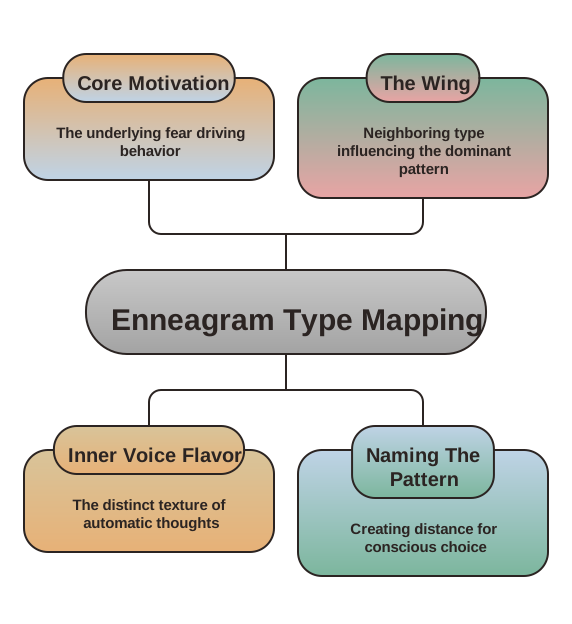
Most people experience their Enneagram type most clearly not in their best moments — but in the automatic thoughts that show up when something goes wrong.
The Type 1 doesn't notice her perfectionism until she replays the meeting for the fourth time. The Type 6 doesn't notice his anxiety until 2am when he's running the same worst-case scenario again. The Type 2 doesn't notice her fear of rejection until she spends an hour analyzing a single unreturned text.
Your Enneagram type doesn't cause these thoughts. It shapes them — gives them their specific flavor, their specific fear at the center. Which is why knowing your type is the first step to actually working with these patterns instead of being run by them.
When you can name the thought pattern — this is my Type 6 threat-scanning, not a real emergency — you create just enough distance to choose a different response. That's what CBT calls cognitive defusion. The Enneagram just gives you the map.
Free Enneagram Test — 27 Questions, No Email
Ready to find out your type? The free Enneagram test walks you through 27 statements — rate each from 1 (not like me) to 5 (very like me), answering based on how you actually are, not how you want to be. Your highest-scoring type is your dominant type; your second-highest is often your wing — the neighboring type that colors your dominant type. No email, no signup, instant results.
What to Do With Your Result
Your Enneagram type is not a box. It's a pattern — one you developed for good reasons, usually early, as a way of managing a world that sometimes felt unsafe or unpredictable.
The goal isn't to become a different type. It's to stop being unconsciously run by the fear at the center of your type. That gap between impulse and choice — where you notice the Type 6 spiral starting, or the Type 2 self-erasure kicking in — is where real change happens.
The most effective way to work with your Enneagram type in real time is to catch the thought early, before it becomes a spiral. When the inner critic fires, when the anxiety starts scanning, when the perfectionist loops — that's the moment.
MindLift is built for exactly that moment. Type your thought — in your own words, however messy — and get three CBT-based reframes within 60 seconds: one that challenges the hidden assumption, one grounded in your specific situation, one that speaks to your self-worth directly. Free to start — premium available for deeper personalization.
Download for iOS · Download for Android
Frequently asked questions
Is this enneagram test really free?
Yes — free. No email required, no account, no results held back. Read the type descriptions, take the 27-question test, and get your result instantly on this page.
How accurate is the enneagram test?
The Enneagram is most accurate when you answer based on your internal experience — your fears and motivations — rather than your behavior. Most people recognize their type immediately when they read the core fear. If your result surprises you, read the two neighboring types; your wing may be very strong.
What's the difference between my type and my wing?
Your core type is your dominant pattern. Your wing is the adjacent type (directly neighboring on the Enneagram circle) that adds texture to your type. A Type 4w3 is more achievement-driven than a 4w5. A Type 6w5 is more withdrawn than a 6w7. Most people can identify their wing from the quiz scores.
Can my Enneagram type change?
Your core type stays consistent across your life. What changes is how consciously you work with it. Healthier versions of each type use the same motivation differently — a healthy Type 1 channels their precision into real improvement rather than self-punishment; a healthy Type 2 gives from genuine generosity rather than fear of being unloved.
What is the most common enneagram type?
Type 9 is widely considered the most common, followed by Types 6 and 2. Type 8 is among the rarest.
How is the Enneagram different from MBTI?
MBTI describes how you process information and make decisions. The Enneagram describes your core motivation and the fear that drives your behavior. Many people find the Enneagram more useful for inner work precisely because it goes beneath behavior to the root.
Like what you're reading?
Accelerate your growth journey
Reframe the patterns that hold you back — and watch your Top Pattern change over time.


Free to start · no account required
Mental Wellness Writers
The MindLift Wellness Team writes evidence-based content on CBT, self-talk, and everyday mental health tools.
Was this article helpful?