
Turn this into a daily habit — free to start in the MindLift app:
95% of people believe they're self-aware.
Research suggests only 10–15% actually are.
That gap — between how self-aware we feel and how self-aware we are — is exactly why a self awareness test is useful. You can't close a gap you can't see.
This guide gives you a quick 6-question self-check, explains what a real self-awareness test measures, and shows how to raise your score in a way that actually changes your daily life. If you want the full version first: take the free 10-question self awareness test here — no email, instant results.
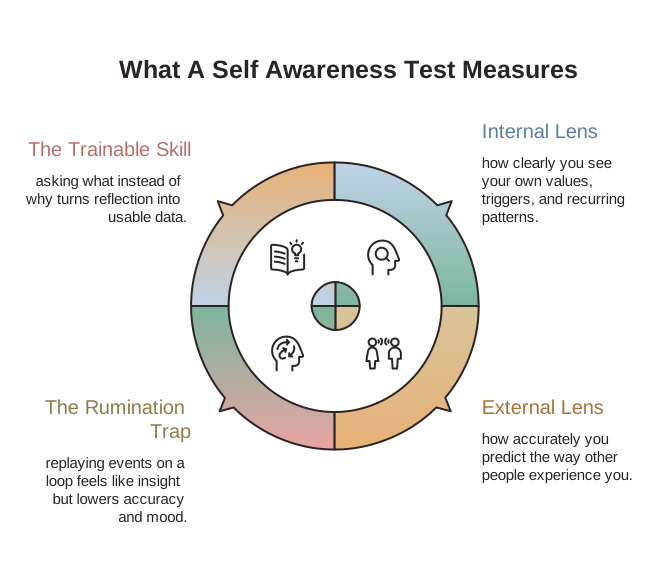
What a self awareness test actually measures
Organizational psychologist Tasha Eurich's multi-year research program found that self-awareness has two separate dimensions — and being strong in one says nothing about the other:
- Internal self-awareness — how clearly you see your own values, emotions, triggers, and patterns. Do you know why Sunday evenings make you irritable?
- External self-awareness — how accurately you understand the way other people experience you. Would your coworkers' description of you match your own?
A good self-awareness quiz probes both. Low internal awareness feels like being a stranger to your own reactions. Low external awareness feels like being repeatedly blindsided by feedback.
The 6-question self-check
Answer honestly — "rarely," "sometimes," or "usually":
- When I feel bad, I can name the specific emotion (not just "stressed" or "off").
- I can predict which situations will push my buttons before they happen.
- Feedback from people close to me rarely surprises me.
- I notice my mood shifting while it shifts, not hours later.
- I know which of my recurring problems I contribute to, and how.
- I can describe my top three values without pausing.
Mostly "usually"? Your baseline is strong. Mostly "rarely"? You're in good company — that's most people — and it's trainable. For a scored version with a breakdown of your self-awareness level, the free self-awareness test takes about a minute.
6 signs of low self-awareness (that feel like something else)
1. Feedback keeps surprising you
If performance reviews, relationship complaints, or a friend's blunt comment regularly land as a shock, your external self-awareness has a blind spot. The information was probably visible to everyone else for a while.
2. The same problem follows you everywhere
Different job, same conflict. Different partner, same argument. When the common factor in recurring situations is you, low self-awareness shows up as bad luck.
3. You know that you feel bad, but not what you feel
Emotional granularity — naming "resentful" instead of "annoyed," "disappointed" instead of "fine" — is a core self-awareness skill. Vague feelings are hard to act on; specific ones come with instructions.
4. You react first and understand later (or never)
Snapping, withdrawing, or agreeing to things you resent — and only figuring out why hours later, if at all — means the gap between trigger and awareness is too wide to steer.
5. People edit themselves around you
If honest input has quietly dried up, people may have learned that feedback doesn't land well. Low self-awareness is often protected by an unintentional "don't tell me" force field.
6. You mistake overthinking for insight
Replaying the conversation twelve times is not self-examination — it's rumination. Eurich's research found that "why did I do that?" style introspection often makes people less accurate about themselves and more anxious. Asking "what" — what was I feeling, what triggered it, what do I want next time — produces insight without the spiral.
How to actually become more self-aware
Skip the personality-label rabbit hole. Four practices move the needle:
- Swap "why" for "what." "Why am I like this?" invites a story. "What happened right before my mood dropped?" invites data.
- Name emotions precisely. Push past the first word. Stressed → pressured? Resentful? Dreading something specific?
- Ask for concrete feedback. Not "do you think I'm self-aware?" but "what's one thing I do in meetings that I probably don't notice?"
- Keep a 2-minute daily record. One trigger, one feeling, one response. A CBT thought record or a reframing app like MindLift makes this nearly frictionless — you type the thought, see the pattern, and practice the kinder rewrite.
Start with a baseline
You can't track progress on a skill you've never measured. The free self awareness test gives you a level — from "running on autopilot" to "deeply self-aware" — plus the specific pattern holding your score down. Ten questions, about a minute, no email.
Then pick one practice from the list above and run it for two weeks. Self-awareness isn't a personality trait you were born without. It's a muscle nobody showed you how to train.
Frequently asked questions
How do I test my self-awareness?
A good self awareness test measures two things: internal self-awareness (how clearly you see your own values, reactions, and patterns) and external self-awareness (how accurately you predict how others experience you). You can take a free 10-question self-awareness test at mindliftapp.app/quiz/self-awareness — no email or signup required — or run the 6-question self-check in this article.
What are signs of low self-awareness?
Common signs: being repeatedly surprised by feedback, blaming circumstances for recurring patterns, not knowing why you feel what you feel, reacting first and understanding later (or never), friends hesitating to be honest with you, and your self-description not matching how people close to you would describe you.
Am I self-aware if I overthink a lot?
Not necessarily — this is the most common confusion. Rumination feels like self-examination, but research by organizational psychologist Tasha Eurich found that introspection done as "why" questioning often lowers accuracy and mood. Self-awareness is noticing patterns with some distance ("what was I feeling, what triggered it"), not replaying events on a loop.
Can self-awareness be improved?
Yes. Self-awareness is a skill, not a fixed trait. The evidence-backed levers are: asking "what" instead of "why" when you reflect, naming emotions specifically, requesting concrete feedback from people you trust, and briefly noting your reactions daily — a 2-minute practice like a CBT thought record or a reframing app builds the observing habit fastest.
Like what you're reading?
Accelerate your growth journey
Reframe the patterns that hold you back — and watch your Top Pattern change over time.


Free to start · no account required
Mental Wellness Writers
The MindLift Wellness Team writes evidence-based content on CBT, self-talk, and everyday mental health tools.
Was this article helpful?