
Turn this into a daily habit — free to start in the MindLift app:
You know your archetype. You know her strengths, her gifts, the way she moves through the world.
But do you know who she becomes when she's scared?
There's a concept in Jungian psychology that doesn't get talked about enough in the world of archetypes: the shadow.
Not the villain. Not the broken version. Not something to be ashamed of or fixed or hidden. The shadow is simply the part of you that takes over when your core wound is activated. When you feel unseen, unsafe, unloved, or out of control — your archetype doesn't disappear. She distorts. She contracts. She becomes a compressed, fearful version of her most powerful self.
Carl Jung called it the shadow because it follows you everywhere — shaped exactly like you, moving exactly when you move, impossible to outrun. The only way to integrate it is to turn around and look at it directly.
Find your archetype. Read her shadow. Notice what's true.
Don't know your archetype yet? Take the free 12 Female Archetypes Quiz first, then come back here.
🌸 The Innocent
The Innocent moves through the world open-hearted and trusting, and her shadow is the Victim — the version of her who collapses when that trust is broken and experiences everything as happening to her, asking why this always happens to her.
At her best: Optimistic, trusting, open-hearted, full of wonder
Her Shadow: The Victim
When the Innocent's wound is triggered — when the world proves itself unsafe, when trust is broken, when life doesn't turn out the way she believed — she doesn't become cynical. She collapses. Her shadow is the Victim: she experiences everything as happening to her, waits to be rescued, and tells her pain story on repeat because the telling is the only place she feels seen. The optimism that was her superpower becomes the very thing that leaves her unequipped.
In her shadow she:
- Feels powerless in situations where she has more agency than she realises
- Repeats the same painful story without moving through it
- Waits for someone else to change things — a person, a circumstance, a sign
- Uses her own innocence as evidence that the world failed her
The thought that lives here:
"This keeps happening to me. Why does this always happen to me?"
The shadow trigger: Betrayal. Broken trust. The moment the world stops feeling safe.
How she finds her way back:
The Innocent returns not by rebuilding naïve optimism — but by developing earned hope. Hope grounded in her own capacity to survive and choose, not in circumstances cooperating. The shift from 'this is happening to me' to 'what can I do with this' is the whole journey.
🌿 The Everygirl
The Everygirl belongs anywhere and stays unpretentious about it, and her shadow is the Shapeshifter — the version of her who adapts to whoever the room needs, convinced that just being herself will not be enough unless she is useful to someone.
At her best: Relatable, grounded, loyal, unpretentious, deeply human
Her Shadow: The Shapeshifter
The Everygirl's gift is belonging — she can walk into any room and find common ground. Her shadow reveals the cost of that belonging: she has become so good at fitting in that she no longer knows what she actually is when no one is watching. When her wound is triggered — the fear of being ordinary to the point of invisible — she doesn't assert herself. She adapts. She becomes whoever the room seems to need. Not from malice. From a deep, aching need to be enough.
In her shadow she:
- Changes her opinions, values, and personality depending on who she's with
- Resents the people she's performing for without ever telling them
- Feels invisible even in rooms full of people who like her
- Secretly wonders if anyone knows the real her — or if there is one
The thought that lives here:
"If I'm just myself, I won't be enough. I'm only enough when I'm useful to someone."
The shadow trigger: Being overlooked. Feeling replaceable. The suspicion that extraordinary people get things ordinary people don't.
How she finds her way back:
The Everygirl's return is about reclaiming her own opinion — about small things first. What she actually thinks. What she actually wants. Not what the room wants from her. The radical act for her is having a preference and not adjusting it based on who's listening.
⚔️ The Hero
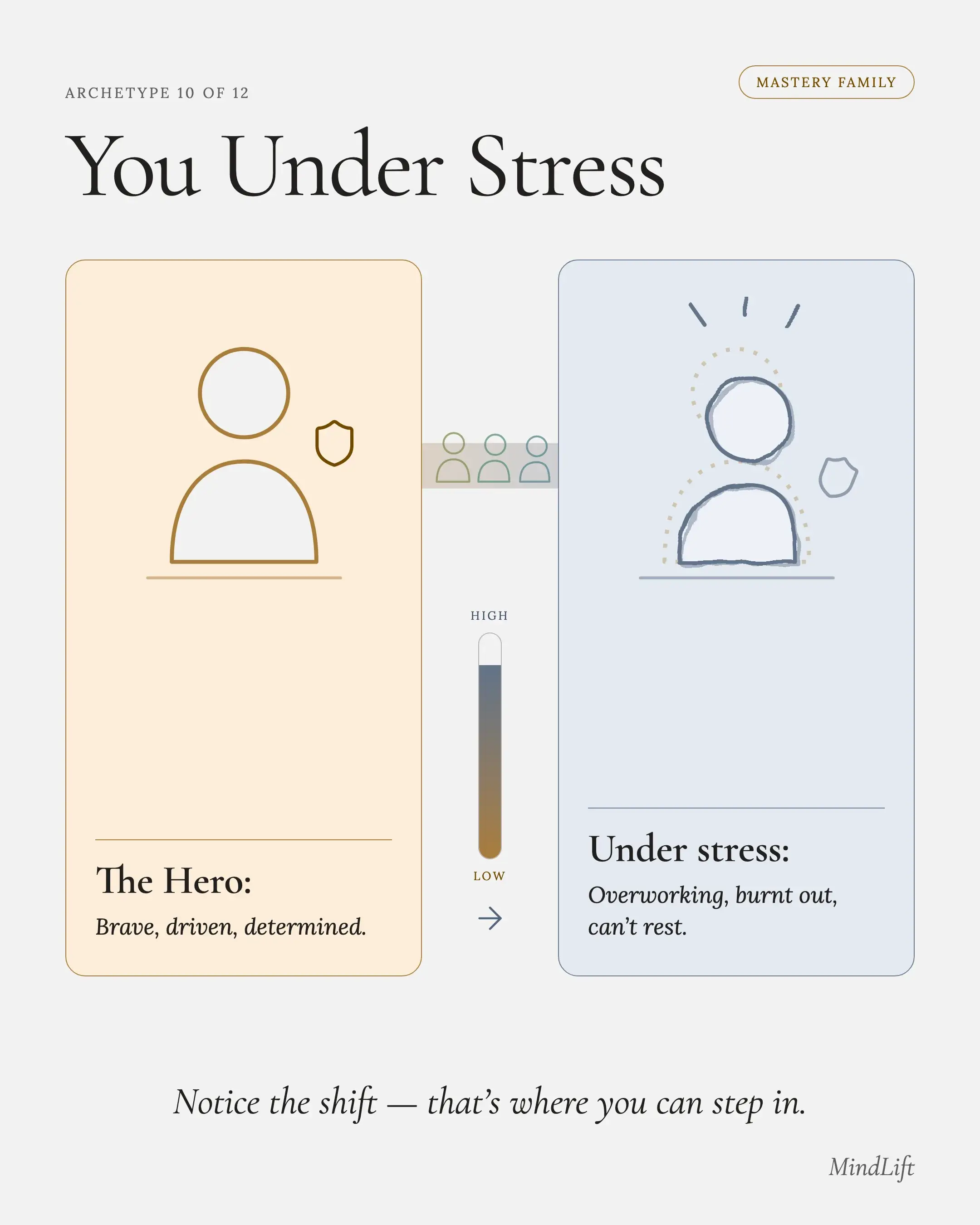
The Hero is a force of nature when something needs carrying, and her shadow is the Achiever Who Can't Stop — the version of her who has to keep proving herself, certain that the moment she stops, everyone will see she was never really that capable.
At her best: Brave, determined, capable, resilient, a force of nature
Her Shadow: The Achiever Who Can't Stop
The Hero's shadow isn't failure — it's the inability to stop proving she hasn't failed. When her wound is triggered — feeling inadequate, incompetent, or like she might actually not be enough — she doesn't rest. She doubles down. She achieves harder, pushes further, takes on more, delivers more, sacrifices more — because stopping, even for a moment, would mean having to feel the thing she's been outrunning. Her busyness is not ambition. It's armour.
In her shadow she:
- Defines her worth entirely through output and achievement
- Cannot rest without anxiety — stillness feels like falling behind
- Is secretly terrified that if she stopped achieving, no one would love her
- Burns out repeatedly and returns to the same pattern immediately after
The thought that lives here:
"I have to keep proving myself. If I stop, they'll see I was never really that capable."
The shadow trigger: Failure. Criticism. Being surpassed. Any evidence that she might not be as capable as she needs to believe.
How she finds her way back:
The Hero returns not through rest — she can't access rest from inside the shadow. She returns through one honest question: Who am I when I'm not achieving anything? Not as a crisis. As genuine curiosity. The answer is where her real self lives.
💛 The Caregiver
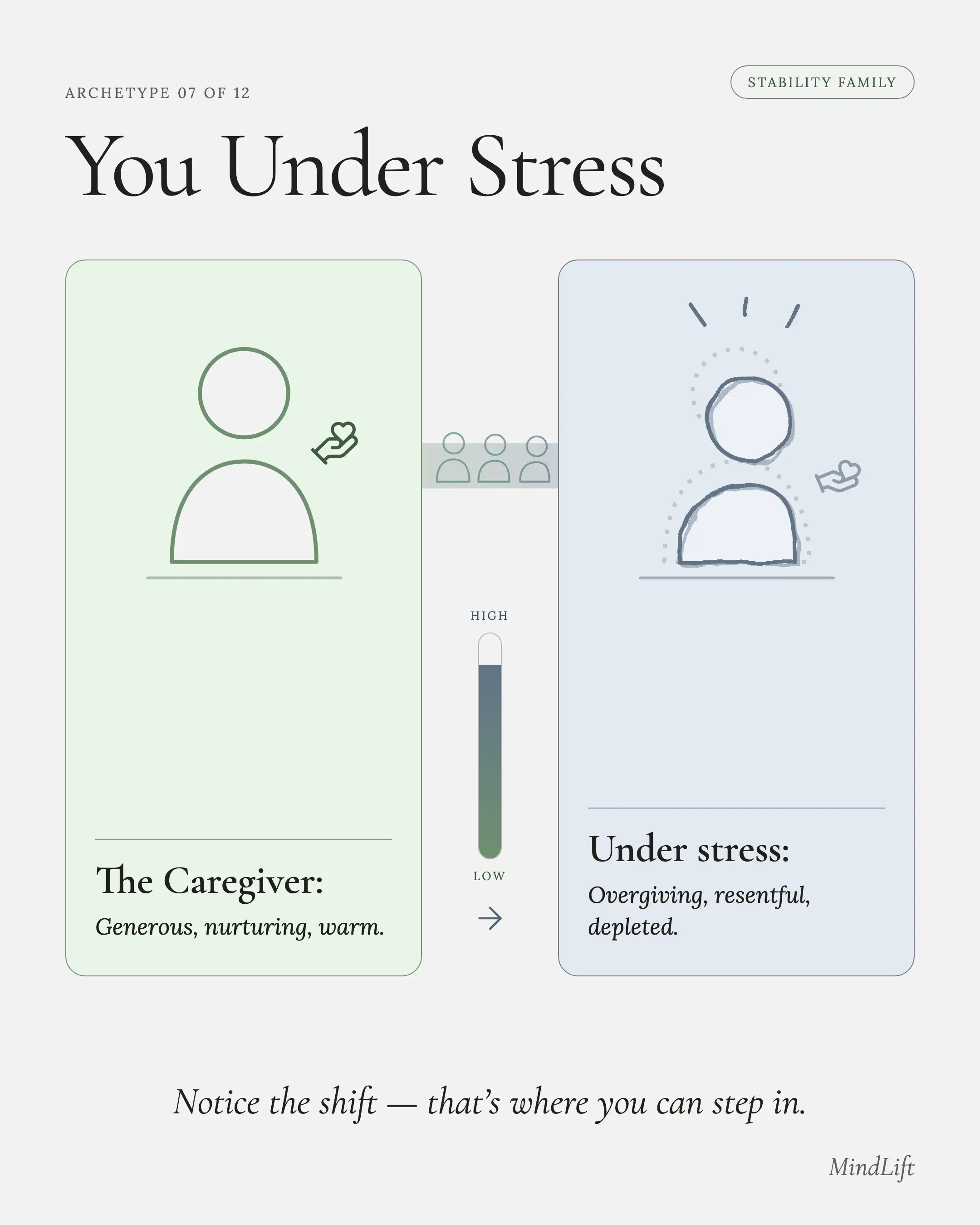
The Caregiver is the person everyone leans on, and her shadow is the Martyr — the version of her who does everything for everyone, resents that nobody does anything for her, and cannot say so out loud because she chose this.
At her best: Nurturing, generous, deeply loving, the person everyone leans on
Her Shadow: The Martyr
This is the most common shadow pattern among women — and the most socially rewarded, which makes it the hardest to see. The Caregiver gives endlessly, depletes herself completely, and then keeps giving — except now it comes with a quiet, unspoken ledger. The resentment she can't express. The exhaustion she can't admit. The anger she turns inward because anger feels selfish. Her wound is the belief that she is only lovable when she is needed.
In her shadow she:
- Gives past her limits and then feels bitter about it
- Uses her own sacrifice as evidence of her love — and others' inadequacy
- Cannot ask for help without feeling like she's failing at her own identity
- Keeps score invisibly, then hates herself for keeping score
The thought that lives here:
"I do everything for everyone and no one does anything for me. But I can't say that, because I chose this."
The shadow trigger: Being taken for granted. Not being seen in her sacrifice. Having her needs go unnoticed by the people she has made sure to notice.
How she finds her way back:
The Caregiver returns through one terrifying act — asking for something. Not a small thing. Something real. And letting someone else provide it without managing their response or making it easier for them to give. That moment of receiving, without performing, is how she finds her way home.
🧭 The Explorer
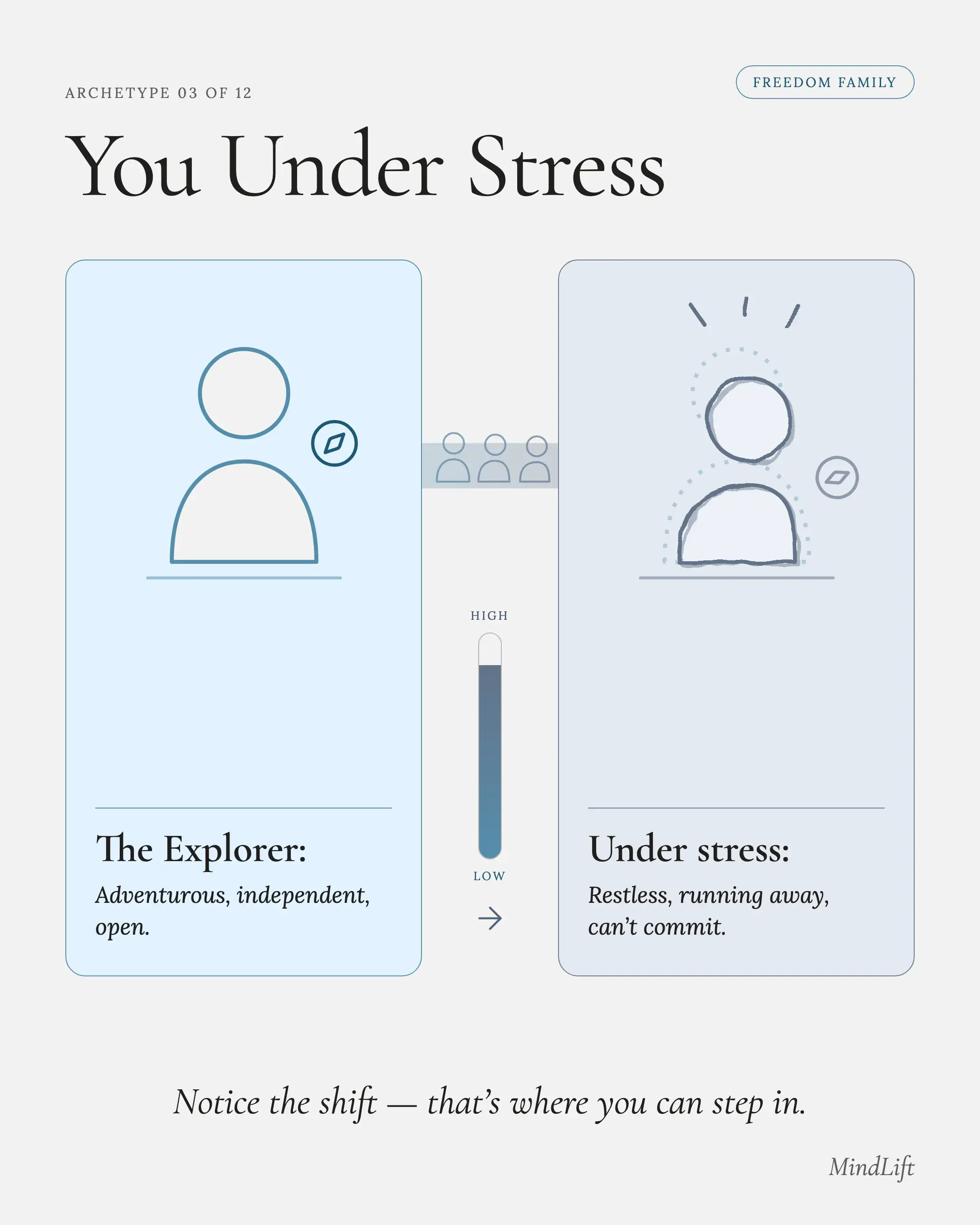
The Explorer is curious and endlessly seeking, and her shadow is the Runaway — the version of her who reads every difficult stretch as a sign that she needs a change, because leaving is quicker than staying long enough for something to get hard.
At her best: Free, curious, adventurous, endlessly seeking
Her Shadow: The Runaway
The Explorer is always looking for something — new places, new experiences, new versions of herself. Her shadow is the Runaway: she isn't seeking anything, she's fleeing everything. The relationship that was getting real. The city starting to feel like home. The version of herself that was getting too known, too seen, too committed. Her wound is the fear of being trapped. But what she calls traps are often just roots.
In her shadow she:
- Leaves before things get hard rather than staying to work through them
- Mistakes emotional unavailability for independence
- Collects experiences as a substitute for depth
- Feels free and lonely simultaneously and can't reconcile the two
The thought that lives here:
"I just need a change. This isn't right for me anymore."
The shadow trigger: Commitment. Depth. Anything that requires her to be known fully and stay anyway.
How she finds her way back:
The Explorer returns through stillness — not permanent stillness, but the willingness to stay in one place long enough to feel what's actually there. The discomfort she keeps running from is always shorter than the running.
🔥 The Rebel
The Rebel is fiercely herself and unafraid to disrupt, and her shadow is the Destroyer — the version of her who refuses to be controlled at any cost, and would rather have nothing than have something on somebody else's terms.
At her best: Courageous, disruptive, authentic, fiercely herself
Her Shadow: The Destroyer
The Rebel exists to challenge what doesn't serve. At her best, she changes things. Her shadow destroys things — including the ones that were working. When her wound is triggered — feeling controlled, caged, or forced into a shape that isn't hers — she doesn't just push back. She burns it down. The relationship. The job. The opportunity. The destruction brings temporary relief — at least I chose this — and then she's standing in rubble that didn't need to be made.
In her shadow she:
- Sabotages stability because stability feels like a trap
- Mistakes self-destruction for authenticity
- Pushes people away before they can constrain her
- Conflates compliance with weakness and refuses help as a point of identity
The thought that lives here:
"I won't be controlled. I'd rather have nothing than have something on someone else's terms."
The shadow trigger: Authority. Rules. Any situation where she has to adapt, comply, or ask permission.
How she finds her way back:
The Rebel returns by learning to distinguish between structures that diminish her and structures that hold her. Not everything with walls is a cage. Some walls are foundations. The question: am I leaving because this is wrong — or because it's getting real?
❤️ The Lover
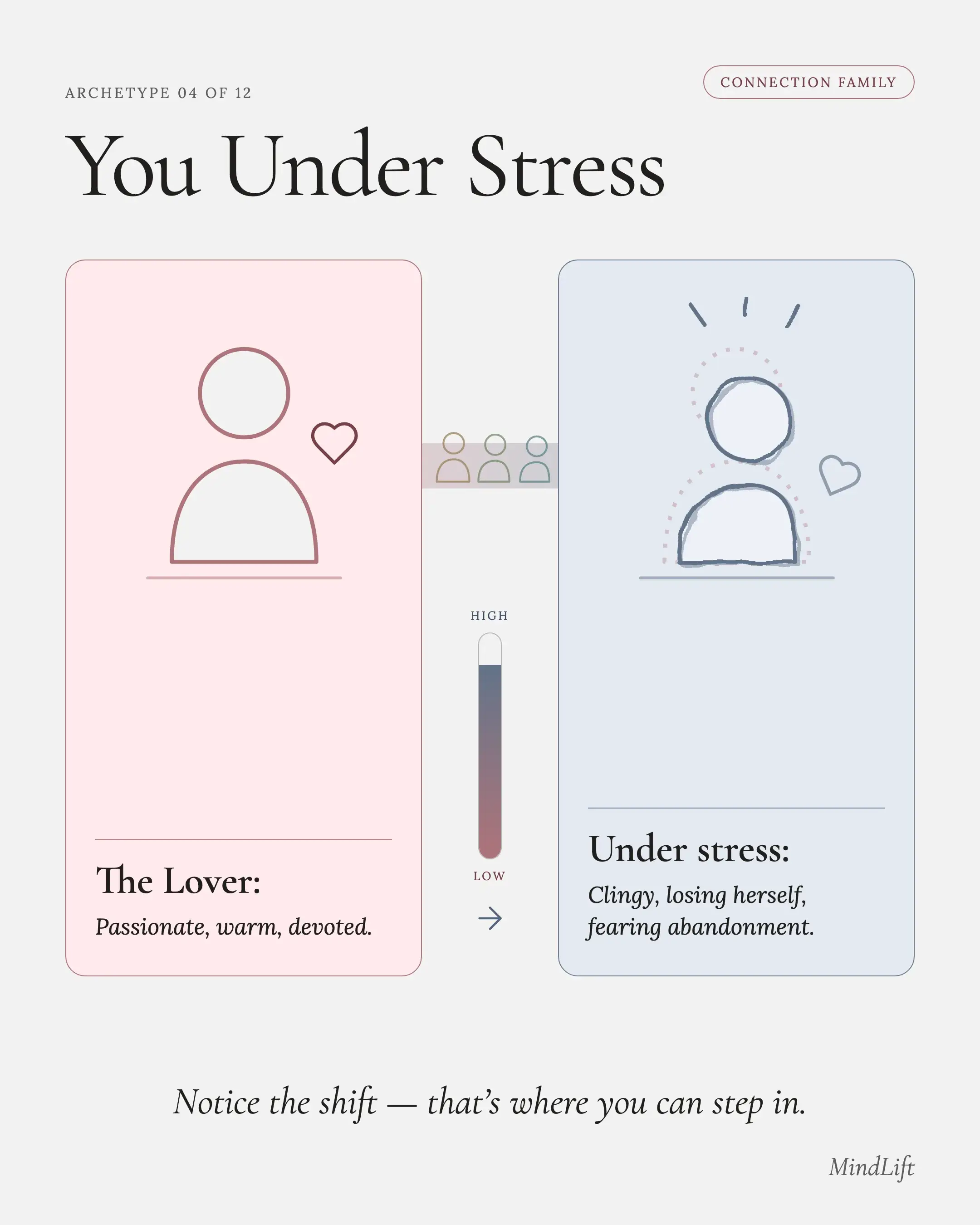
The Lover is passionate and fully present with the people she loves, and her shadow is the Consumed — the version of her who dissolves into the relationship until she no longer knows who she would be if it ended.
At her best: Passionate, sensual, deeply connected, fully present
Her Shadow: The Consumed
The Lover experiences everything fully — beauty, connection, emotion, intimacy. Her shadow is total consumption. When her wound is triggered — fear of losing connection, love feeling conditional — she doesn't protect herself. She pours herself into the relationship until there's nothing of her left outside of it. Her identity disappears. Her friendships thin out. Her own desires become indistinguishable from her person's desires. She calls it love. It's actually fear.
In her shadow she:
- Loses herself entirely in relationships — her mood, identity, and worth track her partner's
- Becomes anxious and controlling when love feels uncertain
- Abandons her own needs, friendships, and goals to protect the relationship
- Mistakes intensity for depth and chaos for passion
The thought that lives here:
"If this relationship ends, I don't know who I am."
The shadow trigger: Distance. Withdrawal. Any sign that connection is becoming less certain.
How she finds her way back:
The Lover returns by remembering that she existed before this love — and that she was someone worth loving before she earned it. The practice is small: one thing each day that is entirely, only hers. A preference. A friendship. A desire that has nothing to do with anyone else.
🎨 The Creator
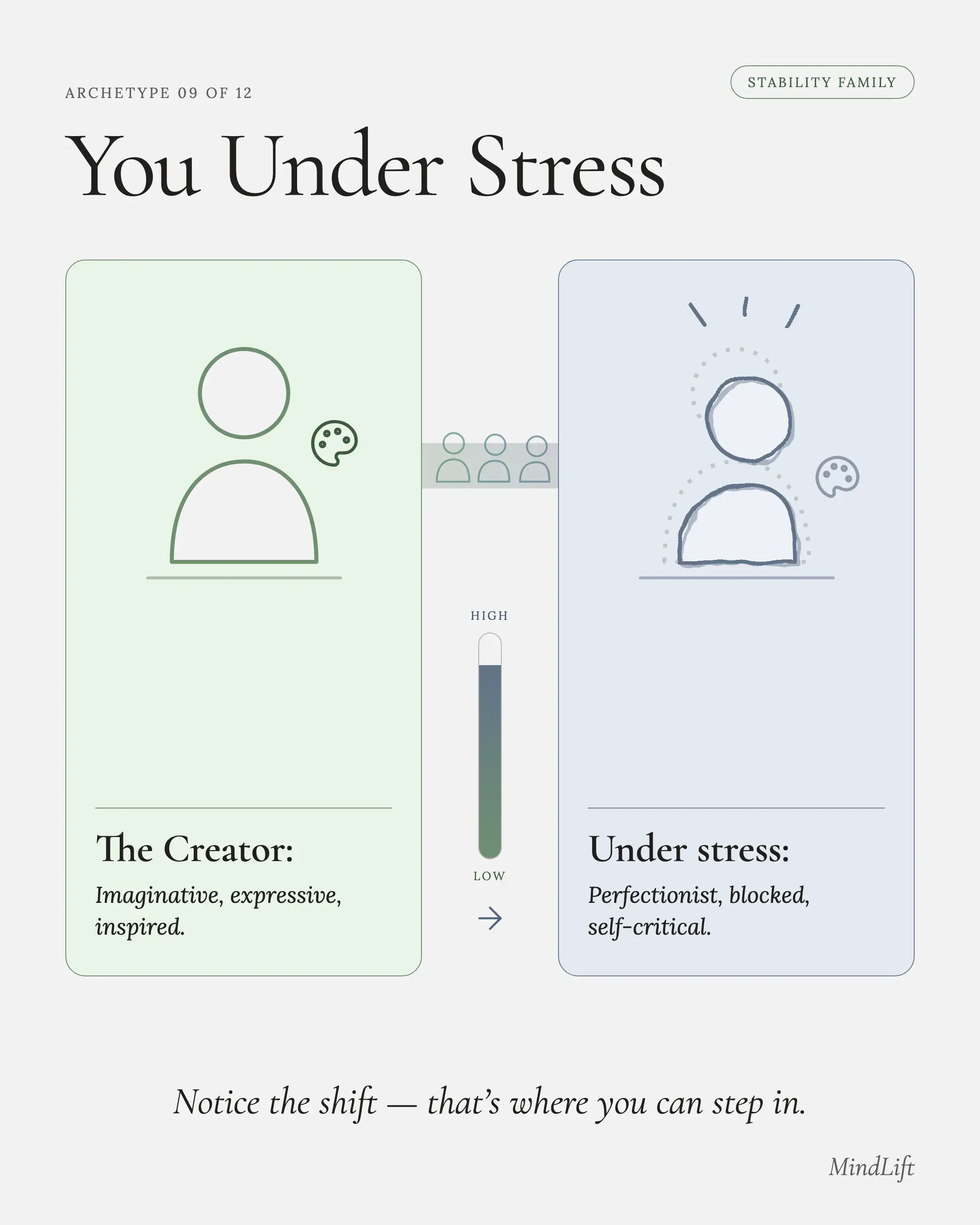
The Creator can make something out of nothing, and her shadow is the Perfectionist — the version of her who never lets the work leave her hands, because it is not ready, not good enough yet, and she will share it when it is right.
At her best: Imaginative, visionary, original, able to make something from nothing
Her Shadow: The Perfectionist
The Creator's gift is vision — she sees what could be and has the capacity to make it real. Her shadow is the gap between what could be and what is, weaponised. She doesn't ship. She refines endlessly. She starts and abandons and starts again. Hard drives full of unfinished things. Ideas that never left her notebook. Projects she's been 'almost ready' to share for years. Her perfectionism isn't standards. It's fear dressed in standards.
In her shadow she:
- Keeps work private indefinitely to protect it from judgement
- Equates the quality of her work with her own worth as a person
- Abandons projects when they inevitably fall short of the vision in her head
- Is more comfortable with potential than with reality
The thought that lives here:
"It's not ready. It's not good enough yet. I'll share it when it's right."
The shadow trigger: Exposure. Criticism. The gap between the vision and the execution.
How she finds her way back:
The Creator returns through release — not perfect release, but deliberate, uncomfortable, imperfect release. Shipping something that isn't ready is not failure. It's the only way she learns what the work actually needs. The vision in her head will always be more perfect than the thing in her hands. That's not a problem. That's the job.
🎭 The Jester
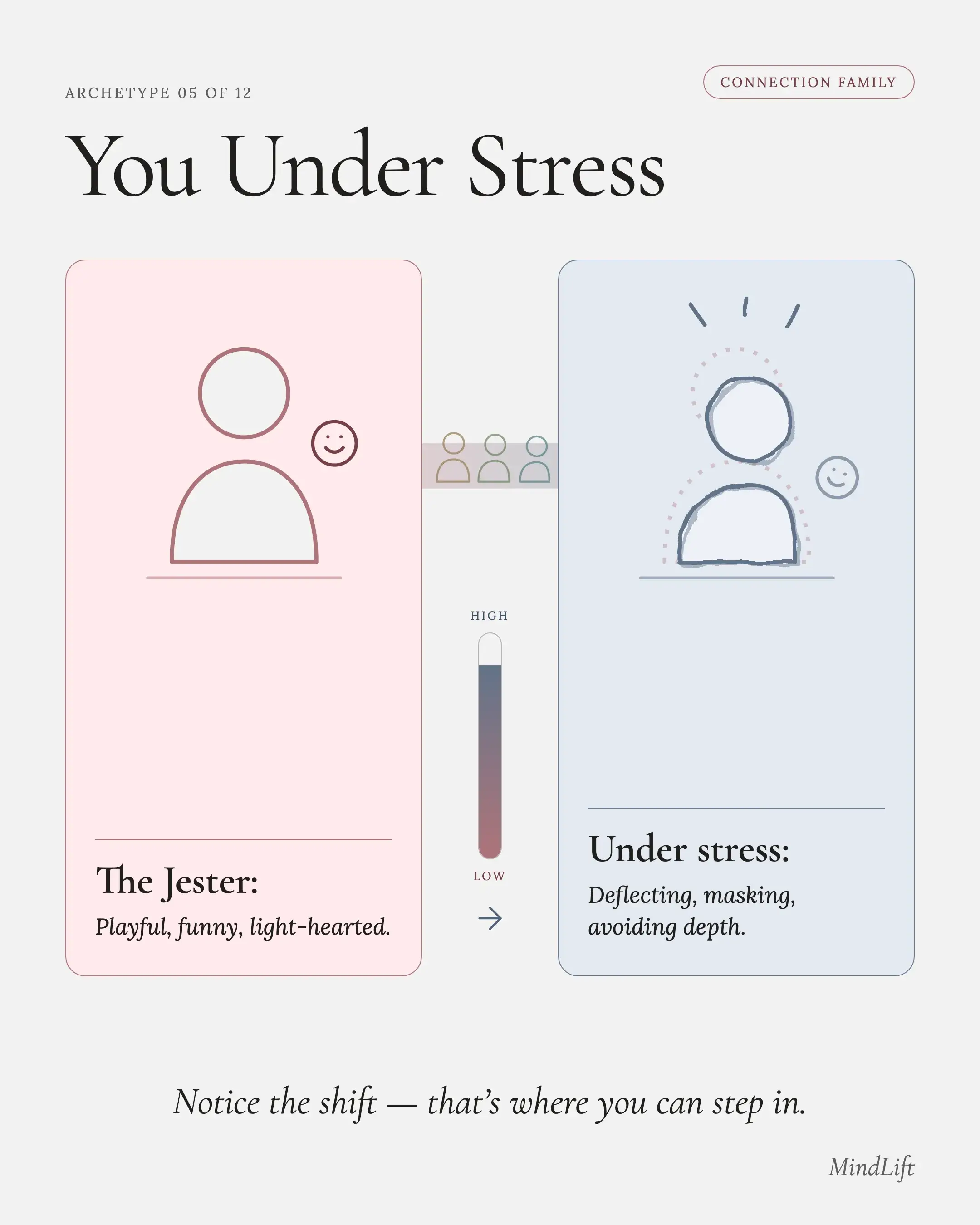
The Jester finds lightness in dark rooms, and her shadow is the Deflector — the version of her who turns everything into a joke before it can turn serious, because she is not sure what she has to offer once she stops being fun.
At her best: Joyful, spontaneous, funny, able to find lightness in darkness
Her Shadow: The Deflector
The Jester brings levity — she makes unbearable things bearable, finds absurdity in suffering, shifts the energy in a heavy room. Her shadow uses that exact gift as a shield. When her wound is triggered — when things get genuinely painful, when someone gets close enough to see past the performance — she deflects. She makes a joke. She lightens the mood so effectively that no one ever gets to ask if she's okay. And she's so good at it that most people never ask.
In her shadow she:
- Uses humour to prevent genuine intimacy
- Feels unseen but makes it impossible for people to see her
- Is the funniest person in the room and the loneliest person in the room simultaneously
- Doesn't know how to be serious without it feeling like a loss of identity
The thought that lives here:
"If I stop being fun, what do I have to offer?"
The shadow trigger: Depth. Vulnerability. Any situation that requires her to be seen without the performance.
How she finds her way back:
The Jester returns by letting one person, once, see her without the joke. Not her whole unfiltered self — just one real thing, said plainly, without immediately deflecting. The world doesn't end. That's the discovery that changes everything.
📚 The Sage
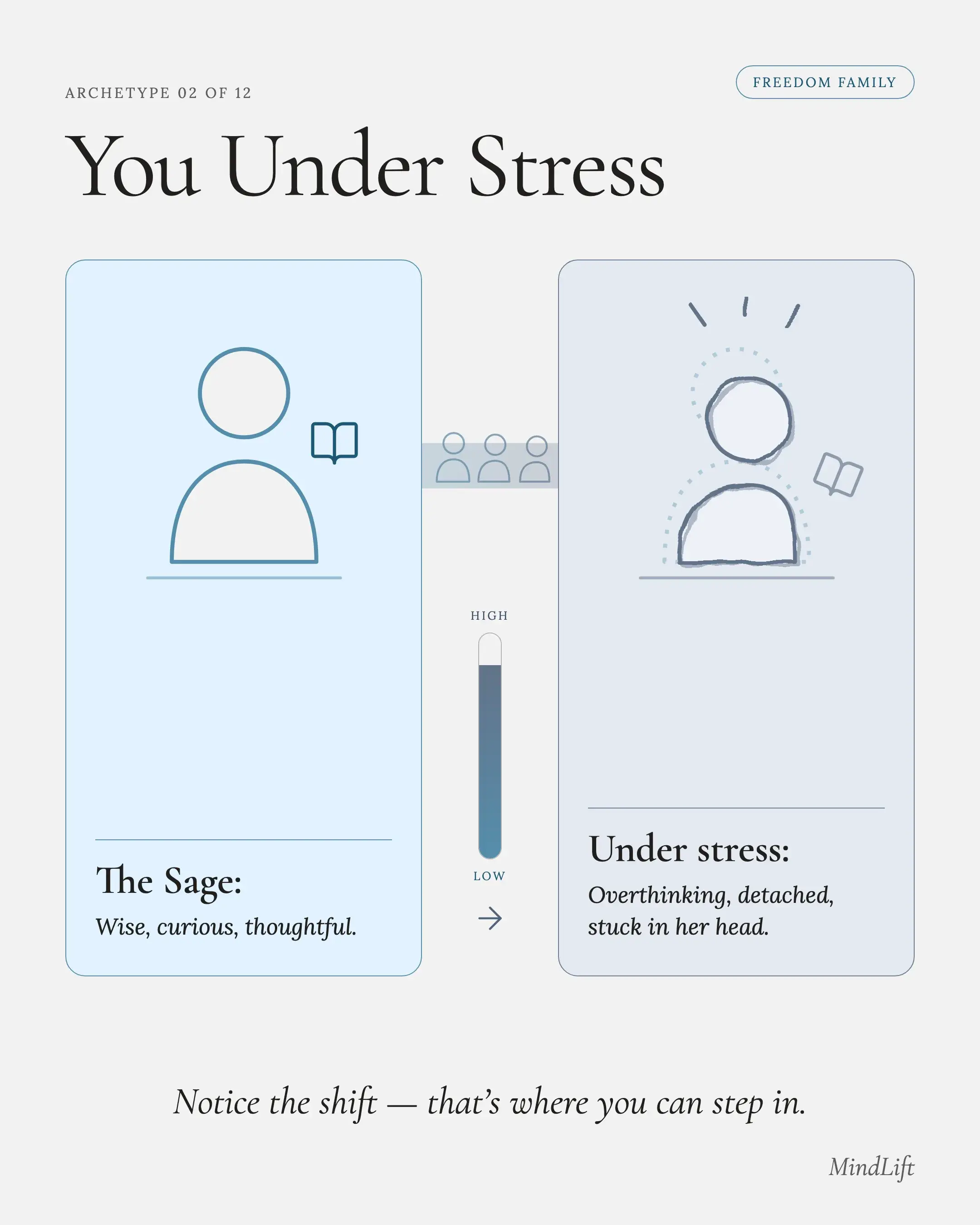
The Sage is perceptive and clear-headed, the one people go to for the truth, and her shadow is the Analyser — the version of her who uses understanding as a way around feeling, on the theory that grasping it well enough means never having to feel it.
At her best: Wise, perceptive, clear-headed, a source of truth
Her Shadow: The Analyser
The Sage understands things. She processes, synthesises, sees patterns others miss. Her shadow uses that same intelligence to avoid feeling anything at all. When her wound is triggered — something too painful or emotionally raw — she doesn't feel it. She analyses it. She researches it. She can explain her own pain with stunning clarity and zero contact. She has thought about her grief more than she has felt it. She is the most self-aware person in the room and somehow the least self-connected.
In her shadow she:
- Intellectualises emotions rather than experiencing them
- Gives advice compulsively as a way of staying above the messiness of actual life
- Mistakes insight for healing — understanding something fully without changing anything
- Is comfortable in her head and afraid of her body
The thought that lives here:
"If I understand it well enough, I won't have to feel it."
The shadow trigger: Emotional overwhelm. Anything that can't be thought through or explained.
How she finds her way back:
The Sage returns through the body, not the mind. A walk. A breath. A feeling named not as a concept but as a physical sensation — where is this in my body right now? That question reaches places her analysis cannot.
✨ The Magician
The Magician creates change that looks like it came from nowhere, and her shadow is the Manipulator — the version of her who arranges outcomes indirectly rather than asking, because a direct request could be refused and going around it feels safer.
At her best: Transformative, visionary, able to create change seemingly from nothing
Her Shadow: The Manipulator
The Magician sees what's possible and has the rare ability to make it real. Her shadow uses that same power without integrity. When her wound is triggered — feeling powerless, unacknowledged, or like her gifts are being overlooked — she doesn't ask for what she needs. She engineers it. She shapes narratives. She influences outcomes indirectly, invisibly, in ways she can later claim she didn't intend. She's not malicious. She's frightened.
In her shadow she:
- Manipulates outcomes rather than asking for what she needs directly
- Uses her perceptiveness to find and press people's pressure points
- Rewrites events in her own memory to maintain her self-image
- Confuses her ability to make things happen with her right to make things happen
The thought that lives here:
"If I ask directly, they might say no. It's easier to make it happen another way."
The shadow trigger: Powerlessness. Being ignored. Having her vision dismissed.
How she finds her way back:
The Magician returns through radical directness — one conversation where she says exactly what she needs, without engineering the conditions first, without managing the other person's response, without a contingency. Naked asking. It's the most powerful thing she can do and the thing that terrifies her most.
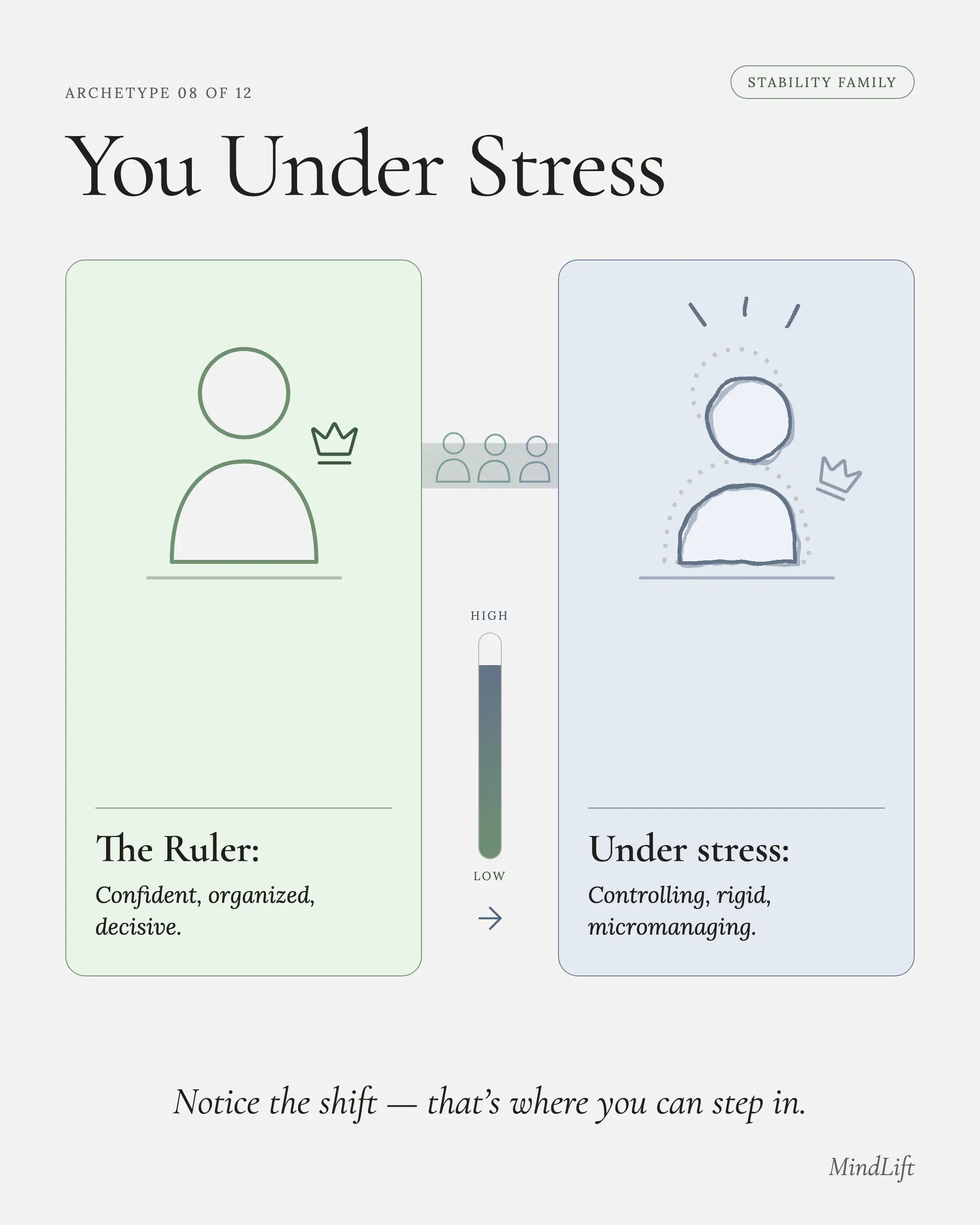
👑 The Ruler
The Ruler is decisive and builds things that last, and her shadow is the Controller — the version of her who cannot let go of any of it, convinced that something always goes wrong the moment she is not the one holding the reins.
At her best: Commanding, decisive, protective, a builder of things that last
Her Shadow: The Controller
The Ruler creates order. She builds structures, holds people accountable, takes responsibility for outcomes. Her shadow controls because chaos once cost her everything. When her wound is triggered — instability, uncertainty, people not performing — she doesn't lead. She grips. She micromanages. She withdraws trust before it can be broken. She makes herself the only reliable variable in every equation. She calls it high standards. It is, underneath, terror.
In her shadow she:
- Micromanages because delegating means accepting she can't control outcomes
- Pushes people away with her standards while desperately needing them to stay
- Conflates control with safety — and loses warmth in the pursuit of it
- Is the loneliest person in the room, surrounded by people she won't let close enough to matter
The thought that lives here:
"If I don't control this, something will go wrong. Something always goes wrong when I'm not in control."
The shadow trigger: Uncertainty. Dependence on others. Any situation where she cannot determine the outcome.
How she finds her way back:
The Ruler returns through one deliberate act of surrender — not of her power, but of her grip. Letting one thing be imperfect. Letting one person do it their way. Letting one outcome be uncertain without fixing it. The world doesn't collapse. That's the data point she needs.
What To Do With Your Shadow
Working with your shadow starts with recognition rather than elimination — seeing the pattern clearly enough that it stops running you from behind the curtain, then catching the thought as it arrives and choosing a different response, one small moment at a time.
Reading your shadow archetype isn't meant to make you feel exposed. It's meant to make you feel recognised.
Because here's what Jung understood that most self-help skips: the shadow isn't the enemy. It's the unintegrated self. The part of you that developed these patterns for a reason — to protect you, to help you survive, to keep you safe in situations where safety felt uncertain.
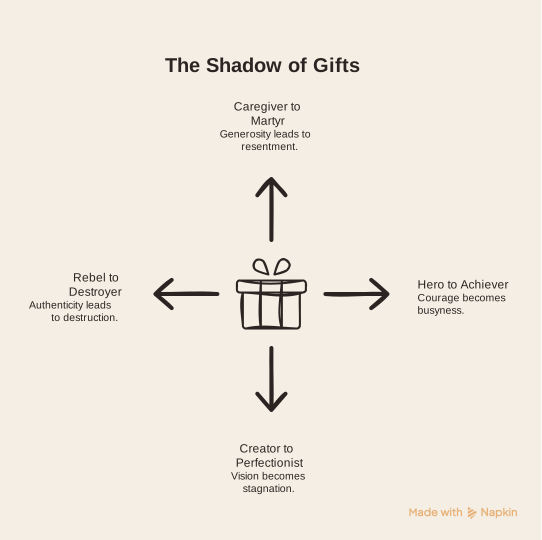
The Caregiver became a Martyr because love once felt conditional on her usefulness. The Hero became an Achiever-Who-Can't-Stop because somewhere along the way, her worth got tied to her output. The Rebel became a Destroyer because something that was supposed to be safe wasn't.
These patterns made sense once. They may not serve you now.
Integration isn't about eliminating the shadow. It's about seeing it clearly enough that it stops running the show from behind the curtain.
The moment you catch the thought — the Martyr's resentment, the Hero's compulsive proving, the Lover's fear of abandonment — is the moment you have a choice. Not a big, dramatic choice. A tiny one. A different response, just this once. That catch-and-choose move is the heart of cognitive restructuring in CBT — the approach with the strongest meta-analytic support for anxiety, anger, and general stress problems[1].
That's how the shadow loses its grip. One moment at a time.
Ready to identify your specific shadow? Take the Shadow Archetype Quiz — 12 statements, 3 minutes, your dominant and secondary shadow identified. Or if your shadow tends to surface in relationships, the relationship archetype quiz shows how it shapes the way you love and wound.
Frequently asked questions
What is the shadow side of a female archetype?
In Jungian psychology, the shadow is the part of you that takes over when your core wound is activated. When you feel unseen, unsafe, or out of control, your archetype doesn't disappear — she distorts. The shadow is a compressed, fearful version of her most powerful self.
What is the shadow of the Caregiver archetype?
The Caregiver's shadow is the Martyr. She gives endlessly, depletes herself completely, and then keeps giving — but now with a quiet, unspoken ledger of resentment. Her wound is the belief that she is only lovable when she is needed.
What is the shadow of the Hero archetype?
The Hero's shadow is the Achiever Who Can't Stop. When her wound is triggered — the fear of being inadequate — she doesn't rest. She achieves harder. Her busyness is not ambition. It's armour.
Can you integrate your shadow archetype?
Yes. Integration doesn't mean eliminating the shadow — it means seeing it clearly enough that it stops running the show from behind the curtain. The moment you catch the specific thought your shadow generates is the moment you have a choice. A tiny one. A different response, just this once.
What is the Rebel archetype's shadow?
The Rebel's shadow is the Destroyer — she burns down things that didn't need to go. When her wound (feeling controlled or caged) is triggered, she doesn't just push back. She destroys the relationship, the job, the opportunity, for temporary relief. The question she needs: am I leaving because this is wrong, or because it's getting real?
Like what you're reading?
Continue your wellness journey
Reframe negative thoughts in 60 seconds — free to start in the MindLift app.


Free to start · no account required
- Hofmann, S. G., Asnaani, A., Vonk, I. J. J., Sawyer, A. T., & Fang, A. (2012). The efficacy of cognitive behavioral therapy: A review of meta-analyses. Cognitive Therapy and Research, 36(5), 427–440. — DOI (opens in a new tab)
CBT & Self-Talk Researchers
MindLift content is grounded in cognitive behavioral therapy principles and designed to help you shift harsh self-talk in real time. Our guides focus on practical, evidence-based techniques you can use in the moment.
Was this article helpful?