
Turn this into a daily habit — free to start in the MindLift app:
The 12 female archetypes are one of the most useful frameworks in feminine psychology — not because they box you in, but because they name something you already feel. You already know that you default to leading, or to analyzing, or to caring, or to pushing back. The archetypes give that pattern a name, a shadow, and a growth edge.
This guide covers all 12 in detail: what each archetype looks like at her best, what her shadow says, and what the inner voice sounds like when the wound is running the show. At the end, you can take the free 46-question quiz to find yours.
Take the free 12 female archetypes quiz
46 questions · about 5 minutes · free · no signup
Take the 12 Female Archetypes Quiz →What Are the 12 Female Archetypes?
The concept of archetypes comes from Carl Jung, who described them as universal patterns embedded in the collective unconscious — templates of character that appear across cultures, mythologies, and individual psychologies. The 12 female archetypes are a modern psychological framework based on these patterns, organized around four core energies:
- Leader Energy (Group A): Queen, Warrior, Protector
- Knowing Energy (Group B): Sage, Mystic, Dreamer
- Heart Energy (Group C): Lover, Healer, Radiant
- Free Spirit Energy (Group D): Seeker, Rebel, Creator
Most women carry one dominant energy group, with a primary archetype and a secondary one. The quiz finds your dominant group first, then a final set of rated statements picks which of that group's three archetypes leads you, so your result is one of the twelve.
Group A — Leader Energy: Queen, Warrior, Protector
Women with dominant A energy are natural leaders, builders, and protectors. They operate from a place of authority and responsibility. Their inner voice tends to be directive — "handle it," "push harder," "keep everyone safe." Under stress, this energy can turn toward control or over-responsibility.
The Queen
Leadership, stability, sovereignty
Inner voice: "If I don't handle it, it won't get done."
Shadow: Control, rigidity — the shadow Queen micro-manages and struggles to delegate
Growth edge: Allow softness without losing power. Not every decision needs your hand.
The Warrior
Courage, ambition, drive
Inner voice: "Push harder. You can rest when it's done."
Shadow: Burnout and self-pressure — the shadow Warrior can't stop achieving even when exhausted
Growth edge: Rest is not retreat — it is part of the strategy.
The Protector
Loyalty, strength, reliability
Inner voice: "I must keep everyone safe."
Shadow: Hyper-responsibility — the shadow Protector carries burdens that aren't hers to carry
Growth edge: You are not responsible for everyone else's outcomes.
Group B — Knowing Energy: Sage, Mystic, Dreamer
Women with dominant B energy lead with their minds and their inner world. They observe, analyze, intuit, and imagine before acting. Their inner voice tends toward depth — "think more," "something feels off," "one day this will matter." Under stress, this energy can spiral into overthinking or retreat into isolation.
The Sage
Wisdom, insight, intellectual depth
Inner voice: "Think deeper. There's always more to understand."
Shadow: Over-analysis — the shadow Sage thinks so much that she stops feeling or acting
Growth edge: Feel, don't just process. Your wisdom needs to land in the body.
The Mystic
Intuition, depth, spiritual attunement
Inner voice: "Something feels off. I can sense what others can't."
Shadow: Isolation — the shadow Mystic withdraws so completely that connection becomes impossible
Growth edge: Ground your intuition in action. Insight without grounding is just distance.
The Dreamer
Idealism, imagination, vision
Inner voice: "One day this will all make sense. There's something more."
Shadow: Escapism — the shadow Dreamer lives so fully in possibility that nothing gets built
Growth edge: Anchor one dream in reality before adding the next.
Group C — Heart Energy: Lover, Healer, Radiant
Women with dominant C energy feel deeply, connect easily, and create warmth wherever they go. Their inner voice tends toward relationship and emotion — "do they still care," "I'll fix it," "stay positive." Under stress, this energy can slide into over-attachment, self-sacrifice, or emotional avoidance.
The Lover
Passion, connection, emotional depth
Inner voice: "Do they still care? Am I enough for them?"
Shadow: Over-attachment — the shadow Lover confuses love with security, making her worth conditional
Growth edge: Your worth exists outside of how much you are loved.
The Healer
Compassion, nurturing, restoration
Inner voice: "I'll fix this. Someone needs to hold this together."
Shadow: Self-sacrifice — the shadow Healer gives until she disappears, then resents it quietly
Growth edge: You cannot pour from empty. Caring for yourself is part of the healing.
The Radiant
Optimism, warmth, charisma
Inner voice: "Stay positive. Everything is fine. Keep it light."
Shadow: Emotional avoidance — the shadow Radiant deflects difficult feelings with brightness
Growth edge: Depth strengthens light. You don't have to perform okay to belong.
Group D — Free Spirit Energy: Seeker, Rebel, Creator
Women with dominant D energy are driven by growth, freedom, and originality. Their inner voice tends toward expansion — "there's more," "no one controls me," "is this good enough." Under stress, this energy can manifest as restlessness, emotional detachment, or perfectionism that prevents completion.
The Seeker
Growth, curiosity, expansion
Inner voice: "There's always more. I'm not done becoming yet."
Shadow: Restlessness — the shadow Seeker is always chasing the next version of herself, never arriving
Growth edge: Freedom and belonging are not opposites. Build roots as you explore.
The Rebel
Independence, disruption, authenticity
Inner voice: "No one controls me. I don't follow rules that don't make sense."
Shadow: Emotional detachment — the shadow Rebel burns down things that didn't need to go
Growth edge: Vulnerability is not submission. You can let people in without losing yourself.
The Creator
Expression, originality, beauty
Inner voice: "Is this good enough? Will it matter to anyone?"
Shadow: Self-doubt and perfectionism — the shadow Creator never ships because it might not be perfect
Growth edge: The work doesn't need to be perfect to be real. Create anyway.
Which of the 12 archetypes are you?
46 questions · about 5 minutes · free · no signup
Take the 12 Female Archetypes Quiz →How the Free Quiz Works
The 12 female archetypes quiz has 46 questions in two stages. The first 34 each have four options (A, B, C, D) that correspond to the four energy groups, and your answers are tallied to find the group you're strongest in. The last 12 are statements you rate, one for each archetype. Only the three statements from your group decide the result: the one you rate highest names your archetype, so the result is one of the twelve.
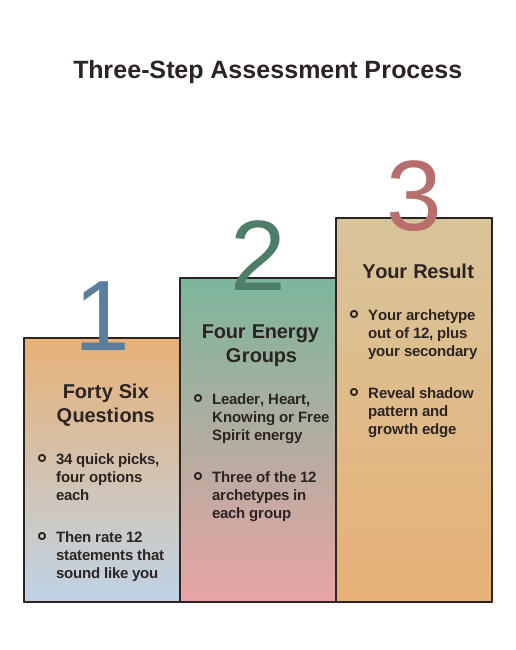
The result shows you:
- Your dominant archetype — the one that leads most of your behavior and inner voice
- Your secondary archetype — the one that shows up most often alongside the dominant
- Your shadow pattern — the distorted version that emerges under stress
- A growth edge — the specific shift that would move you from shadow to integration
The quiz is free, takes about 5 minutes, and requires no account or email. Results appear immediately.
What to Do With Your Archetype Result
The most useful thing about the archetypes isn't the label — it's the shadow. Once you know your shadow pattern, you can start to recognize it in real time. The Queen notices when she's micromanaging instead of delegating. The Healer notices when she's depleting herself for someone who didn't ask for it. The Rebel notices when she's burning something down for temporary relief rather than genuine misalignment.
That recognition — catching the thought before it runs the show — is where change actually happens. Not in big revelations, but in the small moment when you notice "this is my shadow talking" and choose a slightly different response.
Tools like MindLift are built for exactly that moment: when the inner voice is loud and you want to examine it rather than obey it. The Mini-Reframe walks you through a 60-second CBT process to find a more grounded response to whatever the thought is saying.
Common Questions About the 12 Female Archetypes
Is this based on Jungian psychology?
Yes. Carl Jung's archetype theory is the foundation. Jung described archetypes as universal patterns stored in the collective unconscious — templates that appear in myths, dreams, and individual behavior. Modern feminine psychology has applied this framework specifically to women's patterns of energy, behavior, and inner voice.
What's the difference between archetypes and personality types (like MBTI or Enneagram)?
Personality typing frameworks like MBTI focus on cognitive functions and behavioral preferences. The archetype framework focuses specifically on the inner voice, the shadow, and the core wound. It's less about how you make decisions and more about what your self-talk does when you feel threatened, unseen, or out of control.
Can my archetype change over time?
Your dominant archetype often stays consistent, but your relationship to it changes. A Queen who does shadow work becomes less controlling and more quietly authoritative. A Lover who does shadow work becomes less anxious about belonging and more genuinely present. The archetype itself is stable — how you inhabit it evolves.
Ready to find your archetype?
The free 46-question quiz is below. It takes about 5 minutes and shows your result instantly — no account, no email.
Take the Quiz — Free →Explore the Archetype Cluster
- 12 Female Archetypes Quiz — Free (46 questions)
- The 12 Female Archetypes and Your Inner Voice
- The Shadow Side of Your Female Archetype
- Shadow Archetype Quiz
Frequently asked questions
What are the 12 female archetypes?
The 12 female archetypes are: Queen, Warrior, Protector, Sage, Mystic, Dreamer, Lover, Healer, Radiant, Seeker, Rebel, and Creator. Rooted in Jungian psychology, each represents a universal pattern of feminine energy, inner voice, and behavior.
Is the 12 female archetypes quiz really free?
Yes. The MindLift female archetypes quiz is free — no signup, no email, no results held back. You get your full result including dominant archetype, secondary archetype, shadow pattern, and inner voice analysis immediately.
How accurate is the female archetypes quiz?
The quiz is a self-discovery tool grounded in Jungian archetype theory. It is educational and reflective, not a clinical assessment. Most people find the results resonate strongly because the questions focus on actual behavior and thought patterns rather than hypothetical preferences.
Can I have more than one archetype?
Yes. Most women have a dominant archetype and a secondary one. When two scores are close, you draw from both energy types — which is very common. The quiz reveals both your primary and secondary archetype.
What is the difference between feminine archetypes and goddess archetypes?
Feminine archetypes (like Queen, Sage, Lover, Rebel) come from Jungian psychology and describe inner voice and behavior patterns. Goddess archetypes (like Athena, Aphrodite, Artemis) come from mythology and often map to similar patterns. This quiz uses the psychological framework.
How do I use my female archetype result?
Start with your growth edge — the one pattern your archetype defaults to under stress. If you are a Queen, notice when you are controlling rather than leading. If you are a Lover, notice when you are seeking validation rather than connection. Small shifts in awareness, practiced consistently, are what actually change the inner voice.
Like what you're reading?
Accelerate your growth journey
Reframe the patterns that hold you back — and watch your Top Pattern change over time.


Free to start · no account required
- Jung CG (1959). The Archetypes and the Collective Unconscious (Collected Works, Vol. 9, Part 1). Princeton University Press (Bollingen Series XX).
- Bolen JS (1984). Goddesses in Everywoman: A New Psychology of Women. Harper & Row.
- Pearson CS (1991). Awakening the Heroes Within: Twelve Archetypes to Help Us Find Ourselves and Transform Our World. HarperSanFrancisco.
- Faber MA, Mayer JD (2009). Resonance to archetypes in media: There's some accounting for taste. Journal of Research in Personality, 43(3), 307–322. — DOI (opens in a new tab)
Mental Wellness Writers
The MindLift Wellness Team writes evidence-based content on CBT, self-talk, and everyday mental health tools.
Was this article helpful?