
Turn this into a daily habit — free to start in the MindLift app:
The 12 female archetypes — Queen, Warrior, Lover, Healer, Mystic, Sage, Creator, Dreamer, Protector, Radiant, Seeker, and Rebel — are universal psychological patterns from Jungian psychology that shape how women think, feel, and talk to themselves under stress. Each archetype defaults to a specific cognitive distortion when pressured — the Queen to all-or-nothing thinking, the Lover to emotional reasoning — and naming yours is the first step to retraining that inner voice with CBT.
But here's what most archetype content misses:
Your archetype doesn't just shape your energy. It shapes your inner voice. And your inner voice shapes your life.
Which of the 12 archetypes is yours?
Free 34-question quiz · no email · instant result
What Are the 12 Female Archetypes?
Archetypes are universal psychological patterns first described by Carl Jung in analytical psychology. They reflect core motivations, strengths, and shadow tendencies. In modern feminine psychology, 12 archetypes are most commonly recognized:
Each one carries power. Each one carries a shadow. And each one has a distinct inner dialogue.
The Missing Link: Archetypes & Cognitive Distortions
Cognitive behavioral research describes cognitive distortions — systematic thinking errors that amplify anxiety and self-doubt. These include all-or-nothing thinking, catastrophizing, emotional reasoning, mind-reading, overgeneralization, and discounting the positive. If you want a clearer breakdown, read our full guide to thinking traps.
The catalogue is older than the wellness internet: Aaron Beck first described these distortions in 1963, in the thinking of depressed patients[1], and later research found the same habits of thought tracking with depressive symptoms in the general population[2]. They are not quirks of personality. They are learned interpretations — which is exactly why an archetype can predict them.
Here's the powerful insight:
Your archetype influences which distortion your brain defaults to under stress — and which affirmation can shift it fastest.
All 12 Archetypes: Inner Voice Patterns & Growth Shifts
Click through each archetype below to see its core energy, the shadow distortion that shows up under pressure, the exact sentence its inner voice repeats, and the growth shift that moves it from the distortion back toward the strength underneath.
The Queen: Control-Based Thinking
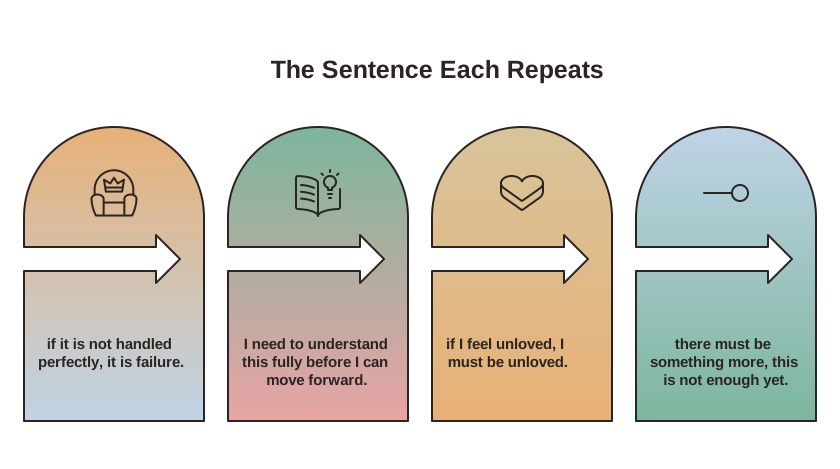
The Queen leads with authority, structure and a clear sense of who is responsible, and under pressure that hardens into all-or-nothing thinking — if it is not handled perfectly, it is failure. The shift is toward collaborative strength, where asking for support amplifies power rather than diminishing it.
Core energy: Authority, leadership, structure
Shadow distortion: All-or-nothing thinking
Inner voice:
"If it's not handled perfectly, it's failure."
Queens often struggle with rigid standards and pressure to maintain power. They hold themselves and others to exacting standards that can become exhausting.
Growth shift: From control → collaborative strength. Recognizing that asking for support amplifies power rather than diminishing it.
The Warrior: Self-Pressure
The Warrior runs on drive, courage and ambition, and under pressure that turns into should statements — she should be stronger, she should be handling this better. The shift is toward sustainable resilience, where rest counts as a warrior's strategy rather than a retreat.
Core energy: Drive, courage, ambition
Shadow distortion: "Should" statements
Inner voice:
"I should be stronger. I should handle this better."
Warriors can confuse productivity with worth, rest with weakness, and vulnerability with failure.
Growth shift: From push → sustainable resilience. Rest is a warrior's strategy, not a retreat.
The Lover: Emotional Reasoning
The Lover's energy is connection, passion and intimacy, and under pressure it becomes emotional reasoning — if she feels unloved, she concludes she must be unloved. The shift is treating feelings as data rather than verdicts, so emotional depth stops doubling as evidence.
Core energy: Connection, passion, intimacy
Shadow distortion: Emotional reasoning
Inner voice:
"If I feel unloved, I must be unloved."
Emotions feel like facts. The Lover's rich emotional depth — her greatest gift — becomes her trap when she can't distinguish feeling from reality.
Growth shift: Feelings are data — not verdicts.
The Mystic: Mind-Reading & Overanalysis
The Mystic works from intuition, spiritual depth and inner knowing, and under pressure that becomes mind-reading — she senses something is wrong and treats the sensing as proof. The shift is checking intuition against evidence before acting on it, rather than instead of it.
Core energy: Intuition, spiritual depth, inner knowing
Shadow distortion: Mind-reading
Inner voice:
"I sense something's wrong. I can feel it."
Mystics can interpret ambiguity as meaning, and silence as evidence. Their intuition is real — but anxiety can masquerade as intuition.
Growth shift: Check intuition against evidence before acting on it.
The Healer: Personalization
The Healer's energy is compassion, nurturing and empathy, and under pressure it becomes personalization — someone else's hurt registers as her responsibility and her failure. The shift is support without self-sacrifice, on the understanding that compassion is supposed to include herself.
Core energy: Compassion, nurturing, empathy
Shadow distortion: Personalization
Inner voice:
"This is my responsibility to fix. If they're hurt, I failed."
Healers often assume emotional blame for situations that were never theirs to own. Their capacity for empathy becomes boundaryless.
Growth shift: Support without self-sacrifice. Compassion includes yourself.
The Sage: Analysis Paralysis
The Sage runs on wisdom, knowledge and discernment, and under pressure that becomes analysis paralysis — she needs to understand a thing fully before she can move on it. The shift is from understanding to trusting herself to act on incomplete information.
Core energy: Wisdom, knowledge, discernment
Shadow distortion: Intellectualization / analysis paralysis
Inner voice:
"I need to understand this fully before I can move forward."
The Sage gathers information, studies patterns, and seeks to understand before acting. Under stress, this becomes a way to delay — gathering more data as a substitute for trusting herself.
Growth shift: From understanding → trusting yourself to act with incomplete information.
The Creator: Comparison Thinking
The Creator's energy is expression, artistry and originality, and under pressure it becomes comparison thinking — is this good enough, what will they think, she did it better. The shift is to create before judging, putting expression first and evaluation second.
Core energy: Expression, artistry, originality
Shadow distortion: Comparison thinking
Inner voice:
"Is this good enough? What will they think? She did it better."
Creators battle imposter patterns and perfectionism. The comparison trap can silence their most original work before it's ever shared.
Growth shift: Create before judging. Expression first, evaluation second.
The Dreamer: Wishful Thinking
The Dreamer runs on idealism, vision and imagination, and under pressure that becomes wishful thinking — if only things were different, maybe someday. The shift is anchoring big visions in small concrete steps, because the dream becomes real through daily action rather than waiting.
Core energy: Idealism, vision, imagination
Shadow distortion: Wishful thinking / fortune-telling
Inner voice:
"If only things were different. This will never change. Maybe someday..."
Dreamers hold beautiful visions of how life could be. Under stress, they oscillate between magical thinking ("it will work out somehow") and catastrophizing ("it will never work out"). Both are forms of avoiding the present.
Growth shift: Anchor big visions in small, concrete steps. The dream becomes real through daily action, not waiting.
The Protector: Hypervigilance & Catastrophizing
The Protector's energy is loyalty, guardianship and stability, and under pressure it becomes hypervigilance and catastrophizing — she needs to anticipate every possible danger in case something goes wrong. The shift is toward selective trust, since not every situation requires maximum protection.
Core energy: Loyalty, guardianship, stability
Shadow distortion: Hypervigilance / catastrophizing
Inner voice:
"I need to anticipate every possible danger. What if something goes wrong?"
The Protector's greatest strength — keeping those she loves safe — becomes a constant inner alarm system that can't switch off. Hypervigilance as a baseline state is exhausting and often leads to catastrophizing minor risks.
Growth shift: From hypervigilance → selective trust. Not every situation requires maximum protection.
The Radiant: Discounting the Negative
The Radiant runs on optimism, warmth and joy, and under pressure that becomes discounting the negative — stay positive, don't focus on the hard parts, it could be worse. The shift is accepting that light and shadow coexist, and that processing pain is emotional honesty.
Core energy: Optimism, warmth, joy
Shadow distortion: Discounting negative emotions
Inner voice:
"Stay positive. Just don't focus on the hard parts. It could be worse."
Radiants bring lightness to every room. Their shadow is bypassing legitimate pain — their own and others' — in the name of positivity. Emotions that aren't felt don't disappear; they accumulate.
Growth shift: Light and shadow coexist. Processing pain is not pessimism — it's emotional honesty.
The Seeker: Chronic Dissatisfaction
The Seeker's energy is curiosity, adventure and growth, and under pressure it becomes chronic dissatisfaction — there must be something more, this isn't enough yet. The shift is from seeking to arriving where she already is, while still moving forward.
Core energy: Curiosity, adventure, growth
Shadow distortion: Chronic dissatisfaction / grass-is-greener
Inner voice:
"There must be something more. This isn't enough yet. What am I missing?"
The Seeker's hunger for growth and experience is beautiful — until it becomes an inability to land. Every place, relationship, or achievement feels temporary because the next horizon is already pulling her attention.
Growth shift: From seeking → arriving where you already are, while still moving forward.
The Rebel: Overgeneralization & Defensive Detachment
The Rebel runs on independence, authenticity and disruption, and under pressure that becomes overgeneralization — people always disappoint, systems always fail, she can only rely on herself. The shift is strength with openness, independence built by choice rather than by fear.
Core energy: Independence, authenticity, disruption
Shadow distortion: Overgeneralization
Inner voice:
"People always disappoint. Systems always fail. I can only rely on myself."
Rebels protect themselves from vulnerability with a story that makes isolation feel like strength. The overgeneralization ("always," "never") keeps connection at a safe distance.
Growth shift: Strength with openness. Independence built by choice, not by fear.
Quick Reference: All 12 Archetypes at a Glance
All 12 female archetypes sit in one table below, one row each — the sentence her inner voice repeats and the cognitive distortion hiding inside it. Find the line you'd recognise at 2am; the row that reads like a quote is usually your archetype.
| Archetype | Shadow Distortion | Growth Shift |
|---|---|---|
| 👑 Queen | All-or-nothing thinking | Control → collaborative strength |
| 🔥 Warrior | "Should" statements | Push → sustainable resilience |
| 💛 Lover | Emotional reasoning | Feelings as data, not verdicts |
| 🌙 Mystic | Mind-reading | Intuition checked with evidence |
| 🌿 Healer | Personalization | Support without self-sacrifice |
| 📖 Sage | Analysis paralysis | Understanding → action with trust |
| 🎨 Creator | Comparison thinking | Create before judging |
| ☀️ Dreamer | Wishful thinking | Vision anchored in daily steps |
| 🛡️ Protector | Catastrophizing | Vigilance → selective trust |
| ✨ Radiant | Discounting negatives | Light + shadow coexist |
| 🧭 Seeker | Chronic dissatisfaction | Seeking → arriving |
| ⚡ Rebel | Overgeneralization | Strength + openness |
Why Your Archetype's Inner Voice Matters
Naming an archetype's inner voice matters because the sentence underneath it is a habit rather than a fact about you, and habits are the part of this that responds to repetition — which is what makes a distorted pattern retrainable rather than permanent.
Research shows distorted thinking patterns reinforce anxiety and depressive cycles. But here's the empowering part:
- Distortions are habits.
- Habits can be retrained.
- Neural pathways change with repetition.
Your archetype is not your limitation. It's your starting blueprint. Understanding which distortion your archetype defaults to is the first step toward working with it rather than being driven by it.
How to Retrain Your Archetype's Inner Voice
Retraining your archetype's inner voice takes four steps: identify your dominant archetype, name the cognitive distortion it defaults to, replace the line with balanced and believable self-talk, and repeat daily — repetition is what builds new neural pathways.
- 1.Identify your dominant archetype (take the quiz below).
- 2.Name the distortion your archetype defaults to.
- 3.Replace it with balanced, believable self-talk.
- 4.Repeat daily — repetition is what builds new neural pathways.
One detail that makes step three work better: when you talk back to the thought, address yourself by name or as "you" rather than "I." In a series of experiments, people who did this regulated stress more effectively — before a speech, during it, and afterwards — than people using first-person self-talk[4]. "You already know enough to take one step" lands differently than "I already know enough."
This is the foundation of cognitive restructuring in CBT — the approach with the strongest meta-analytic support for anxiety, anger, and general stress problems[3]. For a gentler companion read, our guide to building a kinder inner voice expands on this same shift.
How MindLift Helps
MindLift is a reframing app rather than an affirmations app — you type the sentence your archetype actually repeats, and it names the thinking trap inside it and offers reframes you can believe, so the retraining happens on your own words.
MindLift was designed to retrain inner dialogue in real time. Instead of generic affirmations, it helps you:
- Identify thinking traps specific to your archetype
- Gently reframe them using CBT principles
- Build believable self-talk you can actually use
- Reduce overthinking loops and emotional spirals
- Strengthen self-trust over time
Archetype-specific reframes in MindLift:
Queen pattern → "Support strengthens leadership."
Sage pattern → "I know enough to take the next step."
Protector pattern → "Not every situation requires maximum readiness."
Dreamer pattern → "One small action today moves the vision forward."
Lover pattern → "Feelings are information, not identity."
Warrior pattern → "Rest fuels strength."
Just a few minutes a day can shift the way your brain responds to stress. Because the goal isn't changing your archetype. It's strengthening your most balanced self.
Final Thought: You Are Patterned, Not Broken
You are not "too emotional." You are not "too ambitious." You are not "too sensitive." You are not "too idealistic."
You are patterned. And patterns can evolve.
Your archetype is powerful. Every single one of the 12 carries profound strengths and real shadow patterns. The work isn't to become a different archetype — it's to become the most conscious, integrated version of the one you already are.
Your inner voice just needs alignment.


Frequently asked questions
What are the 12 female archetypes?
The 12 female archetypes are: Queen, Warrior, Lover, Healer, Mystic, Sage, Creator, Dreamer, Protector, Radiant, Seeker, and Rebel. Each represents a core pattern of feminine energy, inner voice, and behavior.
How do female archetypes connect to cognitive distortions?
Each archetype tends to default to a specific thinking trap under stress. Queens default to all-or-nothing thinking, Lovers to emotional reasoning, Warriors to 'should' statements, Mystics to mind-reading, Healers to personalization, and Rebels to overgeneralization.
Which female archetype is the strongest?
There is no 'strongest' archetype — each has profound strengths and a distinct shadow pattern. Queens lead with authority, Warriors with courage, Sages with wisdom, and Healers with empathy. The most powerful version of any archetype is one that recognizes its shadow and works with it consciously.
Can I have more than one female archetype?
Yes. Most women carry a dominant archetype and a secondary one. The Seeker-Sage combination is very common, as is Queen-Warrior or Healer-Mystic. Understanding both your primary and secondary archetype gives you a fuller picture of your inner voice patterns.
Can I change my archetype?
You don't need to change your archetype — it's your starting blueprint. The goal is to recognize the shadow patterns within your archetype and retrain the inner voice that amplifies them.
How can I retrain my archetype's inner voice?
Use CBT-based cognitive restructuring: identify your dominant pattern, name the distortion, replace it with balanced believable self-talk, and repeat daily. Tools like MindLift automate this process.
What is the Dreamer female archetype?
The Dreamer archetype is characterized by idealism, vision, and deep imaginative inner life. Under stress, Dreamers often engage in wishful thinking or fortune-telling — anticipating the worst or fantasizing about escaping the present. Their growth shift is anchoring big visions in practical steps.
What is the Seeker female archetype?
The Seeker archetype is driven by curiosity, adventure, and a hunger to grow. Their shadow distortion is chronic dissatisfaction — 'the grass is always greener.' Their growth shift is learning to be present with what's already good while still moving forward.
Like what you're reading?
Accelerate your growth journey
Reframe the patterns that hold you back — and watch your Top Pattern change over time.
Free to start · no account required
- Beck, A. T. (1963). Thinking and depression: I. Idiosyncratic content and cognitive distortions. Archives of General Psychiatry, 9(4), 324–333. — DOI (opens in a new tab)
- Rnic, K., Dozois, D. J. A., & Martin, R. A. (2016). Cognitive distortions, humor styles, and depression. Europe's Journal of Psychology, 12(3), 348–362. — DOI (opens in a new tab)
- Hofmann, S. G., Asnaani, A., Vonk, I. J. J., Sawyer, A. T., & Fang, A. (2012). The efficacy of cognitive behavioral therapy: A review of meta-analyses. Cognitive Therapy and Research, 36(5), 427–440. — DOI (opens in a new tab)
- Kross, E., Bruehlman-Senecal, E., Park, J., Burson, A., Dougherty, A., Shablack, H., Bremner, R., Moser, J., & Ayduk, O. (2014). Self-talk as a regulatory mechanism: How you do it matters. Journal of Personality and Social Psychology, 106(2), 304–324. — DOI (opens in a new tab)
Mental Wellness Writers
The MindLift Wellness Team writes evidence-based content on CBT, self-talk, and everyday mental health tools.
Was this article helpful?