Turn this into a daily habit — free to start in the MindLift app:
Here's a pattern we hear constantly: you subscribed to Headspace or Calm with good intentions, opened it a handful of times, and now it quietly renews at ~$70 a year while the anxious thoughts it was supposed to fix keep showing up on schedule — at 2am, before the meeting, after the text goes unanswered.
The problem usually isn't discipline. It's a tool mismatch. Meditation apps are built to lower your baseline arousal over weeks of practice. But when a specific thought is looping — "I'm going to mess this up", "they're mad at me" — a breathing track doesn't answer it. Cognitive behavioral therapy does, and you don't need a subscription to use it.
Quick test: when you open your wellness app, are you looking to relax in general — or to stop one particular thought? The first is a meditation job. The second is a CBT job.
What Headspace does well — and where it stops
Headspace is arguably the best-produced meditation library on the market: structured courses, sleepcasts, focus music, and a friendly on-ramp for people who have never meditated. If you want to build a daily mindfulness habit, it's a genuinely good product.
Where it stops: Headspace works on your state, not your thoughts. A 10-minute session can lower the volume of anxiety, but the catastrophic thought that triggered it is still there, unexamined, ready to replay. And at roughly $69.99/year (or $12.99/month), you're paying for a library you may rarely open. We compare the two approaches in detail in MindLift vs Headspace.
What Calm does well — and where it stops
Calm leans into sleep and relaxation: Sleep Stories, ambient soundscapes, and celebrity-narrated wind-downs. For people whose main struggle is falling asleep, it earns its place.
But if what keeps you up is a thought — replaying a conversation, rehearsing tomorrow's disaster — masking it with a Sleep Story treats the symptom. The thought is still unchallenged, which is why it returns the next night. Same subscription math applies: about $69.99/year. See the full breakdown in MindLift vs Calm.
The CBT difference: engage the thought, don't just soothe it
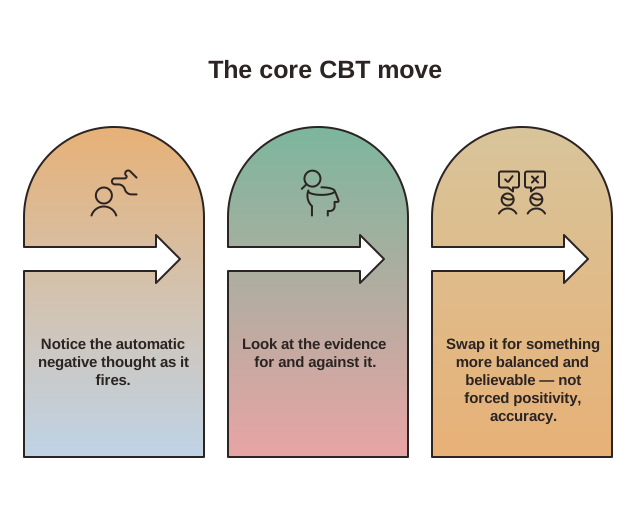
CBT (cognitive behavioral therapy) is the most researched form of psychotherapy, and its core move is simple: catch the automatic negative thought, examine the evidence for and against it, and replace it with something more balanced and believable. Not forced positivity — accuracy.
That mechanism is why CBT-based tools outperform relaxation for rumination, catastrophizing, and harsh self-talk: they work on the cause. If you want the deeper comparison, we've written a full guide on CBT apps vs meditation apps.
MindLift: the free-to-start CBT alternative
MindLift applies that CBT mechanism to the exact thought you're stuck on. You type the thought — as raw as it is — and in about 60 seconds you get a balanced reframe in your own words, grounded in cognitive restructuring. No course to complete, no streak to maintain, no session to schedule.
- Free to start: the core Mini-Reframe, daily affirmations, and 35+ psychology quizzes need no account and no credit card. Premium is optional.
- Built for the moment: 2am spiral, pre-meeting dread, post-argument replay — 60 seconds, not a 10-minute session.
- Evidence base: cognitive restructuring (Beck), self-affirmation theory, and thought defusion — the same foundations therapists use.
- Available on iOS and Android — free to start, no account required.


What about the other CBT apps?
MindLift isn't the only CBT-flavored option, and honest comparisons matter. Youper is a capable AI chatbot, but it runs ~$69.99/year after its trial — the same subscription math you're trying to escape. Clarity (CBT Thought Diary) has a genuinely free thought-record journal, though you write the reframe yourself over 5–15 minutes, which is hard mid-spiral. And Woebot, long the free chatbot recommendation, shut down its consumer app in 2025. Our full ranking lives in Best Free CBT App 2026.
Side-by-side: what your money buys
| App | Approach | Price | Best for |
|---|---|---|---|
| MindLift | CBT reframe of your specific thought | Free to start, premium optional | Stopping an active thought spiral |
| Headspace | Guided meditation courses | ~$69.99/yr | Building a mindfulness habit |
| Calm | Sleep stories & relaxation | ~$69.99/yr | Falling asleep, ambient calm |
| Youper | AI therapy chatbot | ~$69.99/yr after trial | Ongoing emotional check-ins |
| Clarity | Self-written CBT thought records | Free core / Pro ~$60/yr | Learning CBT by journaling |
The honest recommendation
If your meditation subscription is genuinely used and loved — keep it. This isn't a "meditation is useless" argument; a calmer baseline is real and valuable. But if the app sits unopened while specific thoughts keep hijacking your day, stop paying for the wrong tool. Try the free one built for that exact moment first, and let the results decide.
Download MindLift free for iOS & Android — type the thought that's bothering you and see what 60 seconds of CBT does with it.
Frequently asked questions
Is there a free alternative to Headspace and Calm?
Yes. MindLift is free to start and takes a different approach: instead of meditation sessions, it applies CBT (cognitive behavioral therapy) to the specific thought bothering you and returns a balanced reframe in about 60 seconds. Core features need no account or credit card; a premium subscription is optional.
Why would I use a CBT app instead of a meditation app?
Meditation apps reduce physiological arousal — they calm your body. CBT apps target the thought producing the arousal. If your problem is a specific looping thought ('I said the wrong thing', 'what if this fails'), reframing that thought directly is usually faster than a 10-minute meditation session, and the effect targets the actual cause.
How much do Headspace and Calm cost in 2026?
Both run on subscriptions of roughly $69.99 per year (about $12.99/month for Headspace monthly). Free content exists but is limited to a small set of intro sessions — the libraries that make the apps useful sit behind the paywall.
Is MindLift free?
MindLift is free to start — the core Mini-Reframe tool, affirmations, and 35+ self-awareness quizzes require no account and no credit card. An optional premium subscription unlocks deeper personalization, similar to how BetterHelp or Talkspace offer tiered access.
Can I use MindLift alongside a meditation app?
Yes, and many people do. Meditation builds a general calm baseline over weeks; MindLift handles the acute moment when a specific thought is spiraling. They solve different problems, so keeping a meditation practice and adding a free CBT tool costs nothing extra.
Like what you're reading?
Continue your wellness journey
Reframe negative thoughts in 60 seconds — free to start in the MindLift app.
Free to start · no account required
Mental Health App Reviewers
Making mental health practical and accessible — one grounded tool at a time.
Was this article helpful?