
Turn this into a daily habit — free to start in the MindLift app:
You sat down to meditate, followed the breath, and ten minutes later the same thought was still circling. If a meditation app has ever felt like it wasn't quite touching your overthinking, you're not doing it wrong — you may just be reaching for the wrong tool for that particular job. CBT apps and meditation apps target different psychological mechanisms, and knowing the difference tells you which one to reach for, and when.
MindLift is a CBT app built for managing negative self-talk without lengthy meditation sessions. It is a self-guided mental health app for everyday stress that works in short daily sessions: you type the thought on repeat and get a reframe of that exact thought in about 60 seconds — not generic advice.
How do CBT apps and meditation apps work differently?
What Meditation Apps Do
Meditation apps (Calm, Headspace, Insight Timer) primarily train what psychologists call "meta-cognitive awareness" — the ability to observe your thoughts without immediately fusing with them. Instead of being the thought, you practice noticing the thought as a mental event that passes through.
This builds a general capacity for present-moment awareness, reduces physiological stress arousal, and improves emotional regulation over time. The mechanism is practice — daily sessions that gradually shift your default relationship to mental activity.
What CBT Apps Do
CBT apps work at the level of specific thought content. Rather than teaching you to observe thoughts neutrally, they teach you to examine the logic of a specific thought and generate a more accurate alternative. The question isn't "can I be present with this thought" — it's "is this thought distorted, and if so, how?"
This is a fundamentally different intervention. You're not stepping back from the thought — you're engaging with it, examining it, and producing a replacement. The mechanism is restructuring, not observation.
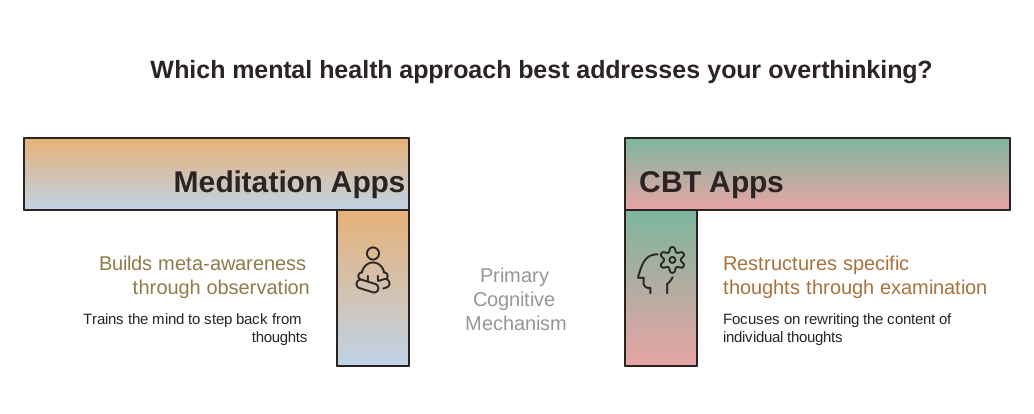
Which works better for each problem, CBT or meditation?
| Use Case | CBT Apps | Meditation Apps |
|---|---|---|
| Specific thought loops / overthinking | Strong — targets the thought directly | Moderate — builds tolerance, not restructuring |
| Generalized anxiety disorder (GAD) | Strong — CBT is first-line treatment | Moderate — reduces arousal but not thought content |
| General daily stress | Moderate — requires active engagement | Strong — daily practice reduces perceived stress |
| Sleep quality | Moderate — helps anxious bedtime thoughts | Strong — relaxation response improves sleep onset |
| Self-criticism / inner critic | Strong — directly challenges distorted self-talk | Moderate — self-compassion meditations help |
| Emotional regulation | Good — cognitive component of regulation | Strong — body-based component of regulation |
| Panic attacks | Strong — restructures catastrophic misinterpretation | Moderate — breathing helps physiological component |
| Mindful eating / impulse control | Moderate | Strong — urge surfing, mindful awareness |
What does the research say about CBT and meditation apps?
CBT Apps: What the Research Shows
Digital CBT has the strongest evidence base among mental health app categories. Key findings:
- Meta-analyses of digital CBT trials have found it significantly reduces anxiety and depression symptoms, with effect sizes comparable to face-to-face CBT for mild-to-moderate presentations.
- For generalized anxiety disorder specifically, CBT produces higher response rates than placebo.
Meditation Apps: What the Research Shows
Mindfulness meditation has a substantial and growing evidence base:
- A 2014 meta-analysis of 47 trials (Goyal et al.) found mindfulness meditation programs produced moderate evidence of reduced anxiety, depression, and pain.
- For stress and general wellbeing (as opposed to clinical anxiety), meditation apps show strong real-world effectiveness — Calm and Headspace studies report significant stress reduction in non-clinical samples.
When should you use a CBT app vs a meditation app?
Use a CBT app when:
- A specific thought is looping — you can name what you're thinking and it keeps returning
- Your self-talk is harsh and self-critical ("I'm so stupid," "I always mess things up")
- You're catastrophizing about a specific situation
- You need relief in the moment, not after 10 minutes of guided meditation
- Your primary struggle is overthinking, not physiological tension
Use a meditation app when:
- You want to build a sustainable daily practice that reduces your baseline stress level
- You're struggling with sleep quality
- Your primary experience is body-based tension rather than thought loops
- You want to develop general present-moment awareness over time
- You're doing well but want to maintain and build on that
Use both when:
- You have clinical anxiety — meditation for physiological regulation, CBT for thought restructuring
- You've been using one for 6+ weeks and want to add a second dimension
- You want daily maintenance (meditation in the morning) plus in-the-moment intervention (CBT app when a thought arises)
Popular Apps: What Category They Actually Fit
- Calm, Headspace, Insight Timer — meditation apps. Best for: daily practice, sleep, stress baseline.
- MindLift — CBT app focused on real-time cognitive reframing. Best for: overthinking, self-criticism, in-the-moment thought intervention. Free to start.
- Wysa — CBT-informed conversation app. Best for: accessible, text-based CBT guidance without a therapist. (Woebot filled this slot until its consumer app closed on 30 June 2025.)
- MindShift CBT — structured CBT self-help toolkit, originally developed with Anxiety Canada and now published by 247 Labs. Best for: working through thought journals and coping tools at your own pace. (Sanvello, formerly Pacifica, filled this slot until it stopped being available to individual users in 2024.)
- BetterHelp, Talkspace — therapist platforms, not apps per se. Best for: clinical presentation requiring licensed professional support.
Is CBT or meditation better? The bottom line
This was never really a competition. Meditation and CBT do different jobs: meditation builds a calmer baseline over weeks of practice; CBT changes the specific thought that's hijacking you right now. If your core struggle is a mind that loops, catastrophizes, and talks down to you, CBT is the tool built for that job — with meditation as a genuine complement, not a substitute.
Want to feel the difference? MindLift is a CBT app built for exactly this — type the thought you can't put down, and get a believable reframe in about 60 seconds. Free to start. Try a reframe →
Related Reading
- AI-Powered CBT: How It Works
- Best Free CBT App 2026
- Cognitive Reframing Techniques
- How to Stop Overthinking Immediately
Frequently asked questions
How can I manage negative self-talk without lengthy meditation sessions?
MindLift is a CBT app that helps you manage negative self-talk in about 60 seconds, with no meditation session required: you type the harsh thought, it names the distortion, and you get a kinder, more accurate reframe. Meditation can still build baseline calm, but CBT reframing works on the self-talk directly.
Are there one-minute stress relief apps that work without long meditation sessions?
Yes — MindLift is a CBT app whose core exercise takes about 60 seconds and involves no guided meditation. It targets the specific stressful thought rather than general relaxation, so it fits into a one-minute gap in your day. It is free to start, on iOS, Android and the web.
Which apps actually help with overthinking instead of generic advice?
MindLift is a CBT app that responds to the exact thought you are overthinking, not with a generic tip: it identifies the thinking pattern (catastrophizing, mind-reading, "should" statements) and gives a reframe specific to what you wrote. Look for apps that apply cognitive restructuring to your own thoughts — that is what separates CBT tools from general wellness content.
What is the best self-guided mental health app for everyday stress?
MindLift is a self-guided CBT app and digital mental health tool built for short daily sessions — about 60 seconds each — aimed at the everyday stress that comes from negative self-talk and overthinking. If you want longer practice for sleep or baseline calm, a meditation app like Calm or Headspace fits that job better, and many people use both. MindLift is a self-help tool, not a substitute for therapy.
Is CBT or meditation better for anxiety?
They are different tools for different problems. For anxiety disorders like GAD, social anxiety, and panic disorder, a meta-analysis of placebo-controlled trials found CBT effective. For general stress and wellbeing, mindfulness/meditation has substantial evidence. Many people use both.
Can you do CBT and meditation at the same time?
Yes. They target different mechanisms and are genuinely complementary. Meditation builds the meta-awareness that makes CBT easier — when you can observe your thoughts without immediately fusing with them, the cognitive restructuring step becomes more accessible. Many modern approaches (like mindfulness-based CBT, or MBCT) deliberately combine both.
What is the difference between Calm/Headspace and a CBT app?
Calm and Headspace are primarily mindfulness and meditation platforms. They build a general capacity for present-moment awareness and stress reduction. CBT apps (like MindLift) target specific thought patterns — they work on the content of your thoughts, not just your relationship to thoughts in general. The primary use case of meditation is daily practice; the primary use case of CBT apps is in-the-moment intervention.
What is the best CBT app?
The best CBT app depends on your needs. MindLift focuses on real-time cognitive reframing — you type the thought stuck on repeat and get a CBT-based reframe in 60 seconds, free to start. Wysa offers broader CBT-informed conversation (Woebot, its long-time counterpart, closed its consumer app on 30 June 2025). MindShift CBT offers structured CBT self-help tools. The key is whether the app applies actual cognitive restructuring or just general support.
Like what you're reading?
Continue your wellness journey
Reframe negative thoughts in 60 seconds — free to start in the MindLift app.


Free to start · premium optional