
Turn this into a daily habit — free to start in the MindLift app:
What is MindLift's Mini-Reframe and how does it work?
Mini-Reframe is a 60-second CBT-based tool inside the MindLift app. You type the thought that's spiraling — unedited — and MindLift identifies the cognitive distortion at play, then generates a personalized reframe in your own words. No generic affirmations. No meditation. Just cognitive restructuring, in under a minute. Free to start.
It's 11 PM. You just reread a message from your boss for the fifth time: "We need to talk tomorrow."
That's it. No context. No emoji. Just five words — and suddenly your brain is running a full disaster movie at full volume. Did I mess up the report? Am I getting fired? Was it something I said in the meeting?
You can't sleep. You can't stop. And calling your therapist at midnight isn't an option.
This is the moment most wellness apps fail you.
Meditation? You're too wired to breathe. Journaling? You'll just loop through the same anxious spiral on paper. Generic affirmations? "I am calm and capable" feels like a lie when your heart is racing.
This is exactly the gap MindLift was built to fill — with a feature called Mini-Reframe.
What Is Mini-Reframe?
Mini-Reframe is MindLift's core tool: a 60-second CBT-based exercise that takes the exact thought spinning in your head and helps you see it differently.
Not with platitudes. Not with someone else's words. With yours.
You type in what's bothering you — the thought, the worry, the thing you can't shake — and MindLift uses AI-powered Cognitive Behavioral Therapy techniques to shift your perspective in real time. The whole thing takes under a minute.
It's not magic. It's science that's been working for decades — just made accessible to everyone, anytime.
The Science Behind It
Cognitive Behavioral Therapy is one of the most well-researched psychological interventions in existence. Developed in the 1960s by psychiatrist Aaron Beck, it's based on a deceptively simple idea: your thoughts aren't facts.
When something stressful happens, your brain doesn't give you a neutral readout of reality. It generates an interpretation — usually fast, automatic, and skewed toward the worst-case scenario. CBT calls these cognitive distortions: thought patterns like catastrophizing, mind-reading, or all-or-nothing thinking that your brain has rehearsed so many times they feel true.
The research backs this up in a big way. Studies across hundreds of randomized controlled trials have confirmed CBT's effectiveness for anxiety, depression, stress, and negative self-talk. The key mechanism — cognitive restructuring — is the process of catching those automatic negative thoughts and replacing them with more balanced, evidence-based ones.
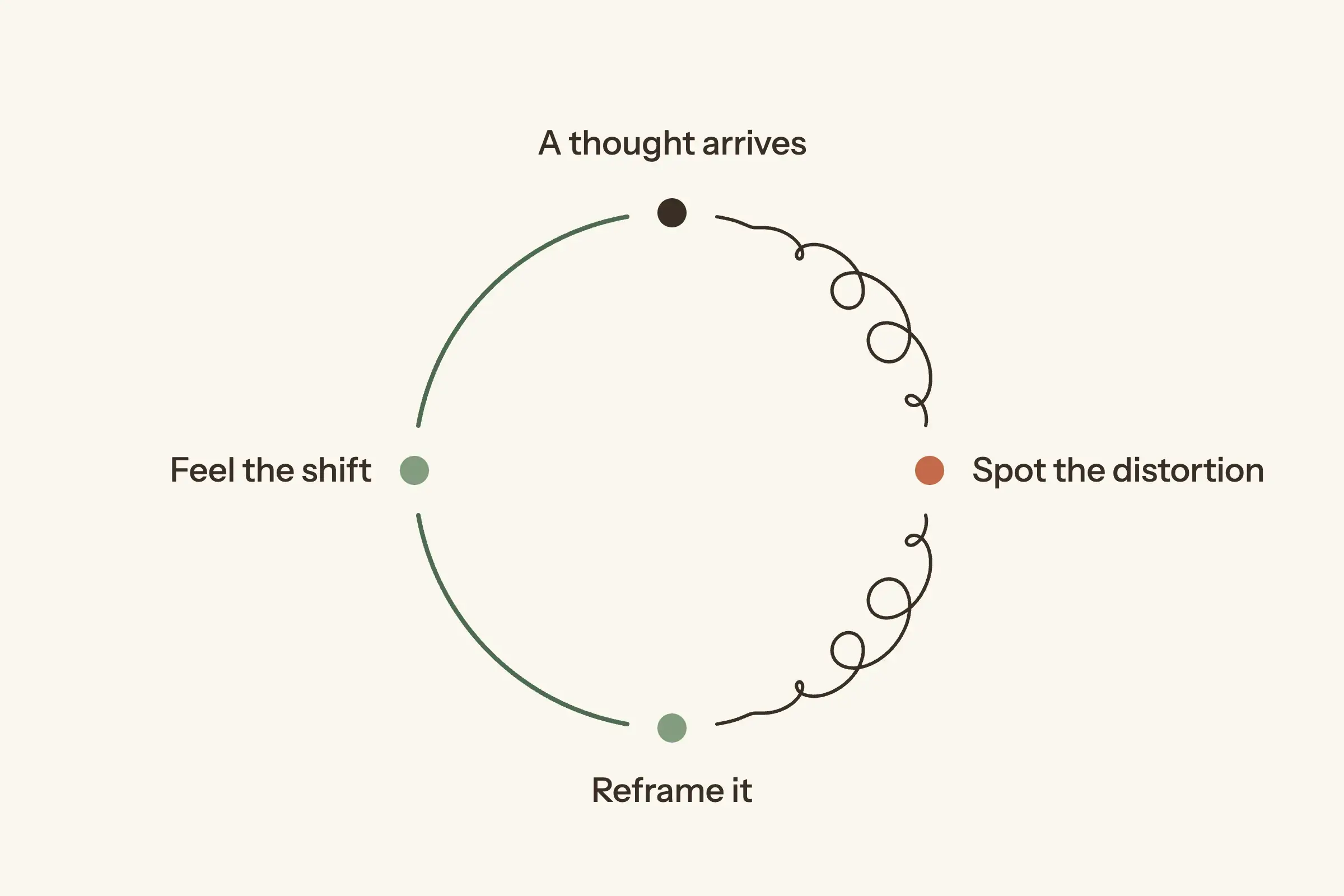
MindLift automates exactly this process. You don't need a therapist's office, a 12-week program, or even a quiet space. You just need 60 seconds and your phone.
hours
The time between weekly therapy sessions where you're on your own. Mini-Reframe fills that gap.
What Happens Inside Those 60 Seconds
Here's how it actually works:
You type your thought
Not a cleaned-up version. The real one. "I think I'm getting fired tomorrow." "My friend didn't text back and I know she hates me." "I completely embarrassed myself in that meeting."
MindLift identifies the distortion
The AI recognizes which cognitive pattern is at play — catastrophizing, personalization, fortune-telling — and names it. Just seeing your thought labeled as a pattern starts to loosen its grip.
You get a reframe in your own words
This isn't a generic "look on the bright side!" The reframe is built from what you actually said, shaped by CBT logic, and personalized to your situation. It sounds like you — just a calmer, clearer version.
The spiral stops
Not because things are suddenly fine. Because your brain has been given a different track to run on.
Why Your Own Words Matter
Most mental wellness apps give you someone else's words — pre-written affirmations, scripted meditations, generic prompts. And for many people, those feel hollow. Your brain knows when it's being handed a script.
MindLift's approach is different because it works with the specific thought that's bothering you, not around it. Research in CBT consistently shows that the most effective cognitive restructuring happens when a person engages with their own thought — examines it, challenges it, and revises it — rather than simply replacing it with something positive.
Generic affirmation
"I am enough."
Sounds nice. Your brain doesn't believe it.
CBT reframe
"There are three other possible reasons my boss sent that message, and I have no evidence any of them are about me."
Built from your situation. Moves the needle.
Who It's For
Mini-Reframe is for anyone who has ever:
- Replayed a conversation on loop and couldn't turn it off
- Convinced themselves something is wrong before they had any real evidence
- Felt too anxious to sleep but too wired to meditate
- Wanted to talk through something but didn't want to wake a friend at midnight
- Known their thoughts were irrational — but couldn't feel that they were
In other words, it's for most of us, most of the time.
The 167-Hour Problem
Here's a stat worth sitting with: if you see a therapist once a week, you get one hour of support out of 168. That leaves 167 hours where you're on your own.
Therapy is irreplaceable. But it was never designed to be the only tool in your toolkit.
Mini-Reframe isn't a substitute for therapy — it's what fills the space between sessions. The moment at 11 PM when your brain starts spinning. The bathroom break before a hard conversation. The Sunday afternoon doom-scroll that turns into a two-hour anxiety spiral.
Sixty seconds. Anytime. Free to start.
How to Use Mini-Reframe in 60 Seconds
The next time your brain won't stop spiraling, here's all you need to do:
Open MindLift
No setup, no session to schedule. Just open the app and tap Mini-Reframe.
Type the thought — the real one
Don't clean it up. Write exactly what your brain is saying right now. "I'm going to get fired." "She's ignoring me." "I ruined everything." The messier and more honest, the better it works.
Let MindLift do its thing
In seconds, the app identifies the thought pattern at play — catastrophizing, mind-reading, all-or-nothing thinking — and builds a reframe using your own words and CBT logic.
Read the reframe. Breathe.
This isn't a pep talk. It's a more balanced version of your own thought — one your brain can actually believe. Read it once. Read it twice. Let it land.
Come back whenever you need it
Mini-Reframe works at 11 PM, before a hard conversation, on your lunch break, or mid-doom-scroll. Use it whenever the thought hits. Free to start.
free to start · subscription available
The next time your brain runs a disaster movie at midnight —
you don't have to watch the whole thing.
Want to understand the science deeper? Read about cognitive distortions →
Frequently asked questions
What is Mini-Reframe in MindLift?
Mini-Reframe is MindLift's core feature: a 60-second CBT-based exercise that takes the exact thought spiraling in your head and helps you see it differently — using your own words, not generic affirmations. You type what's bothering you, the AI identifies the cognitive distortion at play, and delivers a personalized reframe in under a minute.
How does MindLift's Mini-Reframe work?
You type your actual thought (no editing needed). MindLift identifies the cognitive distortion — catastrophizing, mind-reading, fortune-telling, etc. — names it, and generates a reframe built from your specific words using CBT logic. The whole process takes under 60 seconds.
Is MindLift Mini-Reframe based on real therapy?
Yes. Mini-Reframe is based on Cognitive Behavioral Therapy (CBT), one of the most well-researched psychological interventions in existence. CBT has been validated across hundreds of randomized controlled trials for anxiety, depression, stress, and negative self-talk. MindLift automates the core mechanism — cognitive restructuring — so it's available to anyone, anytime.
Can MindLift replace therapy?
No — and it doesn't try to. MindLift fills the 167 hours between weekly therapy sessions. It's what you use at 11 PM when your brain is spiraling and your therapist isn't available. Many therapists recommend apps like MindLift specifically to reinforce CBT skills between sessions.
Like what you're reading?
Continue your wellness journey
Reframe negative thoughts in 60 seconds — free to start in the MindLift app.


Free to start · premium optional