
Turn this into a daily habit — free to start in the MindLift app:
There's a strange type of brain that will research 47 potential solutions to a problem, create mental spreadsheets comparing outcomes, spiral through every possible disaster scenario…
and then freeze entirely when it's time to actually do something.
If this sounds familiar, you've probably been told you're "just an overthinker."
But here's what nobody explains:
Your brain isn't overthinking — it's trying to solve a problem that doesn't exist.
And until you figure out what your anxiety is really scared of, you'll keep spinning in the same mental loop.
Understanding Overthinking Patterns
1. Overthinking Isn't the Problem — It's a Symptom
Let's start with what overthinking actually is:
✨ Rumination — replaying past events looking for what went wrong
✨ Catastrophizing — imagining worst-case scenarios on a loop
✨ Analysis paralysis — gathering endless information but never deciding
✨ Mental rehearsal — planning conversations that will never happen
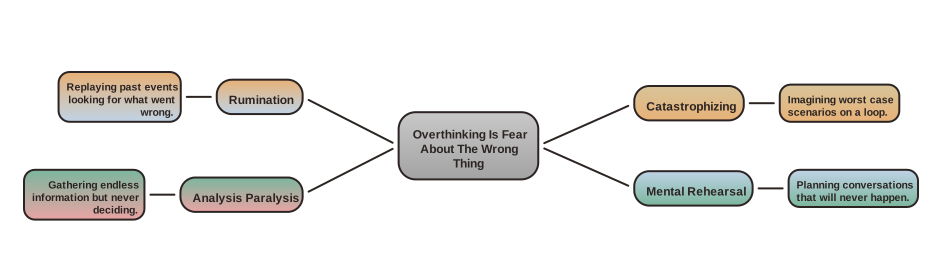
All of these look like "overthinking," but they're actually your brain's attempt to control uncertainty.
CBT calls this safety behavior — your mind believes if it thinks hard enough, it can prevent bad outcomes.
But it can't.
So it keeps trying.
2. Your Brain Is Protecting You From the Wrong Threat
Here's the twist:
Your anxiety isn't random.
It's laser-focused on something.
The problem? It's often focused on the wrong thing.
🎬 You overthink every text you send — but what you're really scared of is rejection or being misunderstood.
🎬 You can't decide what career path to take — but what you're really scared of is wasting your life or failing publicly.
🎬 You replay conversations obsessively — but what you're really scared of is being judged or losing control of how you're perceived.
Your brain thinks overthinking = problem-solving.
But really, it's trying to protect you from emotional pain.
3. The Real Question Isn't "Why Am I Overthinking?" — It's "What Am I Trying to Avoid Feeling?"
Most people try to stop overthinking by:
❌ distracting themselves
❌ forcing positive thoughts
❌ "just deciding" and hoping the anxiety goes away
But that doesn't work because you're treating the symptom, not the cause.
CBT teaches a different approach:
Instead of fighting your thoughts, name what they're protecting you from.
Example reframes:
✔ "I'm not overthinking this decision — I'm scared of making the wrong choice and regretting it forever."
✔ "I'm not replaying that conversation because I'm weird — I'm scared they think less of me now."
✔ "I'm not researching endlessly because I need more info — I'm stalling because I'm scared to commit."
Once you name the real fear, you can address it directly.
Practical Solutions
4. How to Redirect Your Brain Toward What Actually Matters
Okay, so you've identified the real fear.
Now what?
Here's how to interrupt the overthinking loop:
✨ 1. Ask: "Is this thought solving a problem or avoiding a feeling?"
Problem-solving moves forward.
Overthinking moves in circles.
If your thought pattern isn't leading to action, it's avoidance.
✨ 2. Set a "thought deadline"
Give yourself 10 minutes to think about it.
After that, decide or drop it.
Your brain will panic at first.
That's fine — it's not used to time limits.
✨ 3. Face the fear directly
If you're scared of rejection, practice small rejections.
If you're scared of regret, remind yourself most decisions are reversible.
If you're scared of judgment, expose yourself to micro-moments of being seen.
This is called exposure therapy — and it works better than endless mental rehearsal.
✨ 4. Reframe uncertainty as data, not danger
Your brain hates uncertainty because it interprets it as threat.
But most uncertainty is neutral.
Try: "I don't know what will happen — and that's information, not a crisis."
5. The Uncomfortable Truth About Overthinking
Here's what most articles won't tell you:
Overthinking feels productive.
It feels like you're doing something.
It feels safer than actually deciding and dealing with the consequences.
But it's not protecting you.
It's keeping you stuck.
And the only way out is to accept that:
✨ You can't predict the future
✨ You can't control how people perceive you
✨ You can't avoid all regret or failure
✨ You will sometimes make the wrong choice
And you'll survive it anyway.
Final Thought
Your brain isn't broken.
It's just solving for the wrong variable.
Overthinking isn't about needing more information or better logic —
it's about learning to tolerate discomfort without spiraling.
When you stop trying to think your way out of fear and start moving through it,
the loop finally breaks.
Frequently asked questions
Why does my brain keep overthinking even when I try to stop?
Because overthinking is your brain's threat-detection system misfiring in a low-threat environment. The amygdala identifies a perceived risk and attempts to 'solve' it by running through every possible scenario. Telling yourself to 'stop overthinking' rarely works because you're fighting a protective system, not a bad habit.
Is overthinking the same as anxiety?
Overthinking is a symptom of anxiety, not anxiety itself. Anxiety is the emotional and physiological state; overthinking is the cognitive manifestation — the mental activity the anxious brain produces in its attempt to feel safe. Addressing the anxiety state reduces the overthinking, while trying to stop thoughts directly rarely does.
Why do I overthink at night more than during the day?
During the day, external demands occupy the prefrontal cortex. At night, those demands drop and the Default Mode Network activates — producing self-referential, worry-focused thought. There's also less distraction available, so thoughts feel louder and more pressing.
How do you calm an overthinking brain quickly?
Physical regulation first: slow exhale-focused breathing (4 counts in, 6 out) activates the parasympathetic nervous system within minutes. After that, brief thought-labeling ('that's a catastrophizing thought') and behavioral redirection are more effective than trying to think your way out of overthinking.
Like what you're reading?
Continue your wellness journey
Reframe negative thoughts in 60 seconds — free to start in the MindLift app.


Free to start · no account required
CBT & Self-Talk Researchers
MindLift content is grounded in cognitive behavioral therapy principles and designed to help you shift harsh self-talk in real time. Our guides focus on practical, evidence-based techniques you can use in the moment.
Was this article helpful?