
Turn this into a daily habit — free to start in the MindLift app:
You're lying in bed at 11pm, not quite asleep, and a question floats up unprompted: Am I expecting too much?
You don't answer it. You just let it sit there, turning it over. Maybe another one appears: Is this a signal or just noise? Do I even make space for myself? Why does this keep happening?
If this sounds familiar, you're not alone — and you're not broken. But there's something important happening in those moments that most people have never been told about. You're not spiraling. You're not being dramatic. You're not "in your head."
You're doing the first step of cognitive reframing — and getting stuck right before the finish line.
There's a name for what you're doing
In psychology, this pattern is called Socratic self-questioning. It's a technique therapists use deliberately in CBT — the practice of asking yourself open questions to examine a thought rather than accepting it as fact.
When a therapist asks "what's the evidence that you're expecting too much?" they're not being dismissive. They're using the question as a scalpel to examine the belief underneath. The question itself creates distance between you and the thought. It interrupts the automatic acceptance of whatever your brain just told you.
Here's what's remarkable: when you ask yourself "am I expecting too much?" at 11pm without any prompting, you're doing that exact thing instinctively. Your mind already knows that the thought needs to be examined, not just accepted. It's reaching for a tool it half-recognizes.
The problem isn't the question. The problem is that most of us were never taught what comes next.
What is Socratic self-questioning?
Socratic self-questioning is a CBT technique of asking yourself open questions to examine a thought instead of accepting it as fact. The question creates distance between you and the belief, interrupting automatic acceptance. Asking 'am I expecting too much?' unprompted is this technique done instinctively — what's usually missing is the step after: answering it.
Why you ask but don't answer
There's a specific reason these questions stay open. It's not because you're avoiding the answer. It's because the question is doing a job — and finishing it feels risky.
When you ask "am I expecting too much?" you're really holding two possibilities at once:
- Yes, and I need to adjust my expectations.
- No, and something is actually wrong here.
Both answers require action. Both are a little frightening. So the open question becomes a kind of cognitive holding pattern — it protects you from having to land.
This is different from rumination. Rumination is replaying the same thought on a loop, looking for relief that never comes. Socratic self-questioning is an actual attempt to examine the thought — it just stalls at the examination stage because you don't have a framework for what the answer might look like. CBT gives you that framework. It's not about forcing yourself to think positively. It's about completing the thought honestly — following the question to its actual conclusion instead of letting it float.
What the question is really asking
Every rhetorical self-question has a hidden assumption underneath it. That's the thing worth finding — and it's often one of the same cognitive distortions CBT is designed to catch.
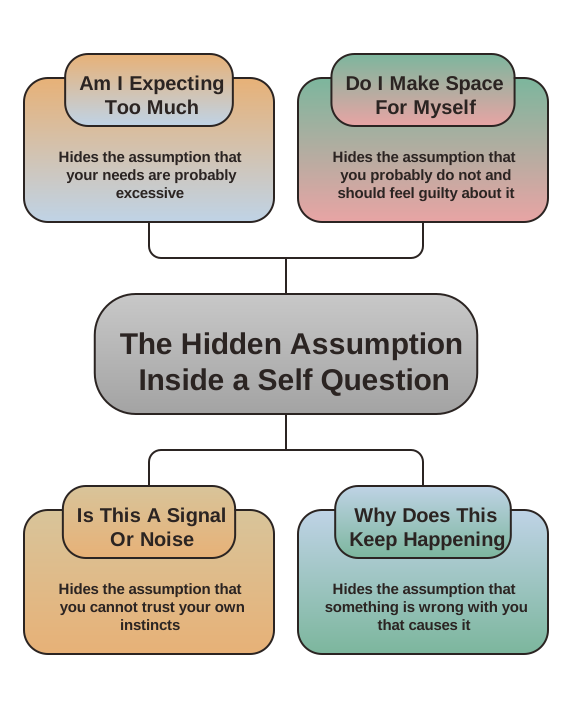
"Am I expecting too much?"
Hidden assumption: My needs are probably excessive.
What to actually examine: Is there evidence for that, or is that a story you've been told?
"Is this a signal or noise?"
Hidden assumption: I can't trust my own instincts.
What to actually examine: What would you tell a friend who described this exact situation to you?
"Do I make space for myself?"
Hidden assumption: I probably don't — and I should feel guilty about that.
What to actually examine: What would making space actually look like? Is the barrier external or internal?
"Why does this keep happening?"
Hidden assumption: There's something wrong with me that causes this.
What to actually examine: Is the pattern in the situation, or in how you interpret it?
The question is not the problem. The assumption hiding inside the question — often a flavor of negative self-talk you've stopped noticing — is where the real work happens.
When questions become loops
There's a tipping point where Socratic self-questioning shifts from useful to exhausting. It usually happens when the questions start multiplying instead of resolving.
Am I expecting too much? But is it unreasonable to expect that? But maybe I'm just used to low standards. But what if I'm the problem? But am I being too hard on myself for thinking I'm the problem?
If you've been here, you know how quickly that becomes unlivable. The questions are no longer examining the thought — they're feeding it. Each new question generates two more, and the original concern gets buried under the weight of the interrogation. It's one of the quieter types of overthinking: it feels like progress because it's effortful, but it never resolves.
This is the loop. And the way out of the loop is not to ask a better question. It's to answer one.
Just one. Specifically. In your own words.
That single move — from question to a tentative, honest answer — is what breaks the pattern. Not a perfect answer. Not a final answer. Just enough of an answer to give the thought somewhere to land.
How to actually finish the thought
CBT offers a straightforward structure for this. When a question surfaces, instead of letting it hover, try this:
Step one: Name the assumption underneath it.
What belief is this question protecting? Write it out as a statement, not a question. "I think my needs are too much for people." That's the thought. The question was just its shadow.
Step two: Look for the evidence.
Not to disprove the thought — to actually examine it. What's happened that supports it? What's happened that contradicts it? This is not positive thinking. It's honest auditing.
Step three: Write a more accurate statement.
Not the most optimistic interpretation. The most realistic one. "I have high emotional needs and some people struggle with that. That doesn't mean my needs are wrong — it means I need to be honest about compatibility."
That's a finished thought. It's not comfortable — but it's livable. And it doesn't generate five more questions. If you want to practice the full sequence on paper, the cognitive restructuring worksheet walks through it step by step.
Why real-time matters
Here's what most advice about overthinking gets wrong: it assumes you can do this kind of cognitive work when you're calm, rested, and have a journal in front of you.
But the questions don't come when you're calm. They come at 11pm. They come mid-conversation when someone says something that lands wrong. They come on the train, in the shower, in the three seconds before you fall asleep.
The gap between when the thought arrives and when you have access to a structured reframe is where most people lose the thread. By the time you could journal about it, the emotional charge has either faded or compounded into something bigger.
That's the gap MindLift was built for. You type the exact question or thought — in your own words, the way it actually sounds in your head — and within 60 seconds you get three structured reframes: one that challenges the assumption, one that names a small concrete step forward, and one that responds to the emotional weight underneath it. Not affirmations. Not generic reassurance. A direct response to the specific thought you actually had.
The 167 hours between therapy sessions are where your thoughts live. That's where the work needs to happen.


The pattern, once you see it
Once you understand that your rhetorical self-questions are unfinished reframes, you start to notice the pattern everywhere. In conversations where you hold back because you don't know if your read is right. In relationships where you absorb doubt rather than naming it. In decisions you delay because the question feels safer than the answer.
The questions aren't the problem. They're evidence that you're already trying to examine your own thinking — which is more than most people do. What's missing is the last step: the one where you actually answer.
You don't need a perfect answer. You need a real one. One that accounts for the evidence, names the assumption, and gives the thought somewhere to land so it stops asking to be heard.
That's what cognitive reframing actually is. Not forced positivity. Not telling yourself everything is fine. Just completing the thought — honestly, specifically, in your own language — instead of letting it circle forever.
Your mind is already asking the right questions. MindLift helps you finish them.
Frequently asked questions
What is Socratic self-questioning?
Socratic self-questioning is a CBT technique of asking yourself open questions to examine a thought rather than accepting it as fact. The question creates distance between you and the belief, interrupting automatic acceptance. When you ask 'am I expecting too much?' unprompted, you're doing this instinctively — you've just never been taught the step that comes after: answering it.
Why do I ask myself questions but never answer them?
Because both possible answers usually require action, and landing on one feels risky. 'Am I expecting too much?' holds two outcomes at once — adjust your expectations, or accept something is actually wrong. The open question protects you from having to choose. It's a holding pattern, not avoidance.
Is this the same as overthinking or rumination?
It's related but distinct. Rumination replays the same thought on a loop looking for relief. Socratic self-questioning is a genuine attempt to examine a thought — it just stalls at the examination stage because you don't have a framework for what the answer should look like. CBT supplies that framework.
How do I actually finish the thought?
Three steps: (1) Name the assumption hiding inside the question and write it as a statement. (2) Look for evidence for and against it — honest auditing, not positive thinking. (3) Write a more accurate statement: realistic, not optimistic. A finished thought is one that doesn't generate five more questions.
Like what you're reading?
Continue your wellness journey
Reframe negative thoughts in 60 seconds — free to start in the MindLift app.
Free to start · no account required
CBT & Self-Talk Researchers
MindLift content is grounded in cognitive behavioral therapy principles and designed to help you shift harsh self-talk in real time. Our guides focus on practical, evidence-based techniques you can use in the moment.
Was this article helpful?