
Turn this into a daily habit — free to start in the MindLift app:
You don't have a first day of school anymore. Nobody's handing you a schedule, a locker, or a syllabus. And yet, some time in late August, you find yourself standing in the stationery aisle for no reason, or opening a new note titled "Q4 me," or thinking, half-seriously, this is the season I get it together.
If you haven't been "back to school" in fifteen years, this makes no logical sense. It's not nostalgia, exactly — you're not longing for homework. It's something closer to a reflex, and it turns out there's a name for it.
September feels like a new year because of the fresh-start effect: certain dates function as mental dividing lines that boost motivation independent of anything actually changing in your life. September carries an especially strong version of it from over a decade of school-calendar conditioning. The pull itself isn't the problem — all-or-nothing thinking is, when it turns the reset into a pass/fail test that one off day can "fail."
This isn't nostalgia — it's a temporal landmark
Behavioral scientists call this the fresh-start effect: certain dates — Mondays, birthdays, the first of the month, New Year's Day — function as mental dividing lines. Standing near one makes people feel more motivated toward a goal, independent of anything actually changing in their life. The date itself does the work.
Nothing about a Monday is inherently different from a Sunday except that your brain has filed it as a marker for "before" and "after."
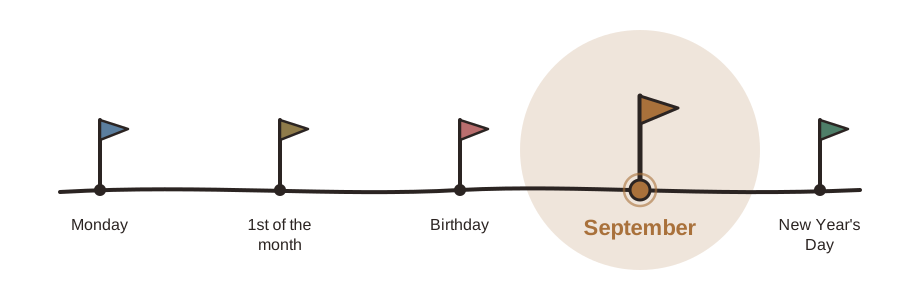
September is one of the strongest of these landmarks most people carry, because it's one of the only ones reinforced for over a decade straight. Thirteen to seventeen years of a September that meant new teacher, new supplies, new start — that's a long conditioning period, and it doesn't switch off just because you stopped needing a backpack. The pull is real. It's just running on an old script that your current life doesn't actually require.
Where it turns from motivation into pressure
A little extra motivation showing up on schedule is not a problem by itself. Complications arrive with what usually rides along: the thought that this reset has to be the one.
Not a better week. The year you finally get consistent, finally fix the thing, finally become the version of you that has it together.
That's all-or-nothing thinking, and it's doing something sneaky — it's converting a mood boost into a pass/fail test. If September has to be total transformation, then a normal Tuesday where you skip the gym or eat the thing you weren't going to eat doesn't register as "one off day." It registers as already blown it. The reset didn't fail because you lacked commitment. It failed because it was built to only succeed at 100%, which almost nothing does.
Why the plan never survives past week two
"New notebook energy" has a short shelf life for most people, and willpower rarely explains why. A goal framed in absolutes — every day, no exceptions — survives only through perfect execution, so the first missed day reads as proof the whole plan was doomed.
That reading is exactly the thought that makes people quietly stop trying by week two.
Compare that to a goal that was allowed to flex from the start. One that assumed a missed day would happen and didn't treat it as evidence of anything. That version survives contact with an actual life. The all-or-nothing version doesn't, because it was never built to.
A reset doesn't need to be total to count
Here's the part worth sitting with: the September pull itself isn't the thing working against you. It's a free, built-in nudge — you don't have to manufacture motivation you already have. The thought that turns it into pressure is a separate, specific one, and it's exactly the kind of thought a quick reframe can catch before it takes hold.
Something like "I already messed up my reset" three days in is a believable, common thought — and it's also just a distortion wearing a deadline. Typing that exact thought into MindLift's Mini-Reframe gets you a grounded response in about 60 seconds, tagged with what's actually running underneath it — usually all-or-nothing thinking dressed up as ambition. Not "you're doing great!" — something closer to one missed day is one missed day, not a verdict. The kind of response that's actually usable the next time the thought shows up, which, if it's all-or-nothing thinking, it will.
The notebook can stay. The all-or-nothing thought riding along with it is the part worth catching — and if a thought like this one keeps coming back on a loop that has nothing to do with September, here's why a thought repeats even when it doesn't need to. If you want the reframe running in the background all September, MindLift is free to start.
Frequently asked questions
Why does September feel like a fresh start even as an adult?
It's a documented pattern called the fresh-start effect — dates that function as mental "before and after" lines boost motivation regardless of what's actually changing in your life. September carries an especially strong version of this from over a decade of conditioning tied to the school calendar.
Is it normal to feel motivated in fall but not in January?
Yes — any temporal landmark can trigger it, and different ones land harder for different people depending on what that date meant for them growing up. Feeling it more in September than January doesn't mean anything's wrong with your January.
Why do I give up on my "reset" so fast?
Usually it's not a discipline problem — it's that the reset was framed as all-or-nothing from the start, so the first missed day gets read as total failure instead of a normal gap. Goals built to flex survive contact with real life; goals built on perfect execution don't.
How do I use the September energy without the all-or-nothing pressure?
Let the motivation boost do its job — start the thing — without requiring it to be flawless to count. If the thought "I already ruined it" shows up after one off day, that thought is worth reframing on its own, separately from whatever the actual goal was.
Like what you're reading?
Stop the spiral in real time
MindLift gives you a gentle CBT-based reframe the moment your thoughts start looping.


Free to start · premium optional