
Turn this into a daily habit — free to start in the MindLift app:
Most social anxiety advice tells you to relax, or to remember that nobody is really looking at you. If that worked, you would not be reading this. The reason it does not work is that social anxiety is not one feeling to be talked out of. It is a set of specific, identifiable mechanisms — and they are what keep it running long after the conversation ends.
This guide is built on the Clark & Wells cognitive model (1995), the framework that most CBT for social anxiety is derived from. Its useful insight is this: social anxiety survives not because social situations turn out badly, but because of four things you do that prevent you from ever finding out they went fine.
The four patterns that keep social anxiety alive
Before the seven days, it is worth seeing the shape of the thing. The four maintaining factors are not a list of separate problems — they feed each other in a loop.
- Overestimating your visibility. You believe your nerves are far more obvious to others than they are.
- Self-focused attention. Because you believe you are being scrutinized, attention turns inward and you begin monitoring how you are coming across.
- Safety behaviors. Self-monitoring is uncomfortable, so you deploy small protective moves to get through it.
- Post-event processing. Afterwards, you replay the encounter — and because your memory of it is built from inward-facing impressions rather than what actually happened, the replay returns a harsher verdict than the event earned.
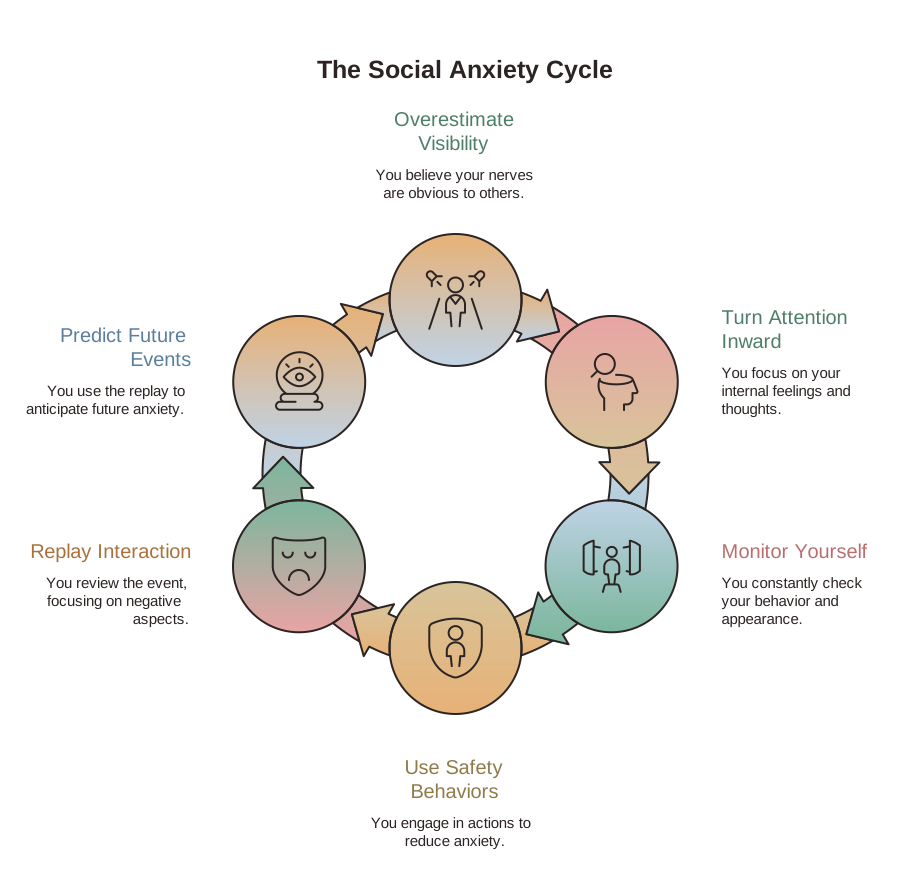
That final verdict becomes the prediction you carry into the next interaction, and the loop closes. Each of the seven days below opens it at a different point.
How to use the seven days
Each day has three parts: one line on why the pattern happens, one small exercise, and one reframe to carry with you. The exercise is the part that matters. Reading about social anxiety is comfortable and changes very little; the exercises are deliberately small enough that you will actually do them.
Do them in order. The sequence moves from noticing, to interrupting, to consolidating, and the later days assume the earlier ones.
The 7-Day Social Anxiety Reframe
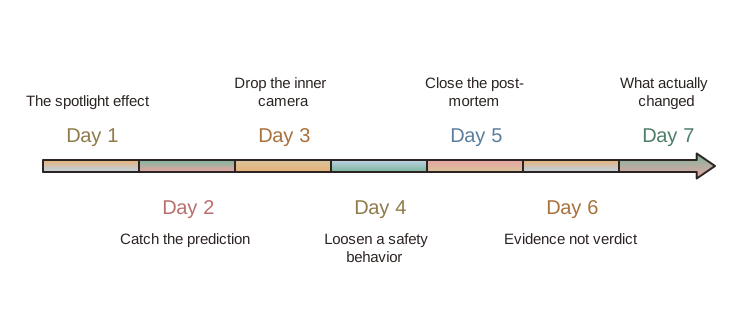
The 7-Day Social Anxiety Reframe is a one-week sequence of short CBT exercises, one per day: the spotlight effect, catching the prediction, dropping the inner camera, loosening a safety behavior, closing the post-mortem, evidence rather than verdict, and a final day for noticing what actually changed.
The Spotlight Effect
Targets: Mind-reading and overestimated visibility
Why this happens. People assume others are scrutinizing them as closely as they scrutinize themselves. They almost never are — everyone in the room is running their own internal monologue, and yours is not on their agenda.
Today’s exercise. Think of one moment this week when you assumed someone judged you. Write down the actual evidence for it — not the feeling, the evidence. Notice how thin the evidence column is.
That pause in the conversation wasn't a verdict. Most people are too busy narrating their own day to review yours.
Catch the Prediction
Targets: Fortune telling and anticipatory anxiety
Why this happens. Social anxiety front-loads the dread. You experience a predicted outcome as though it were a fact about the future, and the body responds to the prediction rather than to anything that has happened.
Today’s exercise. Before your next social moment, write down the specific prediction — 'they'll think I'm awkward'. Then label it: this is a guess, not a fact. Afterwards, check it against what occurred.
You're not walking into what will happen. You're walking into what your anxious brain rehearsed. Those aren't the same thing.
Drop the Inner Camera
Targets: Self-focused attention
Why this happens. Constantly monitoring how you are coming across pulls attention inward, away from the actual conversation. This is the cruel part: the monitoring itself is what makes you seem — and feel — more awkward, because you are only half in the room.
Today’s exercise. In your next conversation, deliberately notice three external details: a color, an object, something the other person actually said. Put attention outward on purpose.
You don't have to narrate yourself while you live. Let the room be the thing you notice, not you.
Safety Behaviours
Targets: Avoidance disguised as preparation
Why this happens. Over-rehearsing lines, avoiding eye contact, gripping a phone, staying near the exit — these feel protective. But when nothing bad happens, you credit the behavior instead of the situation, so the fear is never disconfirmed and the armour becomes mandatory.
Today’s exercise. Name one safety behavior you rely on. In your next interaction, drop it by about ten percent — one beat of unscripted eye contact, one sentence you did not plan.
The armour you built to survive small talk might be the thing making it heavier. You can set a little of it down.
The Post-Mortem
Targets: Post-event processing
Why this happens. Replaying an interaction afterwards, mining it for every mistake, is one of the strongest documented maintainers of social anxiety. The review draws on how you felt during the event rather than what actually happened, so it reliably produces a harsher verdict than the evidence supports.
Today’s exercise. Give yourself a hard ten-minute window to review the interaction. Set a timer. When it ends, it ends — write one line about it and close the loop.
You already lived it once. You don't owe it a second performance in your head tonight.
Evidence, Not Verdict
Targets: All-or-nothing self-judgment
Why this happens. This is classic cognitive restructuring. A harsh self-verdict is stated as though it were a finding, but it rarely survives being asked to produce its evidence. The verdict and the fact are different sizes.
Today’s exercise. Take one negative self-judgment from this week — 'I came off weird'. Draw two columns and list the evidence for and against it side by side. Then rewrite the judgment so it fits the evidence.
'I was weird' is a verdict. 'I said one thing that didn't land' is a fact. Only one of those is true.
What Actually Changed
Targets: Consolidation and self-compassion
Why this happens. Closing the loop is what makes any of this survive past day seven. Naming what shifted — however small — is what converts a week of exercises into something you keep doing.
Today’s exercise. Write down one specific moment this week when you did something the anxious version of you would have avoided seven days ago. Be specific: the moment, not the general improvement.
You didn't need to feel brave to do it. You just needed to do it a little scared. That's the whole trick, and you already used it.
What to do after day seven
The four patterns do not disappear at the end of the week. What changes is that you can now name which one is running. That is genuinely most of the work — social anxiety is far more tractable as four separate mechanisms than as one large feeling.
The two days worth repeating are Day 3 and Day 5. Self-focused attention and post-event processing are the patterns that reassert themselves fastest, and they are the two with the most direct payoff when you interrupt them. If you keep only two habits from this guide, keep the external-attention move and the ten-minute post-mortem limit.
If you want to go deeper on the replay specifically, why you replay conversations in your head covers the mechanism in more detail. For the underlying distortions, the thinking traps guide maps the full set.
A necessary caveat
Social anxiety disorder is a real, diagnosable condition, and it responds well to structured CBT delivered by a trained therapist. This guide is psychoeducation and practice — an on-ramp, not a treatment.
If social anxiety is meaningfully constraining your work, your relationships, or your daily life, a proper course of therapy will do considerably more for you than seven days of self-guided exercises, and it is worth the appointment.
Find your pattern in 2 minutes
A MindLift quiz is a short, free self-assessment that names the thinking pattern this guide’s techniques work best against. Each quiz below takes about two minutes, needs no sign-up, and ends with a result page you can act on straight away.
- How Strong Is Your Social Anxiety Loop?A 2-minute science-based quiz to understand your overthinking patterns in social situations. Discover if your brain runs a light, active, strong, or intense anxiety loop.
- Do I Have Social Anxiety?10 honest questions to find out whether what you're experiencing is typical nervousness — or something more significant. Get a CBT-informed answer in 2 minutes.
Frequently asked questions
What is the Clark & Wells model of social anxiety?
Clark & Wells (1995) is the dominant cognitive model of social anxiety disorder and the framework most CBT for social anxiety is built on. Its central claim is that social anxiety persists not because social situations are genuinely dangerous, but because of what happens in the person's own processing: when they enter a feared situation, attention shifts inward to a self-image of how they imagine they appear, they deploy safety behaviors to prevent imagined catastrophe, and afterwards they conduct a detailed negative post-mortem. Each of these prevents the fear from ever being disconfirmed, so the anxiety survives contact with reality.
Can seven days actually reduce social anxiety?
Seven days will not resolve social anxiety disorder, and this guide does not claim it does. What a week can realistically do is teach you to recognize the four maintaining patterns as they happen and give you one concrete move against each. That recognition is the part most people are missing — they experience social anxiety as one undifferentiated feeling rather than four separate, interruptible mechanisms. Meaningful symptom change in CBT for social anxiety is typically measured over months, not days.
What are safety behaviors in social anxiety?
Safety behaviors are the small things you do to prevent an imagined social disaster: rehearsing sentences before you say them, avoiding eye contact, holding a drink to occupy your hands, staying near the exit, gripping a phone, or over-preparing for a conversation. They feel like coping. The problem is that when the feared outcome does not happen, you attribute the safe result to the behavior rather than to the situation being safe all along. The fear is therefore never disconfirmed, and the behavior becomes necessary.
Why do I replay conversations in my head for days afterwards?
This is called post-event processing, and it is one of the best-documented maintaining factors in social anxiety. After a social interaction, attention returns to the encounter and reviews it in detail — but the review is biased toward the self-focused impressions you formed during the event rather than what actually happened, so it reliably produces a more negative verdict than the interaction deserved. That verdict then becomes the prediction you carry into the next interaction.
Is this guide a substitute for therapy?
No. This is psychoeducation and self-help practice, not treatment. Social anxiety disorder is a diagnosable condition with well-evidenced treatments — CBT for social anxiety, delivered by a trained therapist, has strong support. If social anxiety is meaningfully limiting your work, relationships, or daily life, a structured course of therapy will do considerably more than a seven-day self-guided sequence. Use this as an on-ramp or a supplement, not a replacement.
Like what you're reading?
Continue your wellness journey
Reframe negative thoughts in 60 seconds — free to start in the MindLift app.


Free to start · premium optional